Kloster Heilsbruck: A Former Cistercian Nunnery in Edenkoben, Germany
Site at a Glance
- Rating
- 3
- Popularity
- Very Low
- Country
- Germany
- Primary era
- Early Modern
- Eras represented
- Early Modern, Modern
- Civilizations
- Electoral Palatinate, Holy Roman Empire
- Site type
- Religious
- Remains
- Monastery
On this page18 sections
History
Kloster Heilsbruck is a former Cistercian nunnery in Edenkoben, Germany, founded in 1232 and relocated there in 1262. The Cistercians were a reform branch of Catholic monasticism, and the community became an important religious and economic institution on the edge of the Haardt.
Foundation at Harthausen
The nunnery was first established at Harthausen in 1232. Its mother house was Koenigsbruck in Alsace, and Beringer of Entringen, Bishop of Speyer, confirmed the foundation that year. The project was promoted by Salomon, a canon from the Würzburg region, who wanted to establish a Cistercian nunnery in his homeland. In 1230, Elbewin Schwarz, a citizen of Speyer and former local administrative official, supported the plan by donating land at Harthausen.
Relocation to Edenkoben
After about thirty years, the nuns sought a new site because Harthausen had marshy ground, inadequate supplies of clean drinking water, and insufficient firewood. The Cistercian abbot of Eußerthal appealed to Heinrich of Leiningen, Bishop of Speyer, who authorized the move in 1262.
The convent acquired sovereign, bailiwick, and church-patronage rights over the neighboring villages of Edenkoben and Wazzenhofen from the knight Burkard of Breitenstein. Bailiwick rights concerned secular protection and jurisdiction, while church-patronage rights included influence over a church and its clergy. The new monastery was established at Wazzenhofen on the edge of the Haardt, and Wazzenhofen later became part of Edenkoben.
Growth and protection
Heilsbruck developed rapidly, supported in part by its high-quality vineyards. King Rudolf of Habsburg placed the nunnery under imperial protection in 1281, meaning that it came under the protection of the Holy Roman Empire rather than depending solely on a local lord. Emperor Ludwig the Bavarian renewed its rights and liberties in 1339. In 1408, King Ruprecht issued a letter of protection and appointed his son, Louis III, Elector Palatine, and his successors as protectors of the convent. An elector was a prince entitled to participate in the election of the Holy Roman Emperor. Around 1500, the monastery owned property in 46 settlements.
Destruction and rebuilding
In spring 1525, after Easter, the abbey was plundered and devastated during the Palatine Peasants’ War, an uprising of peasants in the Palatinate and surrounding areas. Under Abbess Sophia Kistel of Dürkheim, the buildings were renovated. A new Gothic church, monastic buildings, and a deep wine cellar were constructed on the ruins, but the resulting debts prevented the monastery from recovering financially.
Dissolution and later religious use
Elector Frederick III of the Palatinate dissolved the convent in 1560 during the Reformation, the sixteenth-century religious movement that led to the establishment of Protestant churches and the dissolution of many Catholic institutions. In 1565, the former monastery’s estates and revenues passed to the electoral administration, under the management of an estate administrator.
During the Thirty Years’ War, the European conflict of 1618 to 1648, the region temporarily returned to Catholic influence. Jesuits from Speyer settled at Heilsbruck in 1636. Cistercian nuns returned in 1646 and tried to revive the nunnery, but the Peace of Westphalia, which ended the war, required the restoration of specified prewar religious and political conditions. The nuns then left permanently, ending monastic life at Heilsbruck.
The secularized monastery was apparently leased to Swiss Mennonites, a Christian Anabaptist tradition that developed in the sixteenth century. Swiss family names predominated among its residents during the seventeenth and eighteenth centuries. After the Palatine electors became Catholic again after 1685, Catholics appear to have used the former monastery church intermittently. In 1787, a Corpus Christi mass was reportedly still held there, and the Edenkoben Corpus Christi procession continued to visit the church until the beginning of the nineteenth century.
Secularization and the wine estate
Heilsbruck became part of France when the German territories on the left bank of the Rhine were annexed during the revolutionary period. On 21 May 1805, the former monastery property was auctioned in Mainz to Louis Keller and Georg Albert Mayer, citizens of Landau. The church still stood at the time and was described as an old church in the auction record. Johann Georg Rieger also recorded it as extant in 1824.
By 1832, Georg Albert Mayer had demolished the church except for a small tower, which he retained as a belvedere. The former monastery was subsequently converted into a wine estate. Ownership and tenancy changed several times during the nineteenth century. In 1891, the owner Hartz of Landau had land in the southern part of the grounds lowered for agricultural use. This exposed old graves, initially regarded as probably Frankish burials from the eighth century. Further parts of the monastery cemetery were later uncovered farther south.
Modern ownership and preservation
The Kaufmann families Ueberle and Ritzhaupt acquired the former monastery in 1898. Jacob Sulzer, a descendant of the Ueberle family, managed the wine estate until 2018. After his death, Heilsbruck closed as a wine house and events venue in July 2019, and two investors purchased it later that year.
The monastery contributed to Edenkoben’s development from two small hamlets into a village, market town, and eventually a city. Its first historian, Franz Xaver Remling, regarded Heilsbruck as a major reason for this growth. The monastery buildings and wine estate received legal protection through an administrative act of 27 March 1981. In 1996, the entire former monastery and later wine-estate area became the Heilsbruck monument zone, including the buildings, monastery mill, open and green spaces, and the enclosing wall.
Harthausen retained a Heilsbruck estate until the eighteenth century. The connection is commemorated by a lily in the village coat of arms and by the name Heilsbruckhalle, used for the village’s events and sports hall.
Remains
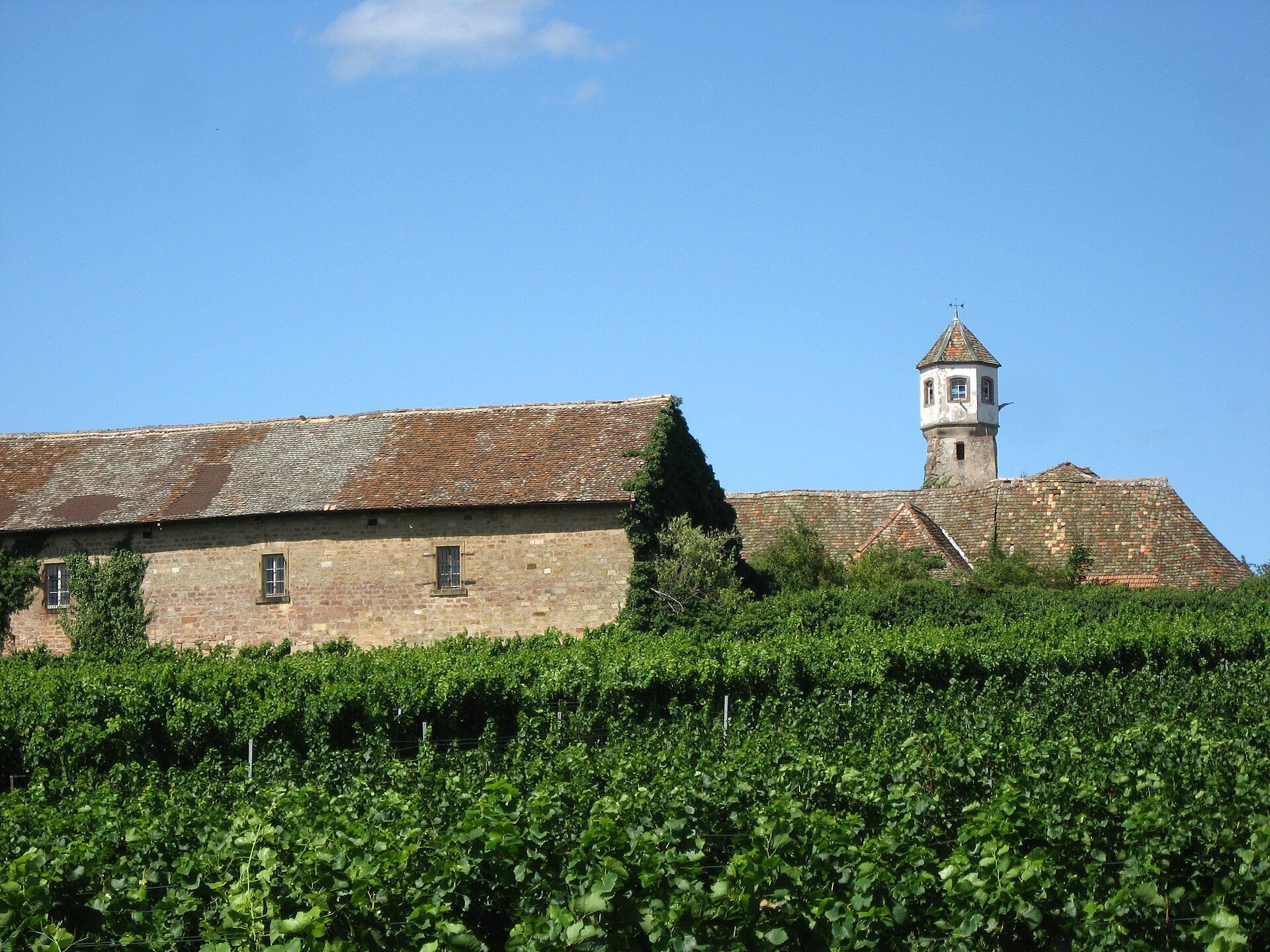
The surviving complex is a coherent monastery and estate ensemble enclosed largely by a wall. Its buildings and structures represent several periods of development, including the medieval monastery, the rebuilding after the destruction of 1525, and its later use as a wine estate. Vineyards and gardens occupy parts of the grounds, while the present farmyard lies on the eastern side and contains the principal estate house and agricultural buildings.
Enclosure and estate buildings
The wall is strongest along the northeastern side facing Klosterstraße. Five massive buttresses on its street side give this section the character of a fortification. Within the enclosure, the farmyard organizes the later estate buildings around the principal house and agricultural structures.
Main estate house
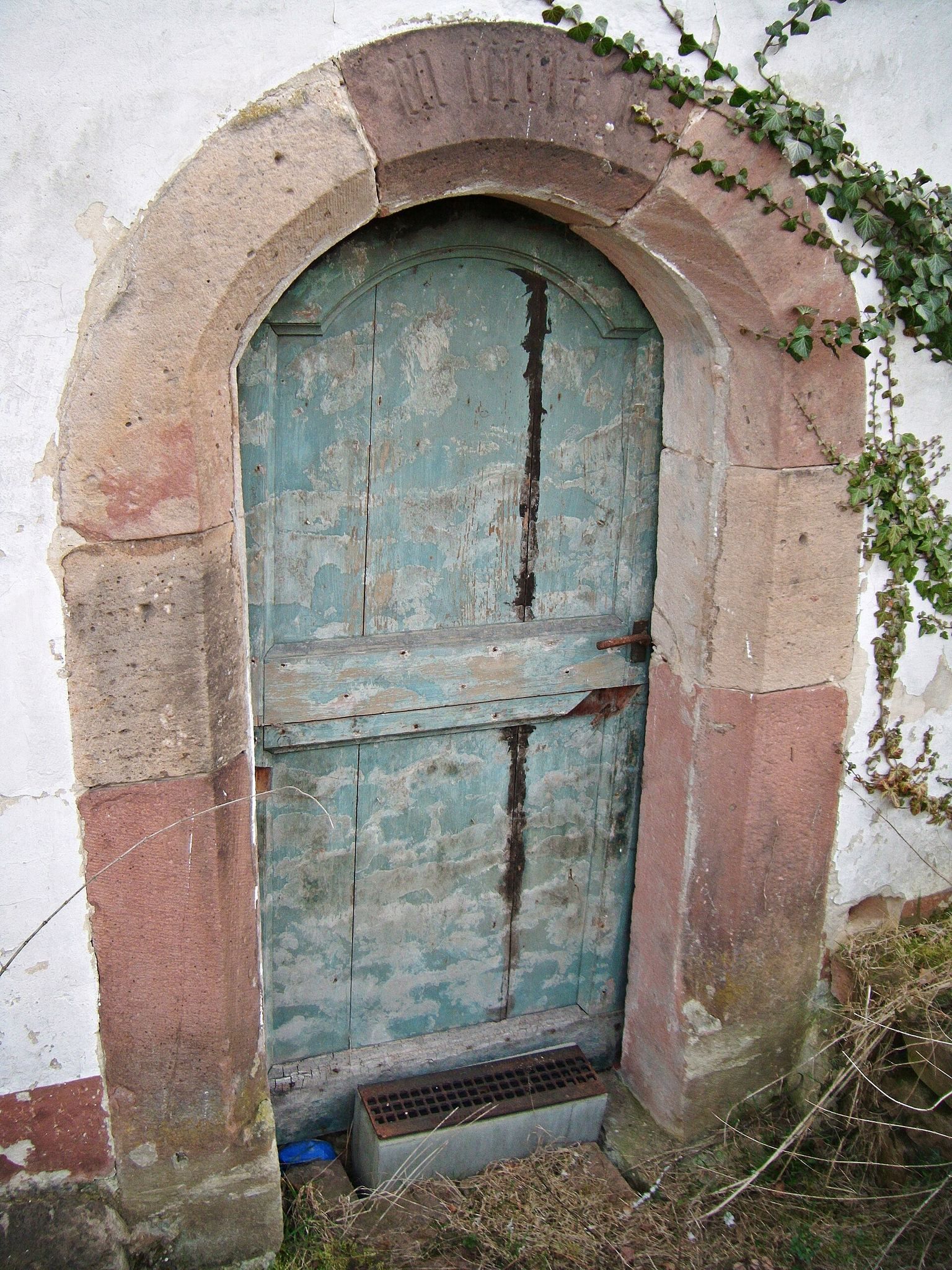
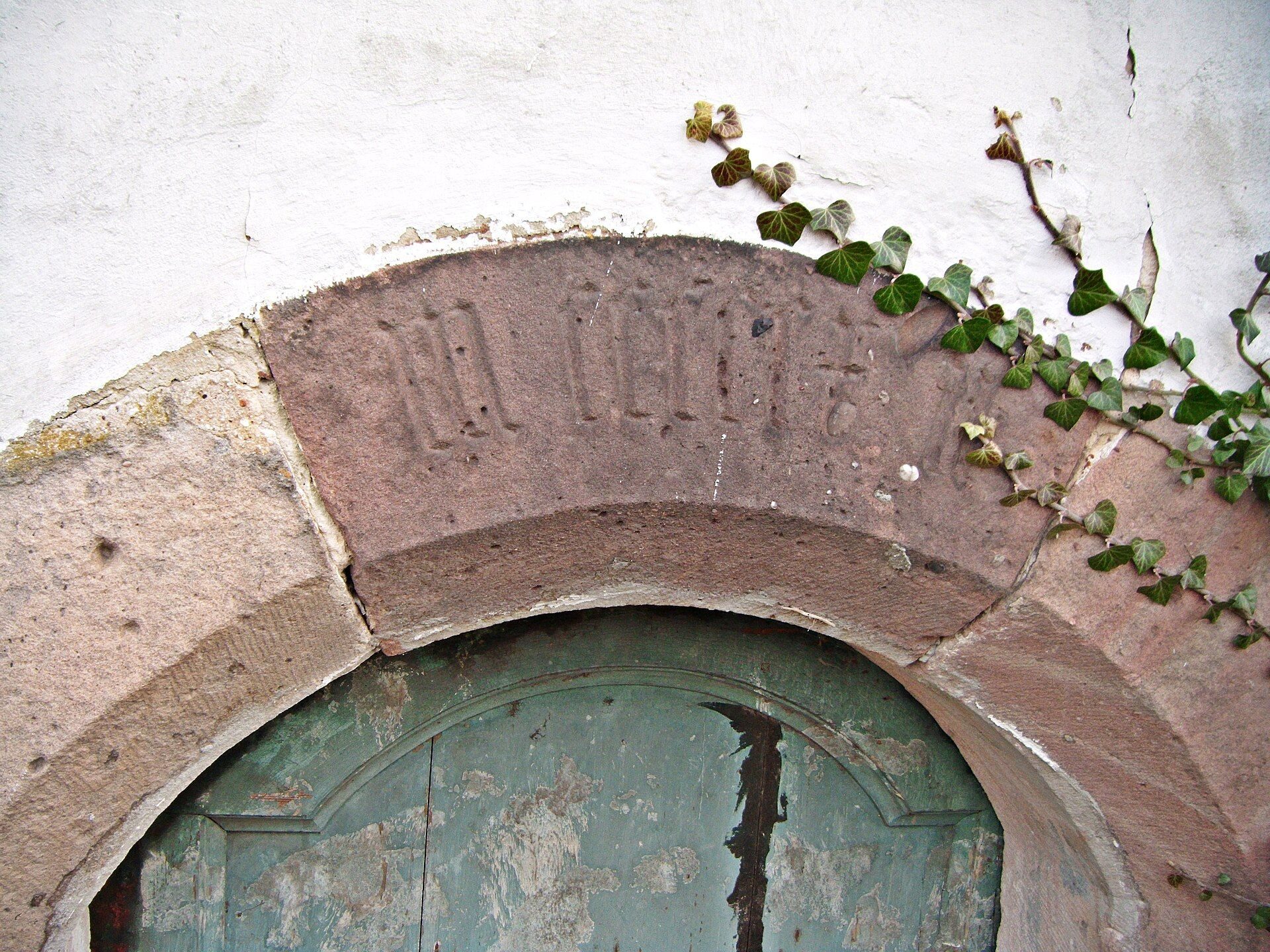
The elongated main estate house has a half-hipped roof, whose sloping end sections do not extend fully to the ridge. Its core is the refectory, the monastery’s communal dining hall, rebuilt at the beginning of the sixteenth century. The building later received an exterior treatment from the Classical period. A small round-arched doorway on its north side bears the Latin year 1552.
Agricultural buildings and cellar
Agricultural buildings stand east and south of the main house. The eastern building rests on a cross-vaulted cellar with a cruciform ground plan. This cellar formerly supported the monastery church, linking the surviving estate structures to the demolished medieval building.
Medieval remains in the courtyard
Stair turret and well basin
A Gothic stair turret from the demolished church survives within the complex. In the early nineteenth century, Georg Albert Mayer added a six-sided upper structure so that the tower could serve as a belvedere. The courtyard between the main house and the outbuildings contains a large Gothic well basin, probably brought from the former cloister.
Boundary stone and funerary slabs
The courtyard also contains an old boundary stone bearing the monastery’s monogram and two simple medieval funerary slabs from the thirteenth century. One marks the grave of a child named Elisabeth, while the other commemorates the nobleman Conrad of Altdorff, a benefactor of the convent.
Inscribed spolia stone
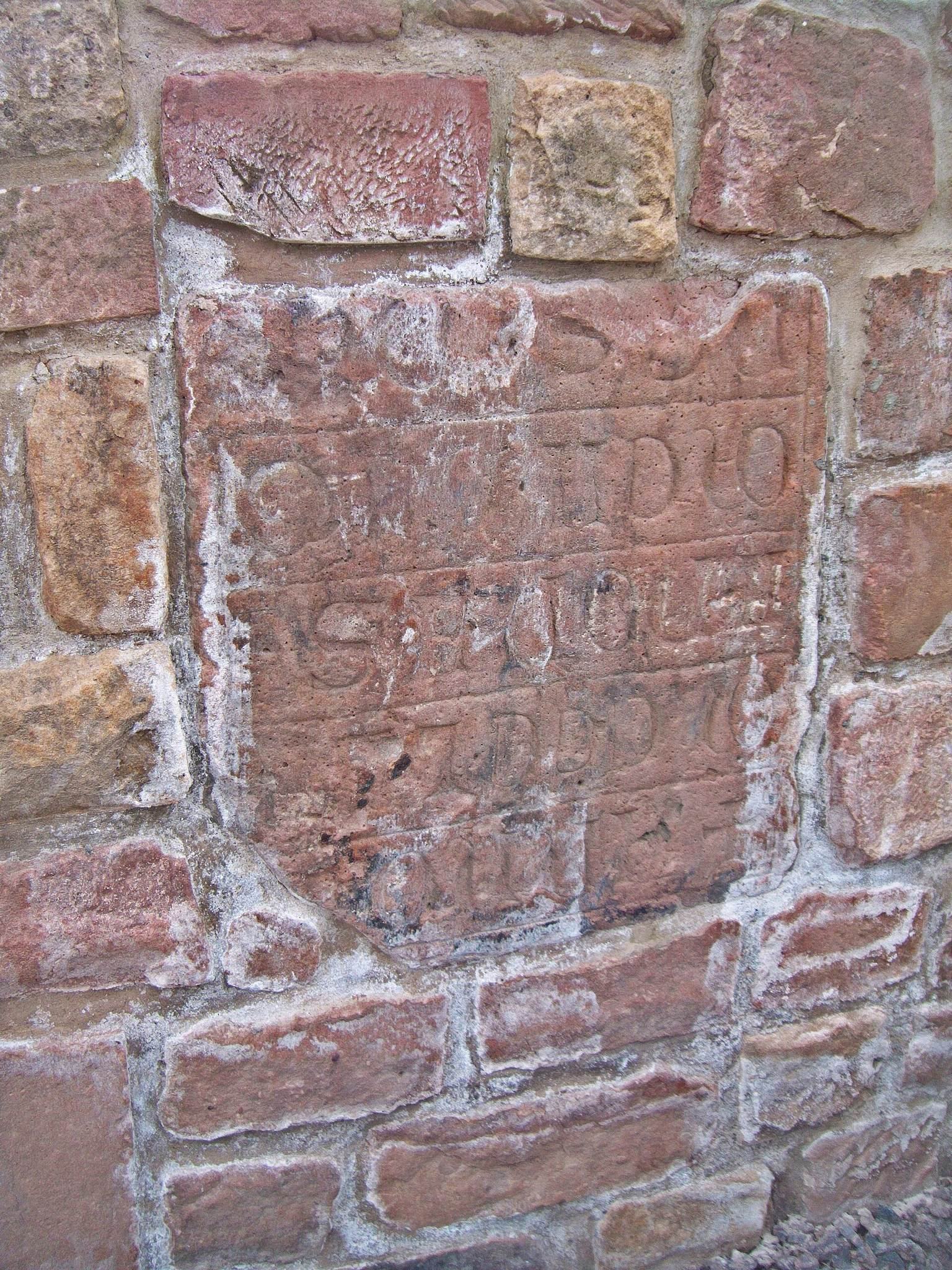
A medieval spolia stone, meaning a reused architectural or masonry element from an earlier structure, has been incorporated into a newly built wall west of the farmyard. The monastery’s arms survive on the courtyard boundary stone. They consist of a horizontally extended, bridge-like letter H for Heilsbruck together with an upright abbess’s staff. The same arms appeared on a 1534 memorial stone for Abbess Sophia Kistel of Dürkheim.
Church and cemetery evidence
Remains of the Gothic church, the monastic buildings rebuilt after the 1525 destruction, and the deep wine cellar constructed during that rebuilding survive within the later estate complex, although the church itself was demolished in the early nineteenth century.
Archaeological work in 1891 exposed old graves in the southern part of the grounds. Later investigations revealed additional sections of the former monastery cemetery farther south. The earliest finds were considered probably Frankish and dating from the eighth century.
Former Heilsbruck estate in Speyer
The former Heilsbruck monastery estate in Speyer, at Heydenreichstraße 8, retains parts dating from the sixteenth century, including an octagonal stair tower.