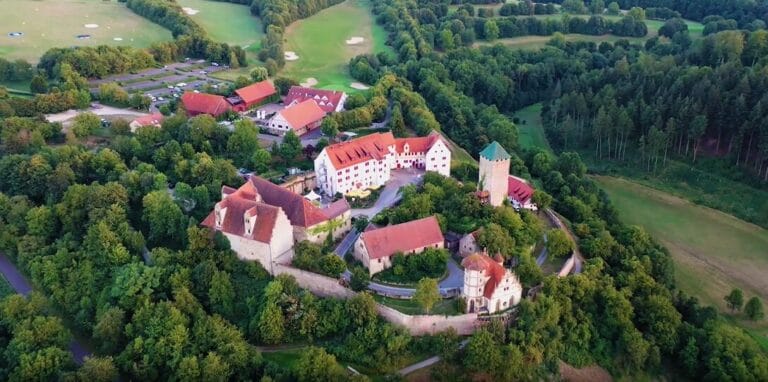
Burgruine Helfenberg: Medieval Hilltop Castle in Germany


Site at a Glance
- Rating
- 4.3
- Popularity
- Low
- Country
- Germany
- Primary era
- Medieval
- External website
- Open
- Eras represented
- Medieval, Early Modern
- Civilizations
- Holy Roman Empire
- Site type
- Military
- Remains
- Castle
On this page8 sections
History
Burgruine Helfenberg is the ruin of a medieval hilltop castle above Helfenberg in Ilsfeld, Germany. Built around 1250 during the Staufer period, the era when the Staufer dynasty dominated the politics of the Holy Roman Empire, it was first mentioned in 1259 in connection with Albertus de Helfenberg, a ministerial, or member of the medieval service nobility.
The Helfenberg family and divided inheritance
The castle remained associated with the Helfenberg family during the late thirteenth and early fourteenth centuries. Hartmann, known as Bruche de Helfenberg, appears in 1293, while Albrecht von Helfenberg is recorded in 1310. From the early fourteenth century, members of the family began transferring parts of their property. A holding at Siglingen went to Schöntal Monastery, and in 1344 a share of the forest at Talheim passed to the Lords of Neipperg. Hans von Helfenberg, the last recorded member of the family, sold a tithe share at Lauffen am Neckar in 1354.
The inheritance was divided between the Lords of Sachsenheim and the Lords Sturmfeder. Their identical coats of arms indicate a possible family connection between the Sturmfeder and Helfenberg families. Werner Sturmfeder held the castle from 1339 to 1370, and Hans Sturmfeder held it around 1400. The Sachsenheim share later passed to Heinrich von Hohenriet.
Transfer to Württemberg and sixteenth-century rebuilding
Konrad von Hohenrieth eventually owned the entire castle. In 1456 he sold Helfenberg Castle and its associated estates to Württemberg. The transaction included inhabitants, forests, tithes, revenues, a forest fief at Söhlbach, the Abstetter Hof, and serfs in thirteen places. It also covered properties in Helfenberg, Abstatt, Ostheim, Ilsfeld, Beilstein, Oberstenfeld, and Etzlenswenden, together with the abandoned site of Alt Helfenberg behind the castle.
From 1457, Helfenberg was a Württemberg fief, meaning property held in return for service, granted to various noble families. Dieter von Weiler gave it as a subfief, a fief passed onward by its holder, to Hans von Talheim in 1464. Hans von Talheim or his heirs sold it to Werner Notthafft in 1482. Notthafft demolished the old deserted tower at the eastern end of the castle ridge. In 1521, Daniel Notthafft transferred part of the castle to Wolf Rauch von Winnenden, who undertook further building work. Wolf Rauch was killed by peasants during the Weinsberg Bloodbath in 1525, during the Peasants’ War, a series of uprisings in the German-speaking lands between 1524 and 1525.
Wittstatt ownership and the upper and lower castles
Conrad von Wittstatt acquired the castle in 1527, and Philipp von Wittstatt enlarged it in 1579. By 1625, the property had developed into two noble residences. Philipp Christoph von Hoheneck occupied the upper castle, while Johann Christoph von Buchholz lived in the lower manor house at Unterhelfenberg. Both men were related by marriage to the Wittstatt family.
A second manor house had been established by 1625 in the settlement of Finkenbach below the castle. The settlement was probably renamed Unterhelfenberg when the lower residence was built, while the hilltop castle became known as the Upper Castle, or Oberhelfenberg. The alternative name Upper Castle Helfenberg reflects this distinction between the two residences.
War damage, ruin, and later history
The castle was destroyed during the Thirty Years’ War, the European conflict of 1618–1648 that caused widespread destruction across the German lands. It was subsequently restored under Peter von Pflummern, a colonel and Württemberg councillor. Duke Eberhard had granted Pflummern the Hoheneck share of the castle as a fief, and Pflummern also held nearby Wildeck Castle. The castle chapel belongs to this restoration period.
After Pflummern’s death, the castle passed as a female-inheritance fief, a fief that could descend through the female line, to his daughter Elisabeth and her husband Claus Jacob Böcklin von Böcklinsau. Their daughter Maria Dorothea inherited the property in 1681. Her marriage to Wolf Ernst Horneck von Hornberg, which began in 1671, brought Helfenberg into the Horneck von Hornberg family.
An inheritance record from 1702 refers to the partial demolition of the Upper Castle and the creation of a vineyard on the site. By 1746, the Helfenberg lordship had passed through the marriage of a Horneck daughter to the von Gaisberg family, a family represented in the Kocher knightly canton, the regional association of imperial knights. The von Gaisbergs occupied the Lower Castle, while the hilltop castle was already a ruin and supplied stone for buildings in Helfenberg.
The castle chapel was demolished in 1817. The Lower Castle in Helfenberg was destroyed by bombing in 1945 and later replaced by the present community hall. Burgruine Helfenberg remains in the possession of the von Gaisberg family. Repairs have been carried out with assistance from monument authorities, the Heilbronn district, and the former municipality of Auenstein.
Remains
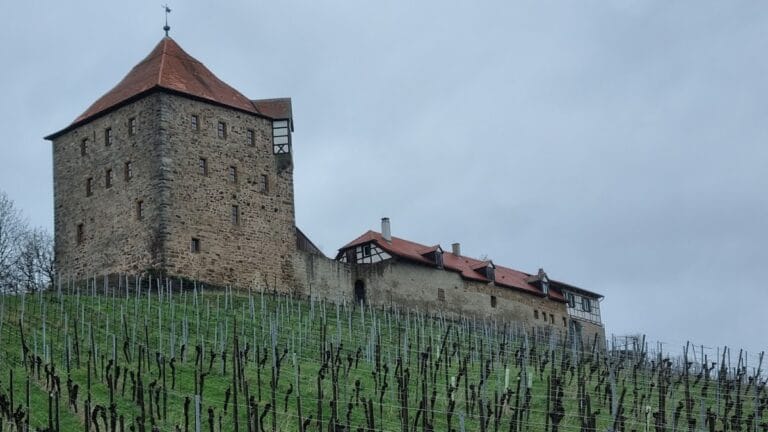
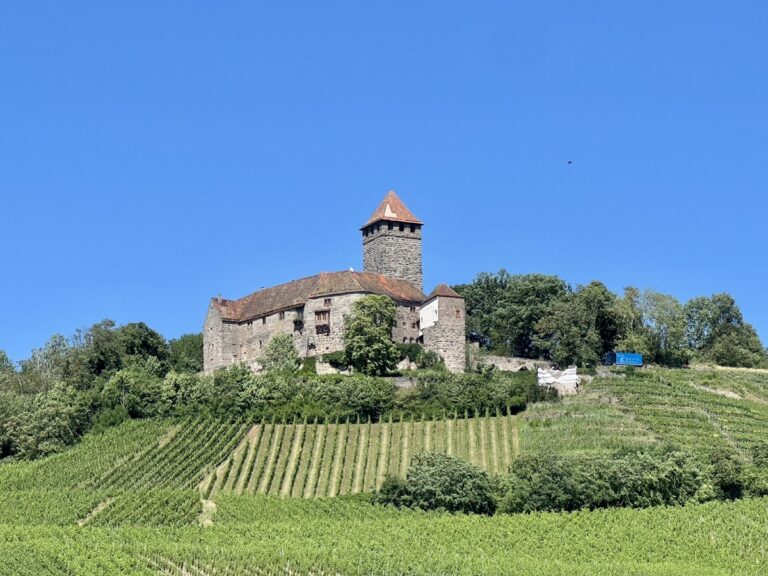
Burgruine Helfenberg occupies a west-to-east ridge at an elevation of 335 metres above sea level. The castle stands east of Abstatt, southwest of Wildeck Castle, and northeast of Auenstein, with the historically associated hamlet of Helfenberg below the hill to the south. Viticulture now covers much of the castle hill. The high plateau around the ruin and a small wooded depression in the western part of the terrain remain outside the vineyards.
Castle ridge and eastern complex
The castle complex extended eastward across an area of approximately 40 by 25 metres. The eastern part probably contained service or agricultural buildings and a chapel. The tower at the eastern tip of the ridge was the old deserted tower demolished by Werner Notthafft in 1482. After the castle became a ruin, its masonry was quarried for construction in Helfenberg.
Residential tower and shield wall
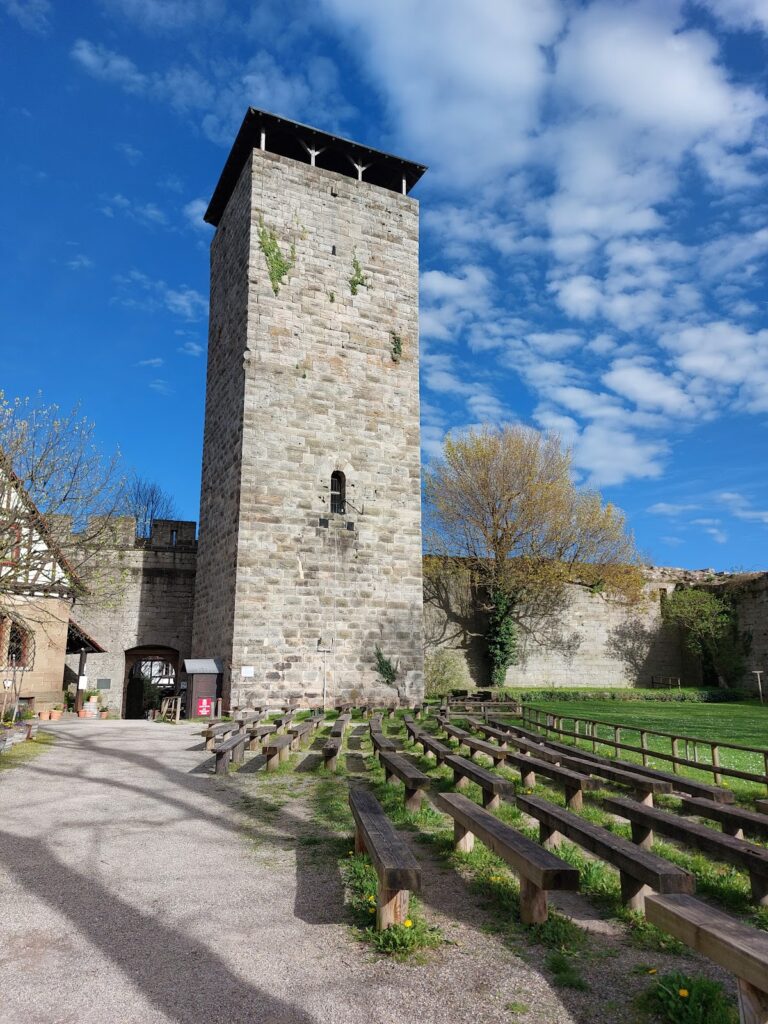
The principal surviving remains are a residential tower built against the former shield wall, a particularly strong defensive wall protecting the vulnerable side of a castle. Both the tower and portions of the shield wall survive. A later coat of arms belonging to the Lords of Gaisberg is displayed above the portal of the residential tower, linking the surviving structure with the family that retained the ruin.
Nearby sites