Burg Wildeck, Abstatt: A Medieval Spur Castle and Wine Estate


Site at a Glance
- Rating
- 4.4
- Popularity
- Low
- Country
- Germany
- Primary era
- Medieval
- Eras represented
- Medieval
- Civilizations
- Holy Roman Empire
- Site type
- Military
- Remains
- Castle
On this page8 sections
History
Burg Wildeck, also called Schloss Wildeck, is a medieval hilltop castle in Germany above Abstatt. Its exact foundation date is unknown, but the lords of Heinriet probably built the stone fortress between 1250 and 1330 during the late medieval expansion of territorial lordships. It served as the family’s second castle and as the residence of a cadet branch, a secondary line of the noble family. Some members of this branch later used the name von Wildeck.
The Heinriet and Löwenstein lordships
Between 1336 and 1364, Abstatt was separated from the Heinriet holdings and became the family’s sole seat. When the male line ended, the castle passed in 1450 through the daughter of Philipp von Heinriet, the last Heinriet owner, to her husband Peter Harrant von Hohenberg. Harrant died without children in 1490, after which the property reverted to the feudal lord and was granted to Wilhelm von Neipperg.
In 1492, Ludwig I of Löwenstein bought Wildeck and Abstatt. The son of Frederick I, Elector Palatine, Ludwig founded the third comital line of the Löwensteins and became Count of Löwenstein in 1494. A feudal grant gave the Counts rights of use over the lordship while ultimate sovereignty remained with the feudal lord. In 1504, that sovereignty passed from Baden to Württemberg. Württemberg granted the lordship of Wildeck to the Counts of Löwenstein again in 1510, while Abstatt and Wildeck came under the Württemberg administrative office at Beilstein. The castle also briefly came under Austrian administration during the early sixteenth century.
Destruction, rebuilding, and changing ownership
Wildeck was destroyed during the German Peasants’ War in 1525, a major uprising of peasants and townspeople in the German lands in 1524 and 1525. A building inscription indicates that the castle was probably rebuilt by 1533.
After the Battle of Wimpfen in 1622, Abstatt and Wildeck passed to Anton Wolfradt and later, together with Helfenberg, to Colonel Peter Pflaumer of Möckmühl. The Peace of Westphalia, which ended the Thirty Years’ War in 1648, enabled the property to return to Count Carl of Löwenstein through a legally regulated repurchase completed in 1653.
Viticulture and the modern estate
Viticulture became an important activity on the uplands around the castle during the sixteenth century. The vineyards covered 16 Morgen in 1589 and 28 Morgen in 1653. A Morgen was a traditional German land measure whose size varied by region. Ecclesiastical administration held shares in some high-quality princely vineyard sites, and Muscat was probably the most highly valued variety grown there in the seventeenth century.
Napoleon I’s reorganization of the German territories brought the Confederation of the Rhine into existence in 1806 and abolished the Lordship of Wildeck. The castle, vineyards, and other lands remained privately owned by the Löwenstein-Wertheim family. Wildeck became the seat of a district forester, while the estate was administered from the Löwenstein rent office in Abstatt, an office responsible for estate finances and property management.
In July 1932, Karl Hereditary Prince of Löwenstein-Wertheim-Rosenberg sold the Abstatt forestry district and the Wildeck winery to the Jewish merchant Salman Schocken. The Fideicommiss Court in Stuttgart, which administered estates held under a family entail, rejected the purchase, and the Württemberg state acquired the estate in July 1933.
The Weinsberg Wine-Growing School received the winery on 1 August 1939 and began rebuilding the wine estate in 1940. During the Second World War, artillery fire damaged the castle and the vineyards suffered severe damage. Restoring the agricultural operation took decades. Privately owned vineyard parcels around the castle were acquired by 1972, when grape production had broadly returned to its pre-war level. Since 1940, Wildeck has housed an experimental estate of the Weinsberg Wine-Growing School. Its breeding work contributed to the development of the grape varieties Samtrot and Dornfelder, and since 1992 the estate has been managed according to organic viticulture principles.
Remains
Hilltop fortification and setting
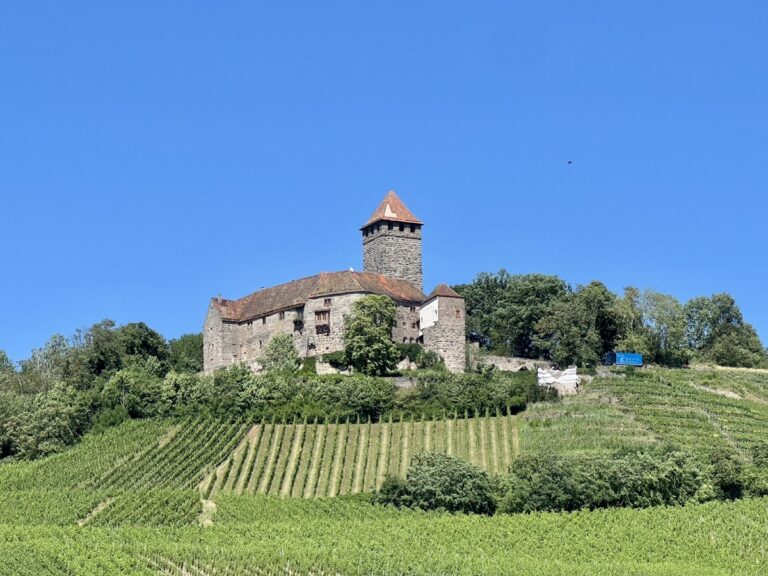
Burg Wildeck occupies a projecting ridge above Abstatt on the edge of the Löwenstein Mountains, at an elevation of about 353 metres. This spur position uses the surrounding slopes as part of the castle’s defensive setting. The hilltop complex was built with stone and brick and has been extensively altered, renewed, and rebuilt. It stands above the surrounding vineyards and the settlement of Abstatt. The site has views toward Vohenlohe, Happenbach, Beilstein, Söhlbach, Ilsfeld, Auenstein, Helfenberg, Untergruppenbach, and Unterheinriet, with further settlements visible in clear weather.
Main tower and surviving buildings
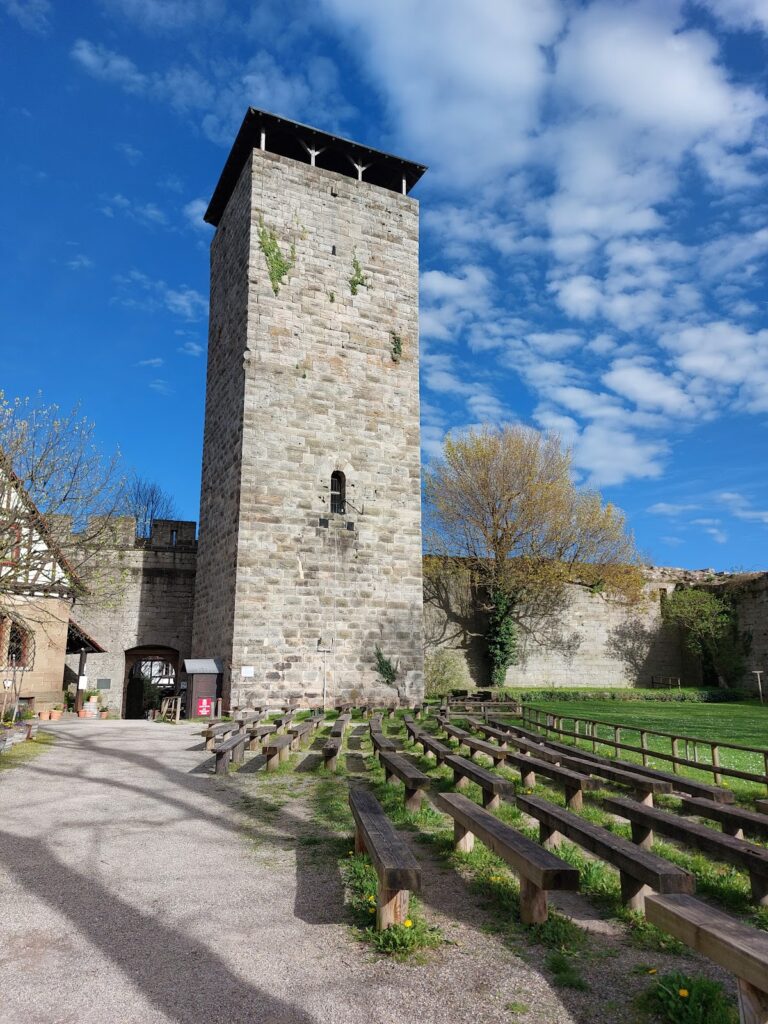
The present complex is largely shaped by later building measures. The large main tower suffered particularly severe damage from artillery fire during the Second World War. Training rooms were added in its upper storeys only in 1995, and a bay window is incorporated into the tower. For a long period after the war, parts of the complex were protected only by emergency roofs. Nineteenth- and early twentieth-century service buildings, including a well house, a press-house annex beside the tower, a press house, and a day-laborer’s house, were demolished, while a new machinery hall was built.
Altered grounds and vineyard estate
The grounds were repeatedly reshaped during the twentieth century by road construction, the creation of reservoirs, and the use of excavated reservoir material to fill depressions. Parts of the vineyard terrain were levelled in 1954, and the state acquired the newly created vineyard areas in 1982.
In 1996, the Wildeck estate covered 21.1 hectares. Productive vineyards occupied 8.6 hectares, while the remainder consisted of young plantings, fallow land, meadows, water surfaces, buildings, and paths. About one quarter of the vineyard area was planted with Riesling, with substantial additional areas devoted to Samtrot, Müller-Thurgau, Pinot Noir, Pinot Blanc, and Pinot Gris. The ruins of Helfenberg Castle lie about one kilometre away, and Weiler Castle is approximately ten kilometres to the northeast.