Kemenate Orlamünde: Central Tower of a Medieval Castle


Site at a Glance
- Rating
- 4.6
- Popularity
- Low
- Country
- Germany
- Primary era
- Medieval
- External website
- Open
- Eras represented
- Medieval
- Civilizations
- Holy Roman Empire
- Site type
- Military
- Remains
- Castle
On this page8 sections
History
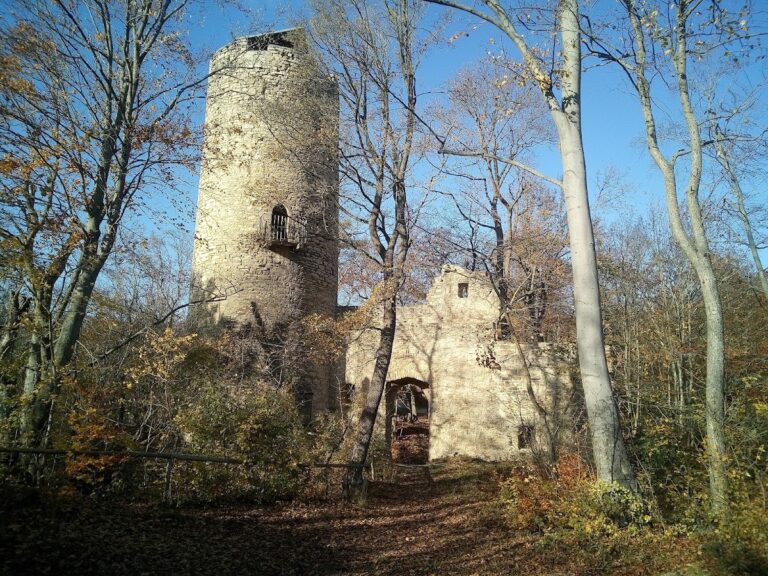
Kemenate Orlamünde is the surviving central tower of a medieval castle complex above the Saale Valley in Germany, dating from the eleventh and twelfth centuries. The castle became the principal seat of the Counts of Orlamünde after Weimar Castle was destroyed, linking the site to one of the most powerful ruling dynasties in medieval Thuringia.
Origins and the Counts of Orlamünde
The castle was mentioned in a parish charter of 1194, which referred to older records dating from before 1067. At that time it was held by Count Otto I of Weimar. A prolonged inheritance dispute over the County of Weimar-Orlamünde was eventually won by Hermann, Otto of Weimar’s great-grandson through Otto’s daughter. Hermann then adopted the title Count of Orlamünde.
After the destruction of Weimar Castle, Orlamünde became the principal seat of the counts. The Counts of Orlamünde-Weimar later divided into several lines, but for a period the dynasty held exceptional political power in Thuringia. Around 1300, Orlamünde was the only castle in Thuringia shown on the Ebstorf World Map, a medieval Christian map that represented the geographical and political landscape as it was understood at the time.
Decline and changing uses
An indebted sale in 1344 began a succession of ownership changes. The castle subsequently fell into decay, and local residents used it as a quarry. The Kemenate survived as the only usable building of the former complex. At the end of the Middle Ages, the town of Orlamünde repaired it as urban residents gained greater influence. The building was later used to store grain and other materials.
During the twentieth century, the remaining castle fabric acquired new cultural and recreational uses. In the 1920s, the wall beside the main entrance served as a theatrical backdrop for celebrated performances attended by visitors arriving on special trains from Leipzig. An open-air cinema was installed in the same castle remains in the 1960s. The Kemenate is now used by the local castle association as an events venue and clubhouse, and it contains a small local-history museum.
The castle is also connected with the legend of a White Woman, whose historical model was Kunigunde of Orlamünde, a medieval noblewoman associated with the tradition.
Remains
The Kemenate forms the central and last surviving usable building of Orlamünde Castle. Parts of the enclosing wall and the gate installation also remain. Built as a massive, austere tower with a fortress-like character, it occupied the ridge in a way that blocked the castle’s principal attack side.
The residential tower and defenses
The Kemenate
A kemenate was a substantial residential or heated building within a medieval castle, often combining domestic accommodation with defensive features. At Orlamünde, the term refers to the broad residential tower that served as the castle’s central building. It was one of the most powerful broad residential towers in Thuringia, combining living quarters with strong defensive capacity.
The tower has small, narrow light slits and an access opening positioned 9.5 metres above ground level. Its severe fortress-like form was probably derived from southern Italy and adapted at Orlamünde. Similar surviving Kemenaten stand at Ziegenrück and Reinstädt, above the Saale or in one of its tributary valleys.
Enclosing wall and gate
Fragments of the castle’s enclosing wall and gate installation survive around the tower. The wall alongside the main entrance later provided the setting for the theatrical performances held in the 1920s, while the same castle remains accommodated an open-air cinema during the 1960s.
Later features on the mountainside
On the mountainside below the Kemenate are monuments to Friedrich Ludwig Jahn, Viktor Lommer, and Hermann Julius Beyerlein. Jahn was a nineteenth-century German educator and an influential advocate of organized gymnastics. The monuments stand in spatial relation to the surviving castle building and its remains.
Nearby sites