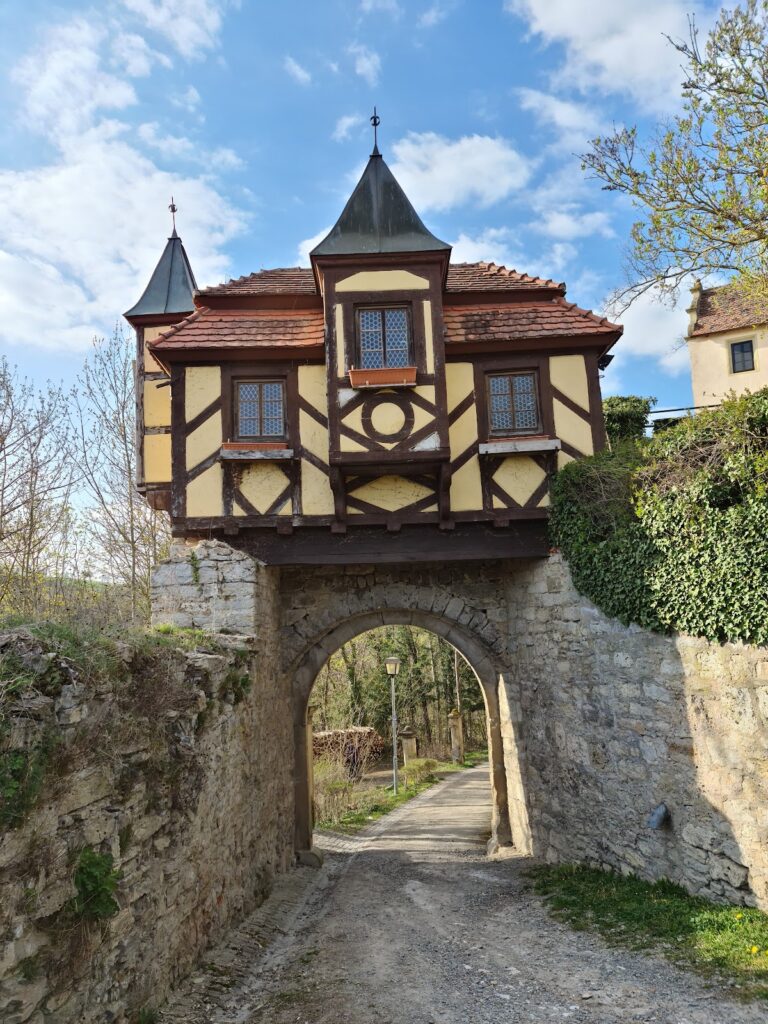
Burg Forchtenberg: A Medieval Hilltop Castle in Germany


Site at a Glance
- Rating
- 4.5
- Popularity
- Low
- Country
- Germany
- Primary era
- Early Modern
- External website
- Open
- Eras represented
- Medieval, Early Modern
- Civilizations
- Holy Roman Empire
- Site type
- Military
- Remains
- Castle
On this page9 sections
History
Burg Forchtenberg is a medieval hilltop castle in Germany, built between approximately 1210 and 1234 by the nobleman Konrad von Dürn. It stands on a hill spur above the Kocher in what is now northern Baden-Württemberg, and its construction helped consolidate property acquired by Konrad after his marriage into the family of the Counts of Lauffen.
Foundation and the rise of Forchtenberg
Konrad von Dürn married Mechthild, the daughter of Boppo V, the last Count of Lauffen, in 1210 or, according to another dating, around 1216 or 1217. After Boppo died between 1216 and 1219, Konrad acquired Wülfingen on the Kocher near the mouth of the Kupfer, together with further property in the surrounding area. He built the castle on the opposite bank of the Kocher to strengthen his control of these possessions, and the castle was complete by 1234.
The fortress was connected with the foundation of the town of Forchtenberg below it, which was first recorded in 1298. The older settlement of Wülfingen was later abandoned in favor of Forchtenberg. Konrad’s descendants expanded both the castle and the town. Shortly before Konrad’s grandson Ruprecht died without children in 1323, the estate passed to Kraft II of Hohenlohe.
Hohenlohe use and wartime destruction
The House of Hohenlohe, a prominent noble dynasty in Franconia and surrounding areas, used the castle only intermittently as a residence. Ulrich of Hohenlohe stayed there briefly after 1367, and the complex also served as a residence for widows. In time, it became the seat of Hohenlohe officials and a place for storing the tithe, a customary levy often paid in agricultural produce or wine. During the Renaissance, the castle was enlarged in a palace-like form.
During the Thirty Years’ War, the major European conflict fought between 1618 and 1648, Swedish troops probably set the castle on fire and largely destroyed it. The administrative seat was then transferred to the town of Forchtenberg. After 1680, the surviving large vaulted cellar was enlarged and continued to hold the wine tithe, while the administrative office remained part of the complex until it was closed after the Principality of Hohenlohe passed to Württemberg in 1806 through the Imperial Deputation Principal Conclusion, the 1803 settlement that reorganized and secularized much of the Holy Roman Empire.
Decline, ownership, and conservation
After the administrative office closed, necessary repairs were neglected and the House of Hohenlohe gradually lost interest in the property. Around 1850, it sold the castle to the court cooper Carl Müller for 33 gulden. The ruin changed hands several times, was used as a stone quarry, and deteriorated further.
Chamber President Kurt von Kleefeld acquired the ruin in 1929 and spent approximately 10,000 marks on repairs. He planned to transfer it to the town of Forchtenberg after his death, but he emigrated because of his Jewish ancestry and died in 1934. The ruin then passed to a man named Schöppler from Esslingen. In 1937, the Forchtenberg saddler Wilhelm Riehmann acquired it and undertook further work to secure the remains.
During the 1960s, the State Office for Monument Protection supported repairs to the dangerously unstable south wall. The town of Forchtenberg acquired the complex in 1989 and carried out comprehensive restoration and stabilization from 1989 to 1995 with financial support of 1.3 million marks from the State Office for Monument Protection. Part of a wall collapsed in July 2012, leading to a temporary closure. By February 2016, the complex had reopened and the tower could again be climbed.
Remains
Burg Forchtenberg occupies a mountain spur above the Kocher, opposite the former settlement of Wülfingen and above the later town of Forchtenberg. The hilltop fortification measures approximately 92 meters in length and up to 50 meters in width. Its surviving fabric includes the remains of the palace-like complex, a large vaulted cellar, a later tower, and sections of the castle walls that have undergone repeated stabilization.
Surviving structures
Vaulted cellar
The large vaulted cellar survived the destruction of the castle and was enlarged after 1680. It continued to serve as storage for the wine tithe, while former grain-storage floors occupied the levels above it. The cellar is therefore a surviving part of the complex’s later administrative and agricultural storage functions.
Tower
The surviving tower dates from the period of the cellar’s enlargement after 1680. Builders used stones taken from the walls of the former palace-like complex, giving the tower a direct material connection with the earlier buildings. It is approximately 11.5 meters high, contains a metal staircase, and serves as an observation tower.
Walls and stabilization
The south wall became dangerously unstable and was secured during work supported in the 1960s. Further stabilization and comprehensive restoration followed between 1989 and 1995. The collapse of part of a wall in July 2012 required additional attention, and the condition of the restored complex allowed it to reopen by February 2016.