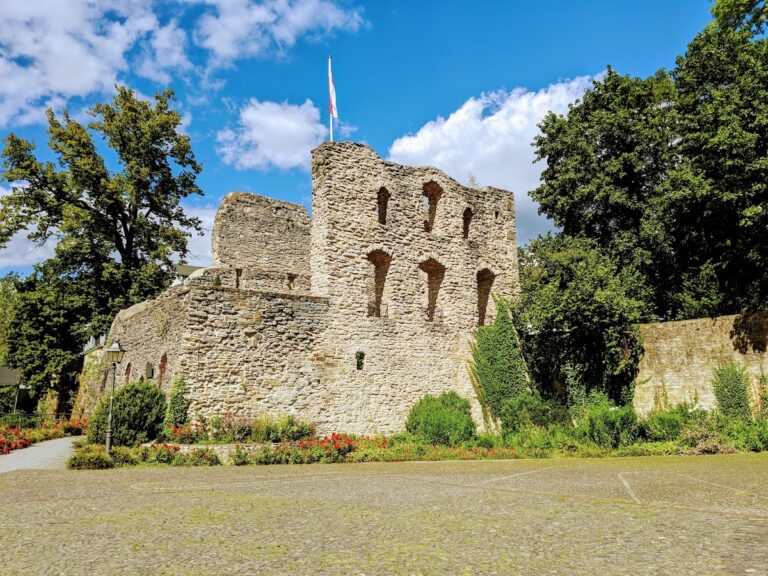
Ruine Falkenburg: A Medieval Hilltop Castle Ruin in Germany


Site at a Glance
- Rating
- 4.7
- Popularity
- Low
- Country
- Germany
- Primary era
- Medieval
- External website
- Open
- Eras represented
- Medieval
- Civilizations
- Holy Roman Empire
- Site type
- Military
- Remains
- Castle
On this page12 sections
History
Ruine Falkenburg is a medieval hilltop castle ruin in Germany, near Detmold-Berlebeck in North Rhine-Westphalia. Bernhard II and his son Hermann II, nobles of the medieval Lippe dynasty, commissioned its construction between 1190 and 1194. Built on a summit in the southeastern Teutoburg Forest, the castle formed a substantial fortified residence and defensive stronghold.
Foundation and medieval use
Falkenburg belonged to the territory and noble family of Lippe during the Middle Ages. Its elevated position strengthened its defensive character, while the size of the complex shows that it served more than a purely military purpose. The castle included residential buildings, defensive structures, and separate areas associated with the main castle and its outer defenses.
During the Eversteiner Feud, a conflict fought from 1403 to 1407, Duke Heinrich I of Brunswick was held prisoner at Falkenburg for an extended period. Ownership passed to Count Simon III of Lippe in 1405, placing the castle within the authority of another medieval count of the Lippe dynasty.
Fire, abandonment, and dismantling
A fire destroyed the already substantial complex in the middle of the fifteenth century. At that time, Falkenburg comprised a main castle, an outer bailey, and an enclosed defensive zone between or outside the walls, known as a zwinger. The damage altered the site’s later history, and the castle was abandoned during the first half of the sixteenth century.
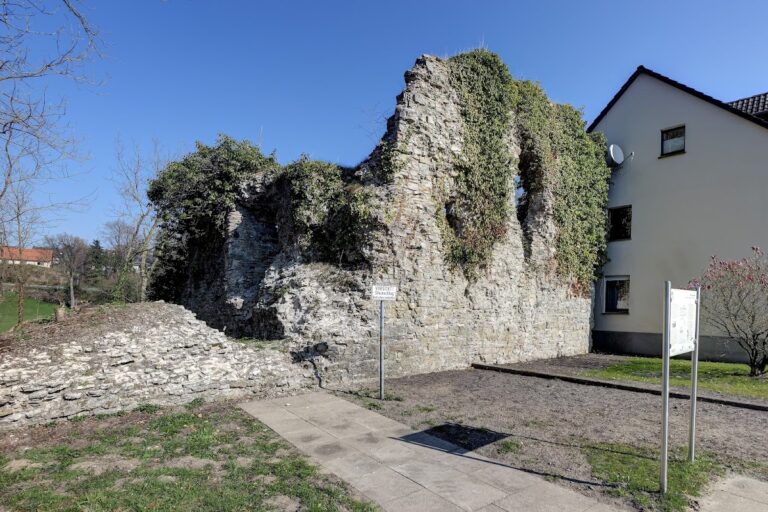
In the early nineteenth century, under Pauline, the ruling princess and regent of Lippe, parts of the castle were dismantled to expand the Gausekote road. Residents of Berlebeck also reused many of the stones in the foundations of their houses. These changes reduced the surviving fabric of the medieval complex and helped shape the ruin visible today.
Archaeology and conservation
Ruine Falkenburg is owned by Stephan Prince of Lippe, a direct descendant of the castle’s builders. The private association Die Falkenburg e. V. was founded at the end of 2004 to preserve and stabilize the site. Archaeological excavations began in April 2005 and continued until 2018.
During the excavations, the entire summit cone was lowered by approximately 2.5 metres. Masonry that had remained buried for centuries became unstable when exposed, making the protection of the surviving walls a central conservation concern. Falkenburg is protected as an archaeological monument, a legally protected site whose historical evidence survives in structures and buried remains. In 2016, Stephan zur Lippe received the German Prize for Monument Protection, the Silver Hemisphere, for his work on the castle’s architectural and archaeological remains. Conservation is directed toward securing the surviving masonry rather than reconstructing the castle.
A very small brooch-like piece of jewellery found during archaeological work in 2012 has prompted a historical hypothesis concerning Hermann II. Archaeologists and historians have suggested that, around 1200, he may have been close to becoming King of Livonia, a historical region around the eastern Baltic corresponding broadly to parts of present-day Latvia and Estonia. The interpretation remains uncertain.
Remains
Falkenburg occupied a 367.95-metre-high summit in the Lippe Forest, in the southeastern Teutoburg Forest. The summit lies on a neighboring hill approximately 700 metres northeast of the 401.9-metre Stemberg and is linked to it by a saddle about 337 metres high. The castle complex was organized around a main castle, an outer bailey, and a zwinger, with buildings arranged on the northern and southern sides of the summit.
Main castle buildings
Southern residential hall
The southern part of the main castle contained the principal residential and representative building, known as the palas. Its masonry has been exposed within the main castle area. The building reflects the residential and ceremonial functions that formed part of the medieval complex alongside its defensive role.
Northern buildings
At least five additional buildings stood on the north side. Their functions can only partly be determined. The central building contains a gun chamber from a late construction phase, while the other northern structures appear to have served mainly residential purposes. Together, these buildings formed the northern side of the castle’s internal arrangement.
Defensive structures
Gate tower and outer defenses
The northern and southern buildings were connected on the west by a gate tower. The wider complex also included an outer bailey and a zwinger, an enclosed defensive zone designed to expose attackers to fire from the fortifications. These elements belonged to the castle’s defensive organization before the fifteenth-century fire altered the complex.
Keep
The open area on the east side of the complex was occupied by the keep, the principal fortified tower and a place of refuge rather than the castle’s main residence. Its position completed the arrangement of the major buildings and defensive features around the summit.
Surviving masonry and archaeological finds
Excavations exposed masonry rising 2.50 to 2.80 metres above the surrounding soil. The walls are unstable in places because their long burial weakened the masonry after it was uncovered. Parts of the original fabric were removed for road construction and house foundations, while the surviving walls are being secured as a ruin rather than rebuilt.
The 2012 excavation produced a tiny brooch-like ornament. Although small, the find contributed to the hypothesis connecting Hermann II with the possibility of becoming King of Livonia around 1200. Its interpretation remains part of the ongoing historical understanding of the castle and its founders.
Nearby sites