Saffenburg: A High-Medieval Hilltop Castle in Germany


Site at a Glance
- Rating
- 4.6
- Popularity
- Low
- Country
- Germany
- Primary era
- Medieval
- External website
- Open
- Eras represented
- Medieval
- Civilizations
- Holy Roman Empire
- Site type
- Military
- Remains
- Castle
On this page12 sections
History
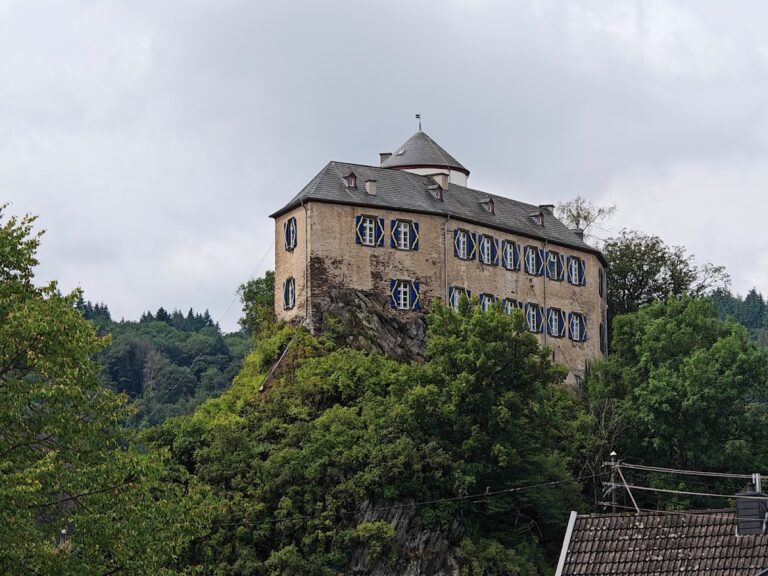
Saffenburg is a high-medieval hilltop castle in Germany, above the Ahr Valley at Mayschoß in present-day Rhineland-Palatinate. Built in the eleventh century by Adolf of Nörvenich and Adalbert of Saffenburg, it is described as the oldest castle ruin in the Ahr Valley. Its elevated position made it both a fortified residence and a military installation, while the surrounding lordship later included villages, religious houses, and its own court.
Foundation and the Saffenberg family
The castle’s first documentary mention is associated with a charter dated 27 September 1074. The document is a forgery probably based on a charter from 1090, but it names Adalbertus de Saffenberch as a witness. Adalbert later founded the Augustinian abbey of Rolduc in 1104 and endowed it with properties in Ahrweiler and Lantershoven. Rolduc, an Augustinian abbey near present-day Herzogenrath and Kerkrade, served for a time as the family monastery of the Saffenbergs.
The Augustinian convent of Marienthal was founded from Rolduc in 1137 and also became part of the Saffenburg lordship. Adalbert’s successor, Adolf I of Saffenberg, strengthened the family’s position through his marriage to Margarete of Schwarzenburg, a niece of Archbishop Friedrich I of Schwarzenburg. Through this connection he acquired the title of count. Around 1147, he became hereditary advocate of the Cologne Church, an office involving the protection and representation of an ecclesiastical institution. He probably transferred Saffenburg to Cologne and received it back as a fief, meaning property or jurisdiction granted by a superior lord in return for service and allegiance.
Inheritance and territorial administration
The male line of the Saffenberg family ended with Herman II in 1172. Through his daughter Agnes, the lordship passed to the counts of Sayn around 1173. When the Sayn line ended in 1246, Countess Mathilde transferred the lordship in 1247 to her husband’s nephews, the counts of Sponheim. Heinrich of Sponheim became its sole owner and gave Saffenburg to his son-in-law Diedrich VII of Cleves in 1255.
A second noble branch, known as the Lords of Saffenburg, held part of the castle from the late twelfth century. Albert of Saffenburg appears in 1197, followed by members of the family named Wilhelm, Herman, Gerlach, Konrad, and later Wilhelm and Johann. This line descended from a branch connected with the Saffenberg inheritance and continued to use the Saffenberg name.
In 1424, the heiress Katharina of Saffenburg, granddaughter of Johann III, married Count Philipp I of Virneburg, bringing the lordship to the counts of Virneburg. Their family held it until the death of the last count, Kuno, in 1545. A dispute then followed over the inheritance. Diedrich II of Manderscheid acquired sole possession by paying 3,190 thalers to Friedrich IV of Wied, and Archbishop Salentin of Isenburg enfeoffed him with the lordship in 1572. A thaler was a major silver coin used in the Holy Roman Empire.
Through the marriage of Diedrich’s sister Katharina to Philipp von der Mark, Saffenburg passed to the von der Mark family in 1593. The family pledged the lordship in the mid-seventeenth century, first to Freiherr von der Reck and later to Count Maximilian Carl of Löwenstein. The dispute over the pledge was settled in 1679. After the last count of the Mark line died in 1773, Saffenburg passed through Louise Margaretha’s marriage into the house of Arenberg.
The lordship comprised Saffenburg, Marienthal Abbey, and the four villages of Mayschoß, Laach, Rech, and Dernau. It had its own court, with elected lay judges from the villages presided over by an Amtmann at the rent office in Mayschoß. An Amtmann was a territorial administrator who exercised judicial and administrative authority on behalf of a lord. People from outside the lordship needed special permission to settle there and paid twelve Reichstalers, or eight additional Reichstalers for a wife.
Sieges and destruction
During the Thirty Years’ War, Swedish troops under General Baudissin besieged and captured Saffenburg on 14 December 1632 after an intense bombardment. The garrison commander, Burckersdorf, had reinforced the defenders with able-bodied men from the surrounding area, while many citizens of Ahrweiler had taken refuge inside the castle. Numerous defenders were killed, and many civilians escaped over the outer walls. The Swedish force left a company under Captain Bodinger at Saffenburg before withdrawing toward the Rhine on 15 December.
In January 1633, Spanish and Electoral Cologne troops led by Count Ernst of Isenburg-Grenzau and Count de Maria besieged the Swedish garrison. After four weeks, the defenders capitulated on 15 February and withdrew under an agreement.
During the War of the Palatine Succession, Electoral Trier troops under Otto von Wentz captured Saffenburg in a night assault on 12 May 1689. French troops seized it during the War of the Spanish Succession on 18 October 1702 after overpowering the gate guard. An allied force under General Sommerfeld bombarded the castle unsuccessfully for two days in January 1703. Another allied siege, commanded by General Bülow, lasted three weeks from 1 May. After Bonn fell on 15 May, the French commander Monsieur le Ballu capitulated and withdrew under safe conduct.
On 6 February 1704, an artillery detachment under Monsieur Borkelinge came from Jülich to demolish the already badly ruined castle. Its masonry and great tower were undermined and blown up, and the destruction was complete by 16 February. Saffenburg thereafter remained a ruin. French troops occupied the lordship in 1794. Under the Reichsdeputationshauptschluss, the imperial settlement of 25 February 1803 that secularized ecclesiastical territories and compensated rulers for losses caused by French expansion, the Duke of Arenberg received compensation. Duchess Louise Margaretha later recovered her possessions on the left bank of the Rhine as private property. In 1815, the Congress of Vienna incorporated the former lordship into the Kingdom of Prussia.
Conservation
Conservation of Saffenburg’s increasingly deteriorated foundations began in 2004. Since 2007, the castle ruin has again been open for public access.
Remains
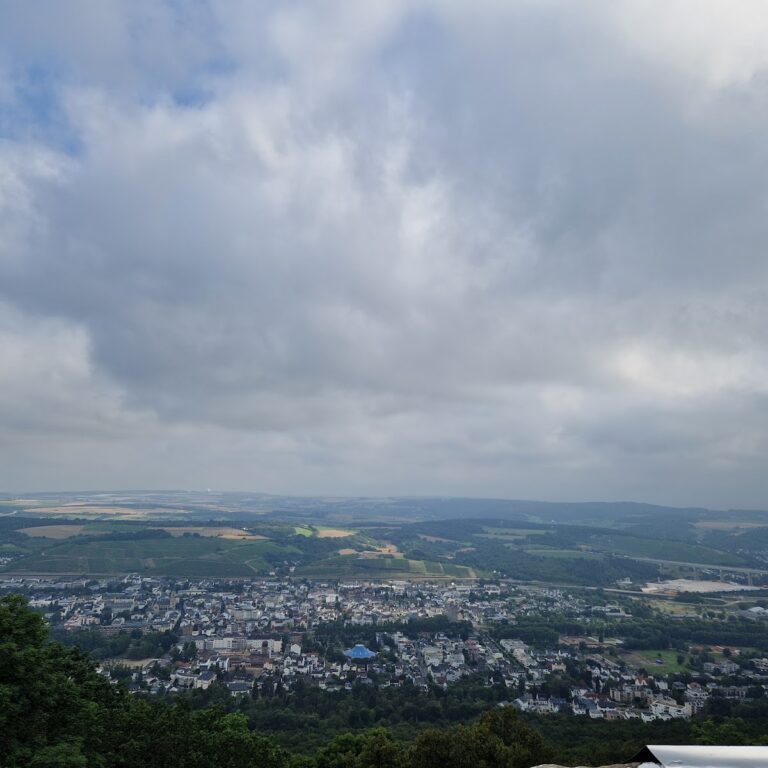
Saffenburg occupies a long, narrow rocky massif approximately 253 metres above sea level above the Ahr Valley. The Ahr surrounds the massif on three sides, and two tunnel tubes of the Ahr Valley Railway pass through it. The castle complex extended for about 260 metres in length and 80 metres in width. Two outer baileys and a core castle formed the main arrangement, with deep neck ditches separating the fortified areas.
Fortified layout
Outer baileys and neck ditches
The two outer baileys and the core castle were divided by deep neck ditches, which were cut across the narrow rocky approach to isolate the fortified areas. Material removed from these ditches was reused as building material within the castle. The arrangement reflects the defensive use of the massif and the way its natural form was incorporated into the complex.
Core castle
The core castle occupied part of the extended complex and included a great tower. The 1704 demolition undermined and blew up the tower together with the castle masonry. Surviving fabric now consists of foundations that appear to merge almost seamlessly with the underlying rock. In some places, embankments preserve the former line of the walls.
Military remains and later landscape use
Artillery equipment
An inventory from 1653 lists seventeen iron and bronze guns, including partly medieval chamber guns. Most of the gun carriages had already rotted by that date, providing evidence of the castle’s poor artillery-defence condition before its final destruction.
Railway tunnel
The disused tunnel of the former northern second railway track later served as part of the Ahr Cycle Route until the 2021 flood. Its presence reflects the continued alteration of the rocky massif after the castle became a ruin.