Frankenstein Castle: A Medieval Hilltop Fortress in Germany


Site at a Glance
- Rating
- 4.4
- Popularity
- Medium
- Country
- Germany
- Primary era
- Medieval
- External website
- Open
- Eras represented
- Medieval, Early Modern, Modern
- Civilizations
- Holy Roman Empire
- Site type
- Military
- Remains
- Castle
On this page15 sections
History
Frankenstein Castle is a medieval hilltop fortress in Germany, situated on a 370-metre-high outcrop of the Langenberg in the Odenwald southeast of Darmstadt. Built by Conrad II Reiz of Breuberg around 1240, it was already standing and in use when it was first mentioned on 2 June 1252. Its position above the Rhine Plain and its control of the surrounding lordship made it the center of the Frankenstein family’s authority.
Foundation and the Frankenstein lordship
Conrad built the castle on land associated with his marriage to Elisabeth of Weiterstadt. He later adopted the name von und zu Frankenstein, and the family that took this name developed into the ruling house of the surrounding territory. Their authority extended over Nieder-Beerbach, Eberstadt, Ober-Beerbach, Schmalbeerbach, Stettbach, Allertshofen, Bobstadt, and Ockstadt, together with additional rights in places such as Darmstadt, Zwingenberg, Bensheim, Groß-Gerau, and Frankfurt am Main. The territory immediately around the castle, particularly Nieder-Beerbach, formed the most coherent part of their lordship.
In 1292, Friedrich von Frankenstein made the family castlemen, or nobles responsible for military service and defense, of Counts Wilhelm I and Diether VI of Katzenelnbogen. The Frankensteins granted the counts unrestricted access to the castle and promised military support. The fortress itself was never besieged.
Division, expansion, and imperial status
The family divided into two lines during the fourteenth century. A castle peace agreement of 1363 set out how the fortress was to be shared, but legal disputes continued. Around 1400, the undersized castle was substantially enlarged and modernized. In 1402, the castle and Nieder-Beerbach became imperial fiefs, territories with a direct legal relationship to the emperor within the decentralized Holy Roman Empire rather than dependence on an intermediate lord. This change made them independent of Katzenelnbogen.
Further building during the sixteenth century reflects the apparently strong economic position of the Frankenstein lordship. Rebuilding and expansion began at the start of that century, and the complex reached its final historical extent by the middle of the 1500s. At the same time, relations with the Hessian landgraves grew more difficult. After 1567, Landgrave George I of Hesse-Darmstadt, the ruler of the branch of Hesse centered on Darmstadt, consolidated his territory around the city and extended judicial authority into Frankenstein lands. The legality of these actions was disputed, and the Frankensteins pursued numerous cases before the Imperial Chamber Court. They eventually had to accept Hesse-Darmstadt’s overlordship.
Sale, decline, and destruction
In 1662, the Frankenstein family sold the castle and lordship to Landgrave Ludwig VI of Hesse-Darmstadt for 109,000 gulden, despite a testamentary instruction against such a sale. The family had been elevated to the rank of barons in 1670 and withdrew to Ullstadt in Franconia after acquiring a new lordship there.
Hesse-Darmstadt was chiefly interested in the territorial possessions, and the castle deteriorated after the sale. During the eighteenth century it served as an institution for invalids, a refuge during the wars of conquest associated with Louis XIV of France, and later a hospital. Rumors of buried treasure caused further destruction. Treasure seekers demolished walls and cellar vaults, while the castle administrator’s wife later sold the inventory, roof lead, tiles, and wooden stairs. Farmers from nearby villages also quarried the ruins for building stone.
Large searches took place in 1763, 1770, and 1787 to 1788. The first created holes, shafts, and cavities and ended temporarily when a treasure seeker died after a shaft collapsed. The 1770 attempt uncovered only two small pieces of wall. Another fatal accident during the search of 1787 to 1788 led the authorities to prohibit further digging.
Restoration and modern traditions
From the middle of the nineteenth century, Grand Duke Ludwig III initiated a partial restoration shaped by Romantic medievalism. The work was historically inaccurate and damaged or altered more original fabric than it reconstructed, particularly in the two towers.
Frankenstein Castle later became associated with tourism and popular traditions. A restaurant in the newer section was completed after five years of construction and opened in September 1970; it closed in October 2023. American soldiers established an annual Halloween festival at the castle in the 1970s. Held there from 1977 to 2023, it became one of Germany’s largest Halloween festivals before moving permanently to Königstein in the Taunus when the organizers and the Hessian state property authority could not agree on its continuation.
The castle is widely presented as a possible inspiration for Mary Shelley’s 1818 novel Frankenstein; or, The Modern Prometheus, but the connection remains uncertain. Shelley’s journals do not mention the castle, the novel contains no castle, and historians have questioned the tradition that she visited it. The proposed link rests partly on her journey through the Rhine region in 1814 and the possibility that she encountered the castle’s name or learned of its noble family.
Local tradition also identifies Johann Konrad Dippel, a theologian, physician, and alchemist born at the castle in 1673, as a possible model for Victor Frankenstein. Historians question this tradition because no evidence shows that Dippel returned to the castle after completing his studies in 1693. Stories of experiments with nitroglycerin are anachronistic, since that substance had not yet been discovered. One interpretation places Dippel’s laboratory at the inn Zum Löwen in Seeheim rather than at the castle. A 1999 book popularized further claims about Dippel and Mary Shelley, but historians associated with the Eberstadt-Frankenstein historical society reject the proposed connection and have described the book’s sources as erroneous or fabricated.
Another local tradition tells of the knight George of Frankenstein defeating a dragon that threatened Nieder-Beerbach. The legend is later than the knight’s presumed death in 1531. His tomb shows him fighting a dragon, probably referring to his patron saint, Saint George, rather than recording the legendary event. Since 2000, the castle chapel has also been used by the municipality of Mühltal for civil wedding ceremonies.
Remains
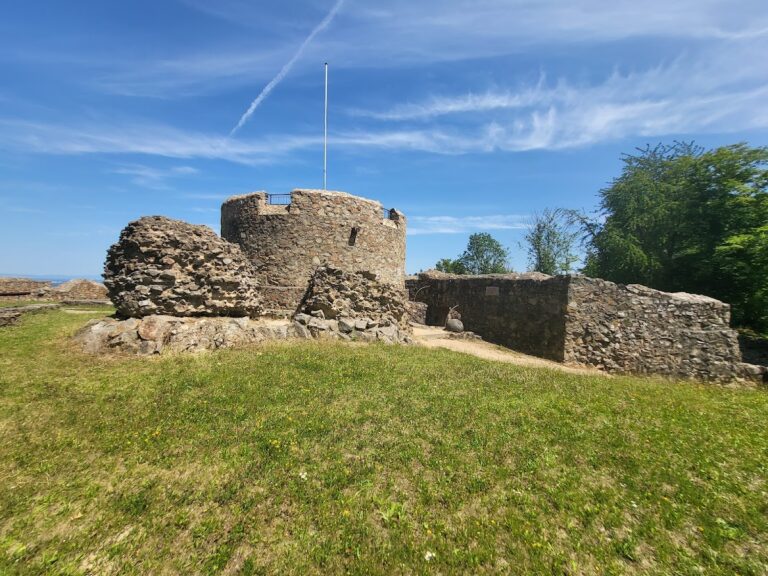
Frankenstein Castle is a hilltop spur castle, or fortress built on the projecting end of a ridge, arranged in several sections constructed during different periods. The oldest area is the southern core castle at the end of the spur. Its defenses, buildings, entrances, and later additions show how the fortress expanded from a compact medieval residence into a larger fortified complex.
Core castle and defenses
Southern core castle
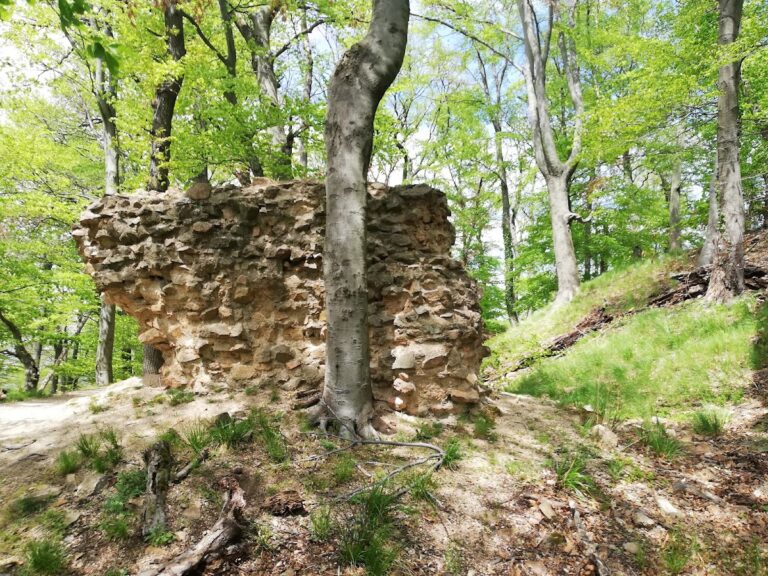
The core castle was enclosed by thick perimeter walls fitted with crenellations and wall walks. Mostly timber-framed economic and residential buildings stood around a narrow courtyard, while their outer walls also formed part of the defensive perimeter. Remains of neck ditches can still be seen south of the castle. A later ring wall strengthened the area around the zwinger, a defended space between successive walls that created an additional position against attackers.
Gate tower and entrance
The gate tower served for centuries as the principal entrance to the inner castle. Before the outer bailey was added, the approach crossed a ditch by a drawbridge. The ditch has since been filled, but the drawbridge rollers and bearing stones remain visible in the gate tower. The tower’s present form was altered during the nineteenth-century restoration, when it received an additional storey.
Battery tower and well house
A battery tower was placed in front of the vulnerable southern side. This fortified structure was open toward the castle, allowing defenders to continue firing on an enemy even if the tower itself was captured. A well house once stood in the inner courtyard, and the surviving well is now covered.
Outer bailey and residential towers
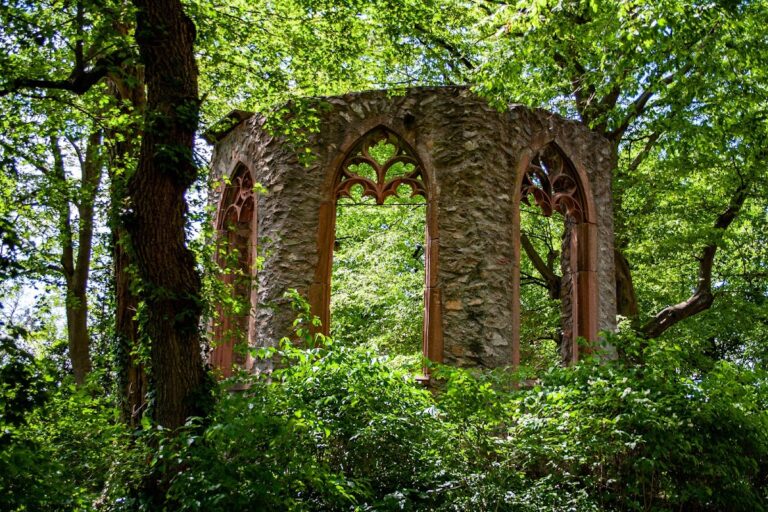
The castle was enlarged by an outer bailey enclosed within a strong wall. Further rebuilding at the beginning of the sixteenth century extended the complex, which reached its final historical extent by the middle of that century. Almost all buildings in the outer bailey have been lost, while the chapel built in 1474 is the structure there stated to survive.
The inner residential tower is one of the castle’s two most conspicuous towers. It was altered during the nineteenth-century restoration and given a tower roof or cap that it probably did not originally possess. Heraldic features associated with the Frankenstein family and Katharina von Rodenstein remain among the recorded details, together with an epitaph for Ludwig Frankenstein, who died in 1602. The recorded coats of arms include those of Ludwig von Frankenstein and Katharina von Rodenstein.
Nearby features and earlier fortifications
War memorial and dragon monument
Beside the parking area stands a war memorial dedicated on 4 September 1927. It has the form of a sword leaning against a stone pedestal. Its crossguard carries the inscription “Remember the dead and what they died for,” together with the dates 1914 to 1918 and 1939 to 1945. A gymnasts’ cross appears above the hilt. Near the quarry below the castle, a stone dragon commemorates the local story of the dragon-slaying knight.
Magnetberg
The nearby Ilbes-Berg, also called the Magnetberg, contains naturally magnetic stones. These formations are associated with local stories about witches and with reports of irregular compass behavior.
Old Castle and Old Burg
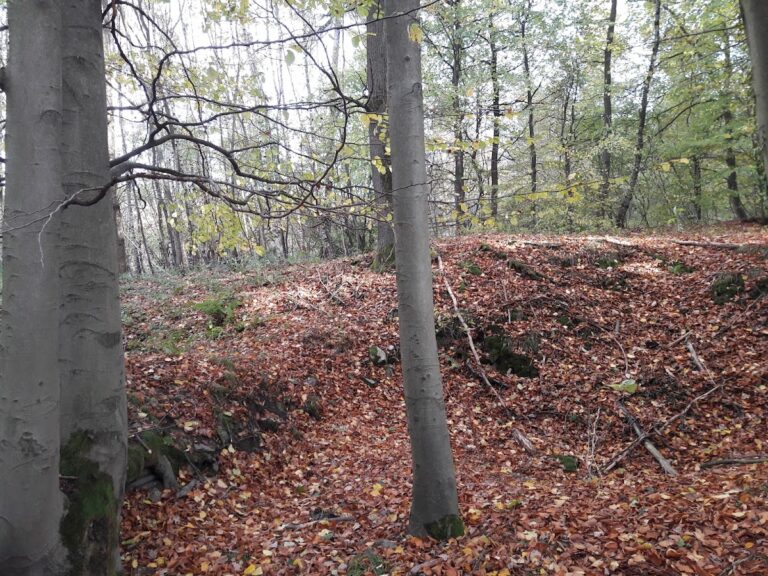
East of the road between Nieder-Beerbach and Ober-Beerbach, a site known locally as the Old Castle survives in the last remnants of a tower castle probably dating from the late Salian period. Local tradition alternatively identifies it as a Bronze Age ringwork or an earlier Frankenstein residence. Another nearby hill called the Old Burg contains remains of a fortification probably dating from the middle of the eleventh century. It has been interpreted as a possible predecessor settlement or the seat of a noble dynasty that ruled the Beerbach valley before the Frankensteins, although its origin remains unresolved.
Alleged underground passages connecting the Old Burg with Frankenstein Castle, the Nieder-Beerbach church, and the former Martins Chapel at Bessungen, along with stories of treasure concealed within them, belong to local legend.
Nearby sites