Alte Schlossmühle Modau: A Historic Grain Mill in Nieder-Modau
Site at a Glance
- Popularity
- Very Low
- Country
- Germany
- Primary era
- Modern
- Eras represented
- Medieval, Early Modern, Modern
- Civilizations
- German, Holy Roman Empire
- Site type
- Economic
- Remains
- Watermill
On this page7 sections
History
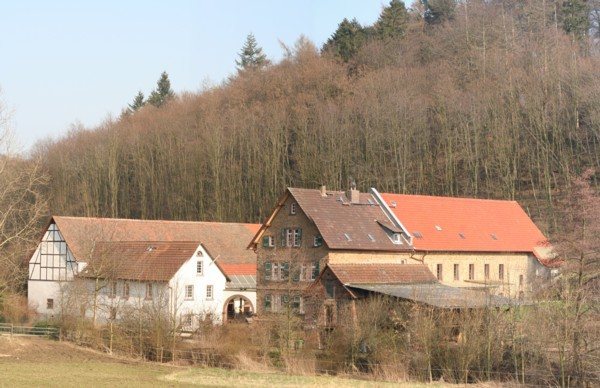
The Alte Schlossmühle Modau is a historic grain mill beside the Modau stream in Nieder-Modau, Germany. It was first mentioned in 1486, but that date does not establish when it was built. The mill’s records trace changes in ownership, use, and name over several centuries.
Early records and rebuilding
In 1486, the mill was named alongside a second mill at Nieder-Modau. Both were described as standing on the lord’s own land, with Hans Thielmann and Hans Sehberg listed as tenants. An estate entry from 1549 records a payment of four shillings from a holding beside the mill, across the stream near the old castle. In 1617, Kaspar Hoffmann was identified as both baker and miller there.
By 1629, the mill belonged to Matthes Lang, a Darmstadt riding master, or horse trainer, and paid rent to Hesse. It was destroyed during the Thirty Years’ War, the major European conflict fought from 1618 to 1648. Heinrich Bernhard was associated with the mill in 1684 and apparently rebuilt it to grind grain and saw timber. By then, the second mill had disappeared. The name Bernhard’s Mill came into use from 1787. Johann Georg Frankenberger was associated with it in 1788, followed by Nikolaus Frankenberger in 1790. In 1809, consistorial councillor Krämer of Reinheim auctioned the property. A consistorial councillor served on an administrative council commonly concerned with church affairs.
Klinger and Bauer ownership
Wilhelm Klinger owned the mill in 1825, and it became known as Klinger’s Mill. It burned down in 1828 and was rebuilt the following year. In 1835, Hessian writer and regional historian Georg Wilhelm Justin Wagner related a local tradition of an underground passage from Nieder-Modau Castle toward the mill. The legend placed the mill’s beginnings in the twelfth century, like those of the castle.
In 1841, Johannes Klinger of the Alte Schlossmühle became involved in a legal dispute with Heinrich Matthes of the Neue Schlossmühle after Matthes sought permission to build a low barrier to control water in the stream. The case went to the appellate court in Darmstadt and continued until 1875. In 1869, fifteen people were recorded as living at the mill.
The mill took the name Bauer’s Mill in 1872, after Christiane Klinger married its owner, Friedrich Wilhelm Bauer. Bauer had come from the Schmalmühle in Fränkisch-Crumbach. A fire on the night of 23–24 January 1880 destroyed much of the flour stored at the mill. The mill was described as newly built in 1881, but a fire on 4 August that year destroyed a large part of it. Another fire struck on 3 September 1907.
Closure and later history
The Bauer family stopped operating the mill on 31 March 1986. It was designated a Hessian cultural monument on 5 September that year and sold in 1993. In 1997, it passed to the owner of a parquet-flooring business. Before Modau became part of Ober-Ramstadt on 1 January 1977, the Alte and Neue Schlossmühlen stood in separate municipalities. They remain independent sites, linked by their position on the Modau.
Remains
Mill layout and machinery
The Alte Schlossmühle stands beside the Modau, with the Neue Schlossmühle immediately upstream. The mill was used to grind grain. Its equipment included one grinding mechanism, while it had two in 1629. An overshot waterwheel, turned by water flowing over its top, powered the machinery; a water turbine was used in a later phase. A steam engine also drove the mill from 1850.
Gate and water-level marker
Johannes Klinger placed the family coat of arms above the gate arch. Between the Alte and Neue Schlossmühlen, a fixed post for monitoring water levels was installed in 1870 following the dispute over the proposed water barrier.