Brest Fortress: Russian Frontier Stronghold and War Memorial in Belarus


Site at a Glance
- Rating
- 4.8
- Popularity
- High
- Country
- Belarus
- Primary era
- Modern
- Eras represented
- Modern
- Civilizations
- Russian
- Site type
- Military
- Remains
- Fort
On this page19 sections
History
Brest Fortress is a nineteenth-century Russian military stronghold in Brest, Belarus, built between 1833 and 1842 at the meeting of the Bug and Mukhavets rivers. The Russian Empire established it because Brest occupied a strategic position on the Dnieper-Bug Canal and the shortest land route between Warsaw and Moscow. The fortress later served as a center of frontier defense, military administration, education, imprisonment, and wartime operations.
Foundation and Russian imperial development
Earlier Russian plans for a western defensive system had included Brest-Litovsk in a proposed line of major fortresses. Construction was delayed by the Napoleonic Wars and by the war with Sweden. After Emperor Nicholas I made the creation of western frontier fortresses a priority in 1825, the military topographer and engineer Karl Ivanovich Opperman prepared a project in 1829. The plan was presented to the emperor in 1830. Ivan Ivanovich Den directed the works, while Field Marshal Ivan Fyodorovich Paskevich supervised the project as a whole.
Construction began in 1833 on the site of the former Brest citadel and the castle of the Lithuanian-Polish period. Temporary earthworks were erected first, and Paskevich ceremonially laid the foundation stone on 1 June 1836. Regiments of the 9th and 10th Infantry Divisions and the 9th Artillery Brigade joined the work in 1838 and 1839. The principal construction was completed on 26 April 1842.
The completed fortress was classified as a first-class Russian fortress and became part of the Warsaw Military District, later the Minsk Military District. At its opening it was regarded as one of Russia’s most advanced fortifications. Its garrison was intended to obstruct the advance of an entire enemy army. An attacker would therefore have faced either a prolonged siege or the need to commit substantial forces to blockade the citadel.
Military, educational, and defensive roles
In August 1842, the Brest Cadet Corps was established in one of the fortress complexes on the initiative of Fyodor Yakovlevich Mirkovich, the governor-general of Vilnius. A cadet corps was a military-oriented residential school for young people preparing for service. The institution was conceived as a closed school after the 1830-1831 uprising.
The fortress was placed under martial law in 1854 during the Crimean War, a conflict in which Russia fought an alliance led by Britain, France, the Ottoman Empire, and Sardinia. Nicholas I’s defensive plan treated Brest-Litovsk as an assembly and fallback point for Russian forces. Troops could regroup there, receive supplies and reinforcements, and defend the Bug line against a possible Austrian advance toward Warsaw.
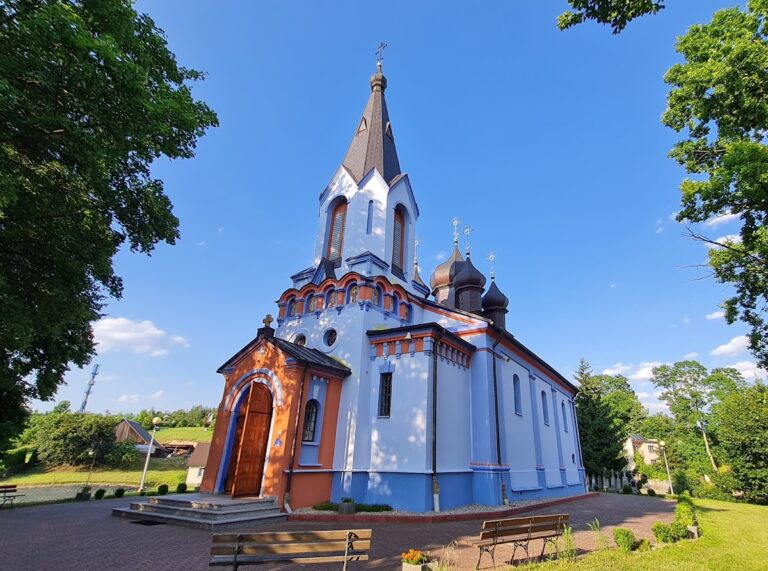
From 1864 to 1888, the fortress was modernized according to the design of Eduard Ivanovich Totleben, a leading Russian military engineer. The works added an outer ring of forts with a circumference of about 32 kilometers, including western and eastern forts in the Kobrin fortification. The Orthodox Saint Nicholas Garrison Church was built inside the fortress in 1876 to a design by David Ivanovich Grimm.
Alexander III and Crown Prince Wilhelm II visited during large military maneuvers in the Brest-Litovsk area in 1886. In 1888, the 2nd Infantry Division was transferred to Brest-Litovsk, and two of its regiments were stationed in the fortress. In 1891, reserve battalions and the fortress regiment were reorganized into four numbered infantry regiments forming a reserve brigade. During mobilization, this brigade could be expanded into a regular infantry division.
Expansion and the First World War
A military deployment plan of 1909 called for a second ring of forts between 9 and 9.5 kilometers from the citadel. The plan approved in 1911 and 1912 included 14 forts, 21 strongpoints, five defensive barracks, and several dozen artillery batteries. It also called for 11 new letter-designated forts between 6 and 7 kilometers from the fortress and the incorporation of older forts. Construction began in 1913, with Dmitry Mikhailovich Karbyshev among the engineers involved, but the projected 45-kilometer ring remained unfinished when the First World War began.
During the war, defensive works were strengthened around the clock with civilian participation. By spring 1915, the defensive position was considered complete and among the strongest in the Russian Empire. The Russian command nevertheless decided not to defend the fortress. During the general retreat, Russian troops abandoned it between the night of 1 August and the night of 13 August 1915, partially demolishing it with explosives.
On 3 March 1918, the Treaty of Brest-Litovsk was signed in the White Palace of the citadel. The treaty ended the war between the new Soviet government and the Central Powers. The building had previously been a church of a Basilian Uniate monastery and later served as an officers’ assembly. German forces controlled the fortress until the end of 1918, after which it passed to Poland.
Polish rule and the 1939 battle
During the Soviet-Polish War, Polish authorities used some fortress buildings, including Graf Berg Fort and the Graevsky Barracks, as camps for Soviet and Ukrainian prisoners of war. More than 1,000 prisoners are said to have died there in 1919 during an epidemic. A Polish Sejm delegation then visited the camp, and conditions were substantially improved. The Red Army captured the fortress in 1920 but soon lost it again. Under the Treaty of Riga in 1921, the fortress became part of Poland.
During the interwar period, the fortress served as a barracks, military storehouse, and political prison. After Brest became part of the Soviet Union in 1939, Soviet security organs used the former prison building for political detention. On 2 September 1939, the day after the beginning of the Second World War, German aircraft dropped 10 bombs on the fortress and damaged the White Palace.
The Polish garrison was placed under the Independent Operational Group Polesie commanded by General Franciszek Kleeberg. On 11 September, General Konstanty Plisowski took command and organized about 2,000 to 2,500 troops into four battalions. They were supported by several batteries, two armoured trains, and Renault FT-17 tanks. Before the battle, military families were evacuated, bridges and passages were mined, the principal gate was blocked by tanks, and infantry trenches were dug in the earthworks.
German forces had approximately twice as much infantry, four times as many tanks, and six times as much artillery as the defenders. On 14 September, 77 tanks of the German 10th Armoured Division attempted to seize the city and fortress but were repelled by Polish infantry supported by 12 Renault FT-17 tanks. German artillery and aircraft then bombarded the position. An assault by the 10th Armoured and 20th Motorized Divisions on 16 September was also repelled, although German troops captured the crest of the earthworks. Seven German attacks were repulsed from 14 September onward, while the defenders lost up to 40 percent of their personnel and Guderian’s adjutant was mortally wounded.
On the night of 17 September, the wounded Plisowski ordered the defenders to abandon the fortress and cross the Bug southward. They withdrew through the Terespol fortification to Terespol. On 22 September, German forces transferred Brest and the fortress to the Red Army’s 29th Tank Brigade under Semyon Krivoshein. The fortress thereby entered the Soviet Union.
The defense of 1941
On 22 June 1941, the fortress contained approximately 9,000 Soviet personnel. They included rifle, reconnaissance, artillery, anti-tank, air-defense, engineering, border, and convoy units, as well as personnel called up for training from the 6th and 42nd Rifle Divisions. Their families included approximately 300 military households.
The German assault was assigned to the 45th Infantry Division of the 12th Army Corps, supported by artillery and other arms. German plans called for the fortress to be captured by noon on the first day of the war. At 4:15 on 22 June, artillery fire destroyed stores and water-supply facilities, severed communications, and caused heavy casualties. The assault began at 4:45. The surprise attack prevented a unified Soviet defense, and the garrison broke into separate pockets of resistance.
Some units of the 6th and 42nd Rifle Divisions fought their way out of the fortress and Brest by about 7:00 on 22 June, but many personnel remained trapped. The defenders continued to fight in separate groups without unified command. On the evening of 24 June, German forces captured the Volhynian and Terespol fortifications. Surviving defenders of the latter crossed into the citadel during the night, concentrating organized resistance in the Kobrin fortification and the citadel.
About 400 defenders under Major Pyotr Mikhailovich Gavrilov concentrated in the Eastern Fort of the Kobrin fortification. They repelled seven or eight attacks each day, including assaults supported by flamethrowers. The last citadel position near the Three-Arched Gates fell on 26 June, and the Eastern Fort fell on 29 June. Organized resistance then ended, although isolated groups and individual fighters continued to resist. Approximately 6,000 to 7,000 defenders were captured.
An inscription in the fortress preserves the words, “I am dying, but I do not surrender. Farewell, Motherland. 20/VII-41.” Gavrilov was captured on 23 July 1941, the thirty-second day of the war, and was officially regarded as the last defender of Brest Fortress. Isolated gunfire was reportedly heard in the citadel until early August.
Memorialization after 1941
The first substantial postwar information about the defense emerged from a German headquarters report recovered in February 1942 from documents of the defeated 45th Infantry Division. Articles, books, paintings, films, and other works published from 1942 onward helped restore public memory of the defenders. The writer and historian Sergei Smirnov played a major role in this process, with support from Konstantin Simonov.
The fortress subsequently became a symbol of Soviet resistance and an important part of official patriotic propaganda. It received the honorary title “Hero Fortress” on 8 May 1965, and since 1971 it has functioned as a memorial complex. In 2024, it was included in Belarus’s UNESCO World Heritage Tentative List and protected as a historical and cultural value of Belarus.
State honors later reinforced its memorial role, including the Honorary State Banner of Belarus in 1996 and the Order of Francisc Skorina in 2021. The memorial institution also received special state awards in 2014 and 2020 for preserving historical memory and reconstructing fortress buildings. Brest Fortress is now understood primarily as a memorial to the Soviet defenders of the Second World War, while its earlier history included frontier defense, administration, education, storage, imprisonment, and military operations.
Remains
The fortress occupies the area where the Bug meets the Mukhavets. Its principal defensive system covered approximately 4 square kilometers, with a main fortified line 6.4 kilometers long. The central citadel stood on an island formed by the Bug and two branches of the Mukhavets. Three artificial islands, shaped by the river branches and surrounding ditches, carried the Kobrin, Terespol, and Volhynian fortifications and were connected to the citadel by drawbridges.
Citadel and defensive fortifications
The citadel
The citadel, the central and usually strongest part of a fortress, consisted principally of two-storey red-brick barracks arranged around a circumference of about 1.8 kilometers. Its walls were 2 meters thick, and its 500 casemates, protected vaulted chambers built into a fortification, were designed to accommodate approximately 12,000 people. The fortress was surrounded by an earth rampart about 10 meters high that incorporated casemates.
The island fortifications
The Kobrin Fortification, formerly called the Northern Fortification, was the largest of the three island defenses. It had four curtain walls, meaning connecting sections of defensive wall between stronger points, together with three projecting ravelins and caponiers. A ravelin is an external triangular defensive work, while a caponier is a covered structure projecting into a ditch and designed for fire along it.
The Terespol Fortification, also known as the Western Fortification, had four projecting lunettes, detached defensive works commonly formed with two faces and two flanks. The Volhynian Fortification, or Southern Fortification, had two curtain walls and two projecting ravelins. Western and eastern forts were added to the Kobrin Fortification during the nineteenth-century modernization.
Gates and outer rings
Five of the original eight gates survive. They include the Kholm Gate south of the citadel, the Terespol Gate to the southwest, the Northern or Alexander Gate north of the Kobrin Fortification, the North-West Gate, and the Southern Gate south of the Volhynian Fortification on Hospital Island.
The fortress was built primarily of brick. Later defensive works incorporated earth, concrete, reinforcing materials, casemates, ditches, and artillery positions. The nineteenth-century outer ring of forts extended over a perimeter of about 32 kilometers. The second ring, planned with a circumference of 45 kilometers, began construction in 1913 but remained unfinished.
Religious, administrative, and prison buildings
Saint Nicholas Garrison Church
The Orthodox Saint Nicholas Garrison Church was built in 1876 to David Ivanovich Grimm’s design. During the Soviet period, the building was converted into a mess. It was restored between 2000 and 2008, and its dome is covered with gilded leaves.
The White Palace
The White Palace survives as a ruin within the memorial complex. It was originally a church belonging to a Basilian Uniate monastery and later became an officers’ assembly. The Treaty of Brest-Litovsk was signed there on 3 March 1918. German bombing damaged the building on 2 September 1939, and the ruin is now incorporated into the memorial area.
The former prison
The former prison building in the Kobrin Fortification was a stone structure dating from 1751 and originally belonged to the Brigittine monastery. After serving as barracks and a disciplinary battalion facility, it became a military field prison and later a transit prison. During the 1863 Polish uprising, the transit prison held detainees, and the facility continued operating until the First World War. In independent Poland, it became a maximum-security prison for major state criminals. Twenty-one opposition deputies were imprisoned there in 1930, and Stepan Bandera was held there in 1938 and 1939.
After Brest became part of the Soviet Union in 1939, Soviet security organs used the building for political prisoners. On 10 June 1941, it held 680 prisoners. A German reconnaissance battalion seized the building on 22 June, during the assault on the fortress. Some prisoners died during the fighting and the others were released. The ruins were demolished with explosives in 1955.
Memorial complex and surviving ruins
Most of the citadel was dismantled after the Second World War for the construction of houses. Ruins of the 333rd Rifle Regiment barracks and other defensive and residential buildings remain on the observation platform and elsewhere in the memorial area. The fortress also contained a hospital, grain storehouse, bakery, pigeon station, artillery facilities, engineering offices, barracks, and residential structures.
Ceremonial Square and museums
The postwar memorial complex is arranged around the Ceremonial Square. The Museum of the Defense of Brest Fortress adjoins the White Palace ruins. The Museum of Post No. 1 opened in 1984, and the Museum of Military Glory of Aviators opened within the memorial complex in 1992.
The “Courage” monument and necropolis
The compositional center of the memorial is the monumental sculpture “Courage,” whose rear reliefs depict episodes from the 1941 defense. A three-level necropolis linked compositionally to the monument contains the remains of 1,038 people. Of these, 277 are identified by name and the remainder are unidentified.
The Eternal Flame of Glory burns in front of the ruins of the former engineering administration. The memorial area also preserves the inscription, “I am dying, but I do not surrender. Farewell, Motherland. 20/VII-41.” The former Post No. 1 commemorative guard was first established in 1972. Together, the nineteenth-century fortifications, wartime ruins, museums, burial areas, restored buildings, and postwar monuments form the fortress’s present physical and interpretive landscape.