Château du Bouchet (Indre): A Fortified Seigniorial Residence in France


Site at a Glance
- Rating
- 4.4
- Popularity
- Low
- Country
- France
- Primary era
- Medieval
- External website
- Open
- Eras represented
- Medieval, Early Modern
- Civilizations
- English, French
- Site type
- Military
- Remains
- Castle
On this page16 sections
History
Château du Bouchet (Indre) is a former fortified castle in Rosnay, France, in the Brenne region, whose surviving complex grew through successive building phases from the 13th to the 17th century. Built as a seigneurial residence, the principal home and administrative centre of a feudal lord’s estate, it occupied an important position in the local history of Le Bouchet.
Origins and medieval lordship
The origin of the medieval castle remains unknown. A minor lord may have occupied the site from the 12th century, and a Gallo-Roman coin found during excavations near the building in 1921 points to habitation at or near the location at an earlier date. The coin does not establish when the medieval fortress was founded.
The earliest identified holder was Guy Sénebaud, a 12th-century lord who was a companion-in-arms of Philip II Augustus. Tradition held that his son, Aimery Sénebaud, accompanied Louis IX, also known as Saint Louis, on the Seventh Crusade. The early lords of Château du Bouchet included the Sénebauds and the Naillacs, who also held the lordship of Le Blanc.
During the 14th century, when the Hundred Years’ War brought prolonged conflict between the English and French crowns, the castle belonged to Pierre de Naillac of Gargilesse. He was the younger son of Pierre II de Naillac, lord of Le Blanc and viscount of Bridiers. After Pierre de Naillac died without issue around 1360, the property passed to his widow, Héliotte de Prie-Buzançais.
War and the d’Oradour succession
Héliotte had already left Pierre de Naillac for Artaud d’Ussel, a leader of armed bands. Artaud surrendered the castle to Gautier Mellot, an English partisan, who later bequeathed it to Jannequin Durant, another supporter of the English side. Durant’s wife, Isabelle de Bret, and their daughter, Sybille la Feuille, subsequently held the property.
Around 1370, Pierre d’Oradour retook Château du Bouchet from the English. In March 1371, Charles V, king of France from 1364 to 1380, confirmed Pierre’s possession. The castle remained with the d’Oradour family until 1451, when it passed to the Taveau family of Morthemer and Lussac through the marriage of Geoffroy Taveau and Marie d’Oradour.
The d’Oradour period also appears in a 1447 legal case concerning Louis d’Oradour, known as “Sandebaud,” lord of the Bouchet. The case records that Louis suffered from leprosy and that his wife, Jeanne de Maillé, was required to live with him but fled to her uncle Geoffroy Taveau. Louis died in 1449. Jeanne later married Guy Frotier, lord of La Messelière.
From the Taveaus to the Rochechouarts
Geoffroy Taveau and Marie d’Oradour transmitted the castle to their descendants. In 1519, their descendant Renée Taveau, lady of Lussac and the Bouchet, married François de Rochechouart of Mortemart. Through this marriage, Château du Bouchet became the property of the Rochechouart de Mortemart family.
The wider regional setting was affected in 1569, when Wolfgang of Bavaria-Zweibrücken, a Protestant leader, ravaged Catholic properties. This episode formed part of the religious conflicts that affected noble estates and fortified places in the region.
In the 17th century, members of the Rochechouart de Mortemart family altered the medieval fortress to provide a more comfortable residence. They demolished the southwestern part of the stronghold and replaced it with two residential wings. Gabriel de Rochechouart, the first Duke of Mortemart, belonged to this family and lived from 1600 to 1675.
Revolutionary seizure and later ownership
In 1789, the French Revolution began and brought the confiscation of property belonging to nobles who had emigrated. Duke Victurnien de Mortemart left France, and revolutionary authorities seized Château du Bouchet. Pierre Huard de La Vignauderie, the duke’s captain of the hunt, bought the castle in 1796 and returned it to the duke after his return to France in 1802.
In March 1808, the duke sold the castle to Victor Hérault de La Véronne, mayor of Rosnay. Chantal de La Véronne, a descendant of this family and the former owner, lived at Château du Bouchet until 2016. The Durand family acquired it in 2018.
The castle has partial protection as a historical monument. The castle itself was classified by an order of 23 September 1955, while the fireplace and medallion in the small salon were classified by an order of 4 January 1960. The property is also included in the General Inventory of Cultural Heritage.
Remains
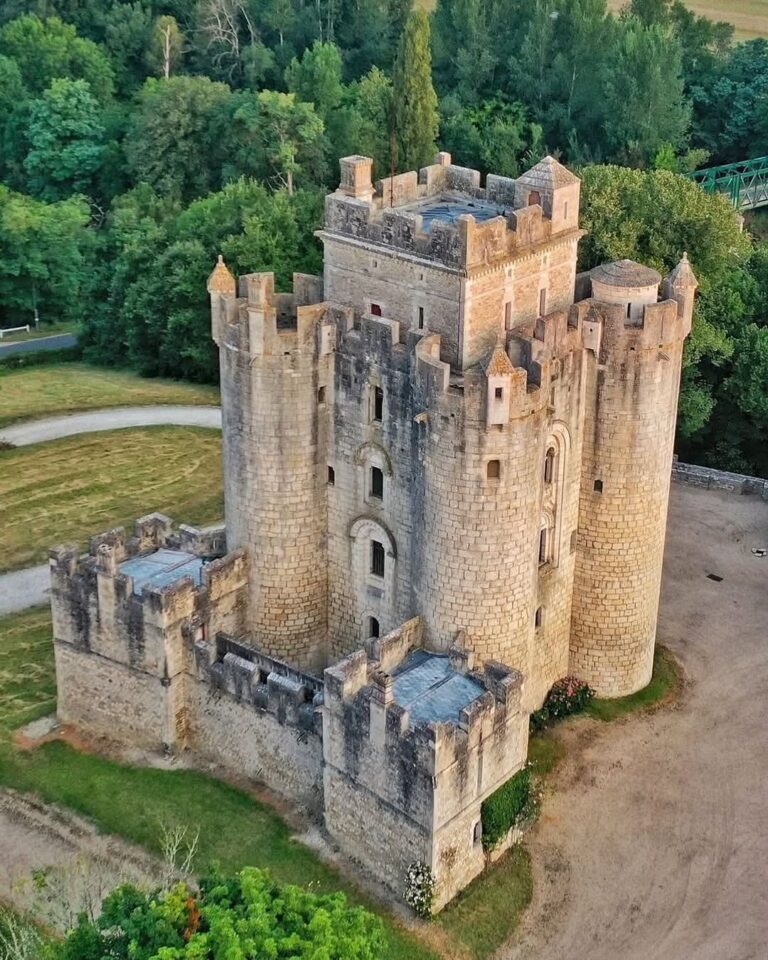
Château du Bouchet occupies the summit of an isolated red-sandstone rocky mound, or “button,” immediately north of the Étang de la Mer Rouge in Douadic. Ditches surround the fortress, whose buildings are arranged around a closed central courtyard. The surviving complex combines 13th- and 14th-century defensive structures with residential additions made in the 17th century.
Medieval fortress
Courtyard entrance and curtain wall
The original fortress had one entrance, approached by a drawbridge used by pedestrians and mounted riders. Traces of the drawbridge survive. The inner courtyard is enclosed by buildings, and protruding stones in its walls were intended to support wooden galleries. Doors that once opened onto these galleries have since been blocked.
Dovecote Tower and Prison Tower
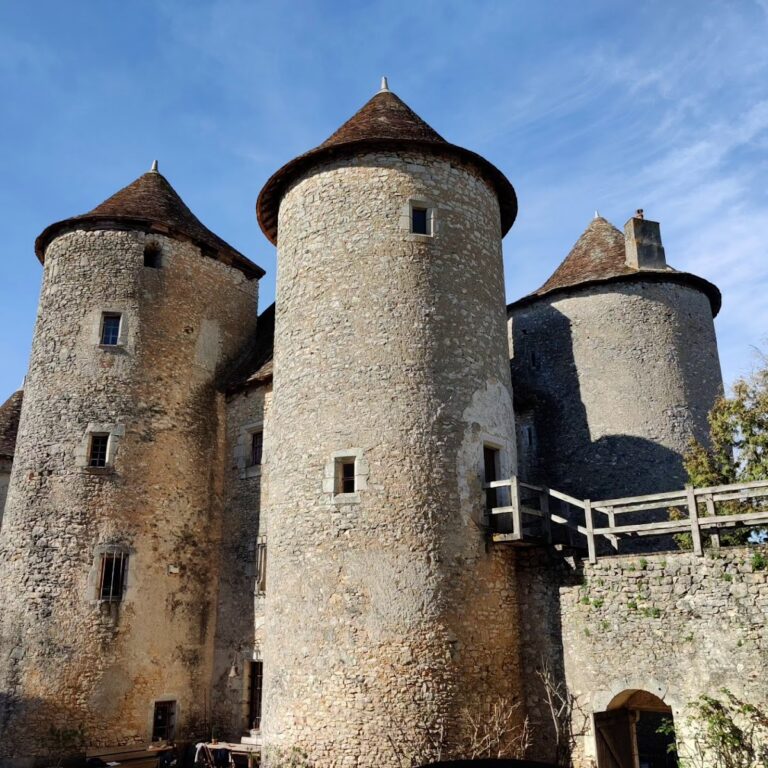
The main building body and the two towers to the right of the courtyard entrance date from the 13th century. Known as the Dovecote Tower and Prison Tower, they remain joined by a curtain wall, the fortified wall connecting two towers. The wall carries a wall-walk, a defended passage where guards could patrol and observe the approaches.
Large keep
The large keep stands to the left of the entrance and was built in the 14th century. It forms part of the defensive group that developed as the castle expanded during the later medieval period.
English Keep
The smaller keep, also called the English Keep, was built by the English during the Hundred Years’ War in the 15th century. Its position near the courtyard records the period when the fortress was involved in the contested control of the region. Traces of the 17th-century demolition remain visible in the courtyard near this keep.
Seventeenth-century residence
Residential wings, gallery, and terrace
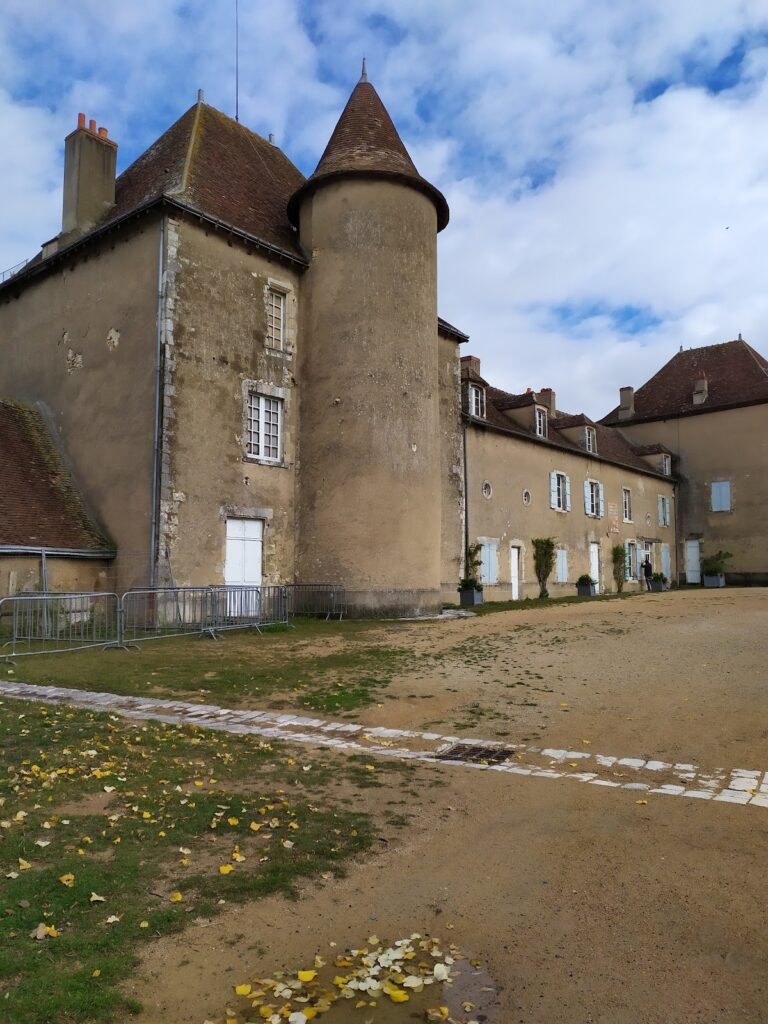
The southwestern part of the medieval fortress was demolished in the 17th century. This change made room for two residential wings designed to provide greater domestic comfort than the earlier fortified arrangement. A gallery and terrace were attached to a medieval wall, and the terrace overlooks the Étang de la Mer Rouge and the Brenne.
Small salon
The small salon contains a fireplace with a medallion above it. Both elements were classified as historical monuments in 1960, preserving this interior feature as part of the later residential character of Château du Bouchet.
Archaeological evidence
Gallo-Roman coin
A Gallo-Roman coin was found near the building during excavations in 1921. It provides archaeological evidence for habitation at or near the site before the medieval castle, while remaining distinct from the masonry and defensive structures of Château du Bouchet itself.