St. Onuphrius Monastery in Jabłeczna: An Orthodox Monastic Center in Poland


Site at a Glance
- Rating
- 4.8
- Popularity
- Low
- Country
- Poland
- Primary era
- Modern
- External website
- Open
- Eras represented
- Early Modern, Modern
- Civilizations
- Polish–Lithuanian Commonwealth, Russian
- Site type
- Religious
- Remains
- Monastery
On this page21 sections
History
St. Onuphrius Monastery in Jabłeczna is an Orthodox male monastery in Poland, situated in the village of Jabłeczna. It was functioning before 1498 and became a durable center of Orthodox religious life through the Union of Brest, the partitions of Poland, the Russian and Polish imperial periods, two world wars, and the postwar transformation of the region. The present Church of St. Onuphrius was built in 1838–1840, while the monastery’s origins are associated with a much earlier tradition concerning a miraculous icon found near the Bug River.
Origins and the sixteenth century
According to the foundation tradition, an icon of St. Onuphrius appeared near the Bug River. Men who stayed to guard it are said to have built a chapel at the site and taken monastic vows. Earlier scholarship placed the foundation in the sixteenth century, while some writers proposed the mid-thirteenth century. The earlier date remains possible, but the surviving evidence does not establish it. Documents from 1522 and 1527 show that the community was already established by that time.
The probable founders were members of the Zabrzeziński family, who owned Jabłeczna, although documents relevant to the foundation disappeared in the eighteenth century. A grant of Jabłeczna to Mikołaj Nassut in 1499 indicates that the monastery functioned within the village while being treated as a separate enclave. In 1527, Hegumen Cyril led at least three monks, and pilgrims from Berestechko attended the monastery’s patronal feast.
During the sixteenth century, Jabłeczna gradually gained authority and remained a regionally important Orthodox center. The owners of the village, including the Zabrzeziński, Nassut, Bohowitynowicz, Bogusz, Proński, Leszczyński, Sapieha, and Kodeński families, supported the monastery with land grants. Its holdings eventually reached about 1,400 hectares of fields, woodland, and meadows on both banks of the Bug River.
Two benefactors were particularly important. Teodora Andriyivna Bohowitynowicz, born Sanguszko, and her daughter, Teodora Bohowitynowicz, later Prońska, protected the community and increased its resources. The younger Teodora continued to support the monks even after her husband converted to Catholicism.
Orthodox resistance after the Union of Brest
The Union of Brest was the 1596 agreement through which part of the Eastern Christian hierarchy in the Polish–Lithuanian Commonwealth entered communion with Rome while retaining Byzantine worship and traditions. The monks of Jabłeczna rejected the union, and the monastery became a center of Orthodox resistance. Monks from communities that accepted the union joined the community, strengthening its role among Orthodox believers.
Paisius Cherkawski, the Orthodox Bishop of Chełm, lived at Jabłeczna and served as its superior until his death in 1633. After several years without a superior, Władysław Leszczyński asked Archimandrite Joseph of the Mielce monastery to provide a leader. Hieromonk Makary Kornilovich arrived by the early 1640s. He introduced moral reforms and undertook a general renovation of the monastery. Metropolitan Dionysius Balaban of Kyiv commended Makary’s work in 1659. Makary, who had become hegumen, died in 1677 with great authority among the monks.
In 1670, Jabłeczna became the last Orthodox pastoral center in the region. After its former parent monastery at Mielce accepted the union, the community, assisted by Andrzej Leszczyński, came under the direct authority of the Orthodox bishops of Lutsk. When the Lutsk diocese later joined the Uniate Church, responsibility for Jabłeczna passed to the Orthodox Metropolis of Kyiv.
A decree issued by King John III Sobieski on 1 March 1681 further restricted the monks’ pastoral work. It prohibited Orthodox clergy from serving villages that contained Uniate churches. In this context, a Uniate parish was an Eastern-rite community united with the Catholic Church, in contrast to Jabłeczna’s Orthodox affiliation. Many of the monastery’s parishioners lived in such villages and resisted conversion.
Pressure, poverty, and rebuilding in the eighteenth century
In 1699, the Jabłeczna estates were purchased by the Catholic nobleman Karol Stanisław Radziwiłł. The Radziwiłł family pressed the monastery to join the Uniate Church and used its patronage rights to force local parish clergy to convert. In 1701, Jabłeczna became a filial community of the Monastery of the Holy Spirit in Vilnius.
Four parish churches were taken from the monastery in 1724. Hieronim Florian Radziwiłł founded a Uniate church in Jabłeczna in 1752, and its parish took much of the monastery’s property while contributing to the conversion of local inhabitants. In 1755, the monastery was attacked and plundered. Documents proving its land ownership were stolen, and Basilian monks from Biała Podlaska were among the attackers.
The community nevertheless remained Orthodox and began receiving regular financial support from the Kyiv Metropolis in 1767. Its finances were extremely poor in 1770, partly because of mismanagement by Hegumen Moses, who fled that year. Bishop Viktor Sadkovsky described the complex as largely ruined in 1785. In 1793, the monks raised money for essential repairs through collections at other monasteries.
Nineteenth-century reconstruction and institutional growth
After the Third Partition of Poland, Jabłeczna came under the Bukovinian Metropolis, while remaining in practice under the spiritual care of the bishops of Minsk. Following the creation of Congress Poland, it was incorporated into the Diocese of Minsk, although the date of the transfer is disputed between 1815 and 1825. From 1840, it belonged to the independent Warsaw and Novohrad-Volynsky Eparchy. An eparchy is an Orthodox ecclesiastical territory broadly comparable to a diocese.
In 1816, only three monks lived at the monastery, supporting themselves mainly through agriculture. During the 1820s and 1830s, the community faced serious financial difficulties, disputes over leases dating from 1787, and litigation concerning land claimed by Count Michał Grabowski. The monastery also housed retired Orthodox clergy. Government assistance included 2,000 złotys in 1828, a partial tax exemption in 1832, and a grant of 300 rubles in 1833.
Because the complex was in poor condition, major construction began in 1838. The work included a new residence for the monks, the present Church of St. Onuphrius, a bell tower, and an enclosing wall. The project has been attributed either to Bishop Antoni of Warsaw or to Bishop Innocenty of Volhynia, whose earlier efforts Bishop Antoni completed. The church cornerstone was laid on 19 May 1838, and the completed building was consecrated on 6 December 1840.
Under Archimandrite Joannicius Mosakowski, who was superior from 1832 to 1854, the monastery opened a two-class school in 1838 for pupils of all denominations and reorganized its agricultural estate. A school of icon painting was established in 1862 under Hieromonk Palladius, although its duration is uncertain and it was no longer mentioned after 1868.
In 1859, the monastery was classified as a second-class monastery and received a larger government subsidy, with an official obligation to maintain sixteen monks. In practice, six monks and seven novices lived there in 1861. By 1863, improved subsidies had enabled the community to accumulate 5,050 rubles in bank savings. During the January Uprising, a Polish insurgent unit entered the monastery in search of money, interrupted an evening service, and damaged part of the furnishings in the Church of St. Onuphrius. The local Catholic priest intervened and prevented more serious damage.
Late imperial expansion
In 1875, the Russian authorities abolished the last Uniate diocese in the Russian Empire. They then directed Jabłeczna to promote Orthodoxy and Russification in Chełm Land. The monks expanded their social, missionary, and educational work among Catholics and former Uniates. Their limited education, small numbers, and predominantly non-Russian backgrounds, however, prevented them from fully achieving the aims set by the authorities.
The complex was enlarged and renovated between 1876 and 1880. In 1881, Archbishop Leontius of Warsaw asked that Jabłeczna be recognized as a first-class monastery because of its historical and contemporary importance. The request was approved in January 1882.
The monastery’s charitable role expanded under Archimandrite German Ivanov, who became superior in 1897. He opened an orphanage, a soup kitchen, and an outpatient clinic, improved the finances of the estate, and helped increase the community to thirty-nine monks and novices in 1899. Jabłeczna consequently became an important pilgrimage center. German died in 1903, and his elderly successor, Archimandrite Arkadiusz Wielmożyn, did not continue the work on the same scale.
From 1905, the monastery belonged to the Diocese of Chełm. The tolerance decree of that year led approximately 180,000 to 200,000 former Uniates to leave Orthodoxy for Roman Catholicism. The tsarist authorities consequently assigned Jabłeczna a greater role in promoting Orthodoxy and Russian identity. Closure was considered in 1906, but the governing synod retained the monastery and appointed Archimandrite Joseph Petrovykh to reorganize it.
Joseph reorganized the monastery school and revived the agricultural estate. About 100 people studied there in 1908. After Joseph’s delegation to Novgorod in 1907, the community elected Archimandrite Serafin Ostroumov as superior, and the synod confirmed the election in January 1908. The monastery had sixteen monks and nineteen novices in 1907, eighty monks and novices in 1913, and sixty-eight in 1914.
Its social institutions also expanded. A branch called the Skete of Saints Sergius and Herman of Valaam was established on an island in Lake Białe in 1909, and the monastery assumed responsibility for St. Nicholas Church in Dratów from 1912. In 1914, 431 people attended its schools. The pharmacy provided free medicines to 1,760 people in 1912, while the monastery distributed 4,500 free meals in 1913. This late imperial period is regarded as the community’s “golden age.”
War, exile, and interwar survival
A fire on 22 December 1914 destroyed the building that contained the pharmacy and outpatient clinic. On 1 August 1915, most of the monks went into exile and took the icon of St. Onuphrius to Moscow, where they settled at the Epiphany Monastery. German troops occupied the monastery buildings for military purposes, and Hieromonk Hiob Dyczko, who had remained behind, was arrested.
The monks returned in 1918 or 1919 to a devastated complex requiring reconstruction. In September 1919, the Church of St. Onuphrius was closed, and the parish church in Jabłeczna was transferred to the Catholic Church. Local and regional authorities promoted liquidation of the monastery, while most of its land was taken by the Catholic parish in Sławatycze.
After Orthodox representatives intervened with the Ministry of Religious Affairs and Public Education, the monks recovered the Church of St. Onuphrius and the church in Dratów in 1920. In 1922, Polish authorities expelled the superior, Bishop Sergius Korolov of Bielsko, because he opposed the autocephaly of the Orthodox Church in Poland after 1918.
In 1924, the number of monks permitted to live at Jabłeczna was reduced to four, and the confiscation of land taken by local Catholics was formalized. Proposals to close the monastery and install a military unit in its buildings continued throughout the interwar period. The state eventually stopped supporting Catholic claims after receiving documents indicating that the monastery had never belonged to the Catholic Church, although permission to operate a parish was not granted.
From 1924 to 1927, the monastery housed an Orthodox children’s shelter transferred from Otwock. Financial difficulties forced the monks to sell the Skete of Saints Sergius and Herman of Valaam to the Orthodox parish in Omielce in 1925. Renovation without state assistance affected several monastery buildings during the 1930s.
From 1929, the monks operated a home for retired Orthodox clergy. They organized two-year courses for psalmists from 1934, courses for deacons from 1936, and a religious-teacher training institute shortly before World War II. In the late 1930s, the community planned to make education and charitable work the main focus of its social activity. The monastery had nine monks in 1929 and fifteen in 1935, most of them Ukrainians or Belarusians. Its finances remained difficult, relying on leases, agriculture, donations, candle sales, and the monastery shop, although assistance from the central authorities of the Polish Orthodox Church helped produce a favorable balance in the 1930s.
Destruction during World War II
After the German invasion of Poland in 1939, Jabłeczna lay within the General Government, the German occupation administration established in parts of occupied Poland. Because the Bug River formed the border with the Soviet Union until 1941, a German military guard post was installed on the monastery grounds.
During the night of 9–10 August 1942, German forces burned the principal monastery buildings. Church furnishings, the library, and the archive were destroyed, and Monk Ignatius Bazyluk was murdered. A Polish underground unit attacked the monastery in 1945, adding to the disruption of the wartime years.
Postwar continuity and revival
After Ukrainian inhabitants were deported to the Soviet Union and the 1947 Operation Vistula forcibly relocated Ukrainian civilians within postwar Poland, the Orthodox Ukrainian population of Chełm Land fell almost to zero. Most Orthodox parishes in the region were closed. Bishop Timothy Szretter requested that Jabłeczna remain open, and the request was granted.
Five monks had returned by that time. Father Włodzimierz Wieżański arrived from Warsaw on 10 August 1946 and appealed for local help with reconstruction and maintenance. In 1950, the monastery lost its remaining land and inventory to the Koroszczyn State Agricultural Farm, destroying its economic basis. By 1951, it retained only an orchard, a garden, and a very small area of arable land.
Provisional postwar repairs were completed by the late 1950s under Archimandrite Eulogius Horbowiec. In 1953, the icons of St. Onuphrius and the Jabłeczna Icon of the Mother of God, both removed in 1915, were returned. The community remained small and elderly. In 1957, it lacked enough monks to perform the full daily cycle of services, while in 1962 three monks and three novices lived there. Despite these difficulties, Jabłeczna retained prestige among Orthodox believers in Poland and continued to function throughout the Polish People’s Republic as the Polish Orthodox Church’s only male monastery.
Archimandrite Sawa Hrycuniak became superior on 8 February 1970. He completed renovation work, brought the higher classes of the Orthodox Theological Seminary in Warsaw to Jabłeczna, and oversaw an institutional revival. The seminary operated at the monastery from 1974 to 1992, and a new wing was added to the complex in the 1980s. The community nevertheless reached a low point between 1984 and 1987, when only one monk lived there.
The Diocese of Lublin and Chełm was created in 1989, and Jabłeczna served as its headquarters for two years. In 1990, the icons of St. Onuphrius and the Jabłeczna Icon of the Mother of God were stolen. They were recovered in August 1994 after a ransom of 10,000 dollars was paid and were returned to the monastery church on 4–5 September. A local feast commemorating their recovery was established, and a diocesan museum was founded at Jabłeczna in 1994.
The community numbered fifteen monks in 1995. Since 1999, the monastery has been a stauropegion, an Orthodox monastery placed directly under a senior hierarch rather than under the ordinary administration of a local bishop. At Jabłeczna, that hierarch is the Metropolitan of Warsaw and All Poland, who appoints a representative to administer the monastery. Archimandrite Peter Dawidziuk has held that role since 15 October 2019.
The domestic Church of St. John the Theologian underwent major renovation in 2016 and was consecrated by Metropolitan Sawa on 18 September. Six monks lived at the monastery in 2022. Its stated purposes are prayer and work, meditation, and the maintenance and strengthening of the Orthodox faith in Podlasie. The complex was entered in the heritage register under number A/14 on 12 March 1966, with further entries dated 18 August 1972 and 19 April 1985. It was designated a historic monument on 2 February 2023.
Remains
The surviving monastery combines a nineteenth-century brick complex with older architectural traditions, later buildings, and two wooden chapels outside the enclosing wall. Its principal focus is the Church of St. Onuphrius, built between 1838 and 1840, while the domestic church, refectory, bell tower, residences, and agricultural buildings preserve the arrangement of a working monastic community.
The main monastery complex
Church of St. Onuphrius
The main church is arranged as a Greek cross, with a porch, nave, and chancel forming three principal sections. A single dome rises above four supporting piers. The interior contains frescoes and a three-tier iconostasis, the screen separating the sanctuary from the nave, made by Vasiliy Lojka and Feliks Skulimowski. The tomb of Archimandrite Narcissus Silwiestrow stands beside the entrance on the left. A bell tower adjoins the church, and a two-ton bell cast in Moscow was installed in the main church.
Domestic church and refectory
The domestic Church of St. John the Theologian occupies one of the monastery’s brick buildings and serves as the principal winter church. Its single-tier iconostasis dates from the early twentieth century. In 2016, Natalia Oniśko of Białystok completed its multicolored painted decoration.
The renovated refectory contains the Chapel of St. Athanasius of Brest. The complex also includes the superior’s house, a brick residential building, and buildings associated with the monastery’s former agricultural and charitable work. These include a pilgrim house, a granary, a pigsty, three cowsheds, a house in the orchard, and a derelict residential building.
Earlier buildings and material evidence
In the seventeenth century, the monastery included the Church of St. Onuphrius with the Chapel of the Meeting of the Lord, a refectory containing the Church of the Dormition of the Mother of God, a bell tower built in 1651, the superior’s house, monks’ cells, and farm buildings. Renovation under Makary was completed around 1659.
A 1775 description lists a wooden, triple-domed church measuring 21 metres in length, 16 metres in width, and 31.5 metres in height. Separate structures included a bell tower, a refectory with a church, a bakery, a kitchen, the superior’s house to the northeast, two cell buildings to the south with seven cells, and another cell in the bell tower. The complex also had a granary, two food stores, two stables, and a bathhouse. Its inventory included twenty-five sets of priestly vestments, six Gospel Books, sixteen candlesticks, two chandeliers, a library, and five bells. The buildings were in poor condition, and by 1785 the monastery was described as largely ruined.
The late 1930s library contained 1,319 volumes, including 1,000 religious works and 319 secular works. The library and archive were destroyed in the 1942 wartime fire, along with church furnishings and the principal monastery buildings.
Chapels outside the wall
Chapel of the Dormition
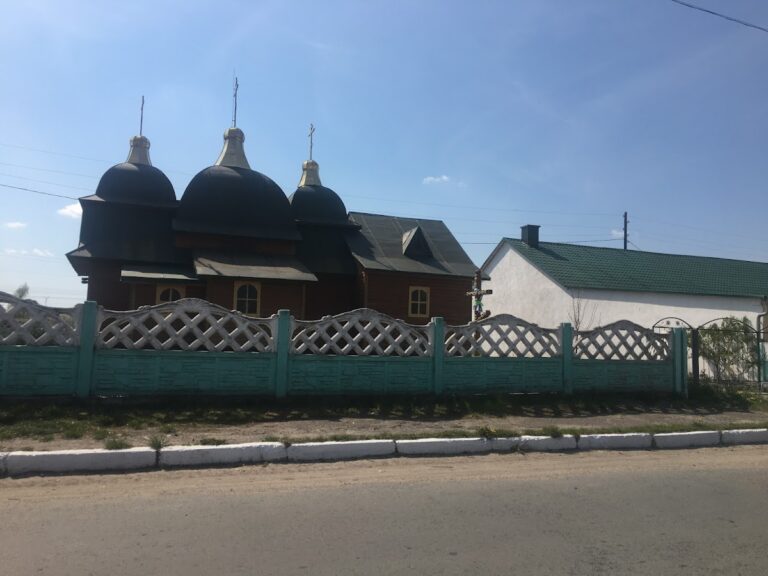
The wooden Chapel of the Dormition of the Most Holy Mother of God stands outside the monastery wall. Built in the early twentieth century, it has a rectangular plan and five onion domes, all covered with sheet metal. It contains a single-tier iconostasis made in Moscow and twelve icons.
Chapel of the Holy Spirit
The wooden Chapel of the Holy Spirit is also an early twentieth-century structure outside the wall. Its plan is cross-shaped, and it has one sheet-metal-covered onion dome. Each of the two chapels contains only a sanctuary beneath its roof, so worshippers gather outside facing the building during services.
Icons and devotional objects
Icon of St. Onuphrius
The icon of St. Onuphrius in the main church iconostasis is dated by art historians to the twelfth or thirteenth century. It is painted on a cypress panel prepared with a chalk ground and measures 112 by 75 centimetres. The standing saint wears only a loincloth and has a grey beard reaching below his knees. A landscape of the Bug River appears behind him.
Jabłeczna Icon of the Mother of God
The Jabłeczna Icon of the Mother of God is likewise dated to the twelfth or thirteenth century. Mary holds the Child Jesus in her left hand and points toward him with her right. The archangels Gabriel and Michael stand beside them, while Old Testament prophets form the frame. The icon is also known as the Fulfillment of Prophetic Predictions.
Turkowice icon
A copy of the miraculous Turkowice Icon of the Mother of God was kept at Jabłeczna from 1990 until 2010. It was then transferred to the female monastery in Turkowice.
Nearby sites