Burg Gieboldehausen: A Medieval Water Castle in Germany


Site at a Glance
- Rating
- 4.3
- Popularity
- Low
- Country
- Germany
- Primary era
- Medieval
- External website
- Open
- Eras represented
- Medieval
- Civilizations
- Holy Roman Empire
- Site type
- Civic
On this page13 sections
History
Burg Gieboldehausen was a medieval lowland water castle in Germany, built in the thirteenth century in the Rhume floodplain at the northern edge of the historic village center. Its builders may have been the dukes of Brunswick or the bishops of Hildesheim. The castle later became an administrative seat for the surrounding judicial and governmental district, linking military authority with the administration of villages in the region.
Early medieval setting
During the Early and High Middle Ages, the surrounding region formed part of the Saxon Liesgau, an early medieval territory in Saxony. A lordly estate probably existed at Gieboldehausen during this period, although its exact position is unknown. It may have stood near the slightly higher ground occupied by the church. A separate refuge fortress lay on the Vogelsburg elevation south of the village, an area still associated with the name “on the castle.”
King Henry II stayed at Gieboldehausen in 1003, an event regarded as the settlement’s first written mention. Henry II became Holy Roman Emperor in 1014. Gieboldehausen may then have been a royal estate that passed in 919 to an ecclesiastical institution, probably Gandersheim Abbey rather than Quedlinburg Abbey. A tradition about a castle belonging to Count Biso says that he transferred it to Gandersheim Abbey and reused its stones for the village’s first church. This tradition rests on a reference in a 1256 duplicate charter rather than direct contemporary evidence.
Foundation and medieval administration
The castle was probably constructed in the thirteenth century. Its first appearance in the surviving historical record came in 1291, when it was captured and destroyed during the Herlingsberg War. This conflict was a feud between Siegfried II, bishop of Hildesheim, and the dukes of Brunswick and Lüneburg.
By 1315 at the latest, Burg Gieboldehausen served as the seat of officials responsible for the local judicial district. This district later developed into the Gieboldehausen administrative district and included the regional court at Bernshausen. The castle initially accommodated officials of Brunswick and later those of Electoral Mainz, the territorial possessions governed by the archbishops of Mainz, who also held electoral status in the Holy Roman Empire.
The castle and its district passed progressively to the archbishops of Mainz from 1342. In 1377, Archbishop Adolf of Mainz pledged the castle to Burchard von Medem and required him to spend 400 marks on construction. The administrative seat may have shifted to the present site at this time because the pledge-holder was permitted to choose the building location. In 1403, Brunswick troops besieged the castle and village and partly destroyed them. The castle returned to Electoral Mainz in the peace settlement of 1405, and a document from 1418 stated that Adolf of Nassau, the elector’s brother, was to restore it.
Castle officials and fiefs
The administration of Burg Gieboldehausen involved successive bailiffs, officials, and castle men. A bailiff exercised delegated judicial and governmental authority, while a castle man was a noble or military retainer responsible for defending a castle or holding a fortified residence and its associated fief. The distinction between these roles is not always certain in the surviving record.
Brunswick officials included von Medenheim and Burghard von Wildenstein in 1315 and 1316. Other named holders in the fourteenth century included Otto von Rusteberg, Hartmann von Seulingen, Count Otto von Lauterberg, a knight of Kerstlingerode, Bertold von Worbis, Johann von Wintzingerode, Eckbrecht von Desingerode, Tile von Bodungen, members of the families von Gladebach, von Bültzingslöwen, von Hagen, and others. Adolf von Nassau was connected with the planned restoration in 1418. Later holders included Hans von Grona, Diele von Germershausen, Heinrich von Minnigerode, the towns of Duderstadt and Heiligenstadt, Dietrich and Henrich von Uslar, Henrich and Kraft von Bodenhausen, Johannes von Minnigerode the Elder, and Henning Brottengeier.
During the sixteenth and seventeenth centuries, the officials included Hans von Minnigerode the Younger, Christoph Polle, Johann Joachim Selge, Burchard von Bodungen, Gobelinus Klein, Kilian Drippel, Georg Germer, Johann Jagemann, Georg Polmann, Johann Jodocus Helmsdorf, and Heinrich Wedekind. Later administrators were Diedrich von Kaiserberg, Philipp Valentin Spönla, Anselm David Valentin Spönla, Georg Philipp Teitzel, and Daniel Klinckhardt, who held office from 1774 to 1802. The long sequence of officeholders reflects the castle’s continuing administrative function.
Rebuilding and destruction
An inventory from 1485 lists weapons, household equipment, livestock, a mill, and a brewery associated with the castle. Residential buildings were added in 1563 and 1588. The administrative building known as Haus auf dem Wall functioned briefly as an Electoral Mainz office between 1521 and 1530. At the beginning of the sixteenth century, Hans von Minnigerode converted Haus auf dem Wall into the present palace.
Brunswick troops destroyed Burg Gieboldehausen in 1622 during the Thirty Years’ War, the major European conflict of 1618 to 1648. The castle was rebuilt after 1673 and again served as the administrative seat. Its remaining buildings were completely demolished in 1806.
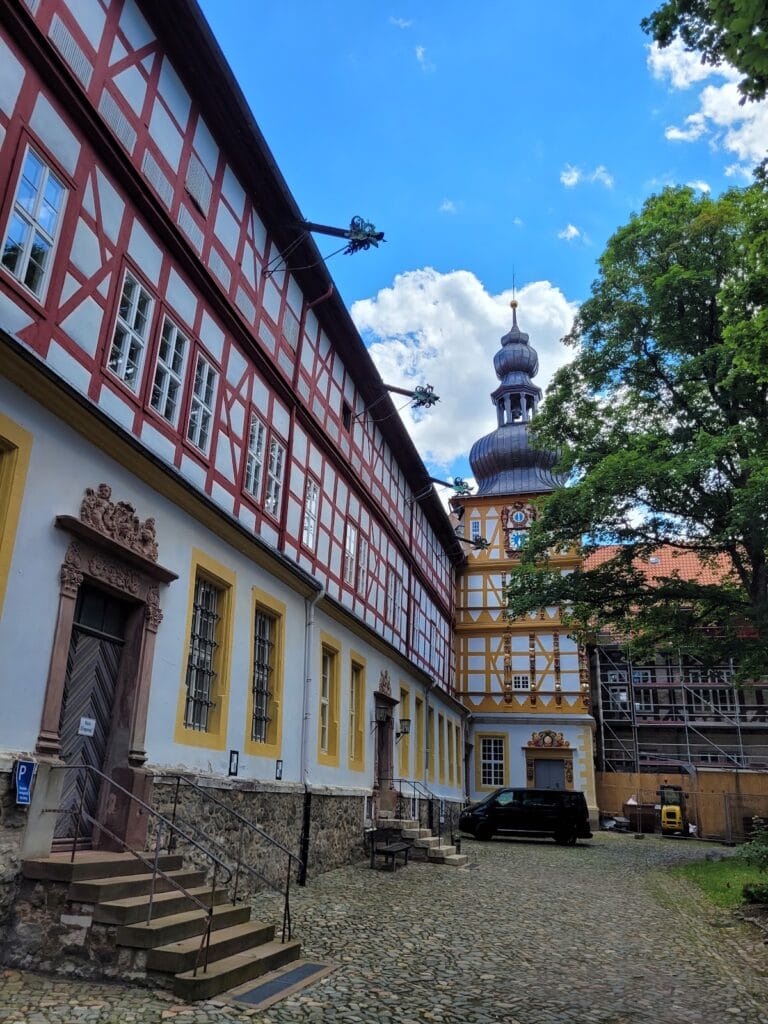
A fire in 1850 destroyed the administrative building, its service buildings, and the registry containing the district’s files. A new Hanoverian administrative building was erected on the former castle grounds in 1854. It later served as a Prussian local court. The building is therefore a nineteenth-century successor on the castle site rather than part of the medieval castle.
Remains
Burg Gieboldehausen occupied a circular site about 70 metres in diameter in the Rhume floodplain, at approximately 150 metres above sea level. The flat, wet setting made it a lowland water castle, a fortified site that used surrounding or nearby water as part of its defenses. The filled water moat and the readable circular outline of the former castle area preserve the basic shape of the medieval foundation in the village landscape.
Castle site and water defenses
Moat and circular enclosure
The archaeological remains include the filled moat and pottery sherds dating from the thirteenth century onward. The moat belonged to a wider defensive system connected with the village. The Hahle and Rhume rivers supplied water for the ditch, while an embankment topped by a hedge or boundary thicket helped define the defended area. The grounds did not undergo extensive later construction, allowing the circular castle area to remain clearly legible.
Administrative successor
The present building on the former castle grounds is the Hanoverian administrative building erected in 1854. This nineteenth-century Amtshaus, or administrative house, later became a Prussian local court. It represents the later governmental use of the site and is physically distinct from the medieval castle.
Village defenses and associated residences
Village gates and defensive boundary
The castle and administrative district formed part of a broader village defense system. A ditch and embankment, reinforced by a hedge or boundary thicket, worked with the Hahle and Rhume rivers. Fortified gate installations stood on roads entering the village, including the Obertor. The nearby ford across the Rhume was also close to several trade and travel routes that converged in the area.
Castle-men’s residences
Up to eight castle-men’s residences are associated with Gieboldehausen. These were not necessarily all inside the circular castle enclosure. Some were independent fortified farms or houses arranged around the village, contributing with the village defenses to a wider defensive system. Families associated with such residences in the thirteenth and fourteenth centuries included Kerstlingerode, Seulingen, Bültzingslöwen, Desingerode, Hagen, and Gieboldehausen.
The residences and the administrative seat held lands granted as fiefs. The Bodensee family’s castle fief, the Eulenburg, passed to the von Kerstlingerode family after the Bodensee line died out in the early seventeenth century. Haus auf dem Wall is the other named residence associated with the castle. Its conversion into a palace by Hans von Minnigerode preserved a later noble residence within the historical network surrounding Burg Gieboldehausen.
Mill and brewery
The castle’s associated working facilities included a mill and a brewery. Together with the recorded livestock, weapons, and household equipment, these remains of the castle estate indicate the range of material resources connected with its administrative and residential functions.