Alte Burg: A Medieval Hilltop Castle in Germany


Site at a Glance
- Rating
- 3.7
- Popularity
- Very Low
- Country
- Germany
- Primary era
- Medieval
- External website
- Open
- Eras represented
- Medieval
- Civilizations
- Holy Roman Empire
- Site type
- Military
- Remains
- Castle
On this page8 sections
History
Alte Burg is a ruined medieval hilltop castle in Germany, located in Osterode am Harz and probably built by the Counts of Katlenburg at the beginning of the twelfth century. The castle was first explicitly recorded in 1153, while an Osterode ministerial family associated with it appears in records as early as 1143. Ministerials were members of the medieval German service nobility who held administrative, military, and household offices for rulers and territorial lords.
Katlenburg and Welf ownership
After the Counts of Katlenburg died out in 1106, the castle passed to Lothar of Supplinburg, a German king and emperor of the early twelfth century. It was apparently occupied by Hermann II of Winzenburg, a nobleman of the same period. After Hermann was murdered in 1152, the inheritance was assigned to Henry the Lion, the powerful Welf duke of Saxony and Bavaria, who became both the legal and actual owner. The castle then passed to his son Otto IV, who later became Holy Roman Emperor, and subsequently to Otto the Child, the first Duke of Brunswick-Lüneburg. Later owners included Albert the Tall and Henry the Admirable. In 1291, ownership passed to the Dukes of Brunswick-Grubenhagen.
Mint and ducal residence
A mint operated at Alte Burg during the thirteenth century. In 1322, the castle served as the dowager residence of Duchess Agnes, the wife of Duke Henry the Wondrous. A dowager residence was assigned to a widowed noblewoman and provided income and status after her husband’s death. Excavations at the castle uncovered a seal belonging to Agnes. From 1487, the castle served the same role for Duchess Elisabeth, wife of Albert II of Brunswick-Grubenhagen.
Alte Burg had been abandoned by 1512 and was no longer included among the ducal castles in 1551. Elisabeth, identified as its last resident, died in 1513, after which the castle fell into ruin. Much of the ruined complex was later quarried for building stone. The Easter Morning Maiden legend is associated with the castle’s destruction, while Heinrich Heine visited the ruin during his Harz journey in September 1824 and described the remains of half of a large, thick-walled tower.
Ruin and preservation
The remaining tower ruin was extensively secured and renovated between 1995 and 1997. Alte Burg is a protected historic monument and a landmark of Osterode am Harz.
Remains
Alte Burg occupies a hilltop spur on the southwest slope of the Butterberg, between the Söse to the south and a tributary of the Lerbach to the northwest. The castle site measures approximately 40 by 60 metres and lies at about 250 to 255 metres above sea level. Its surviving remains stand within a cemetery, while the Alte Harz Road once ran through the Lerbach valley below the castle.
Main tower
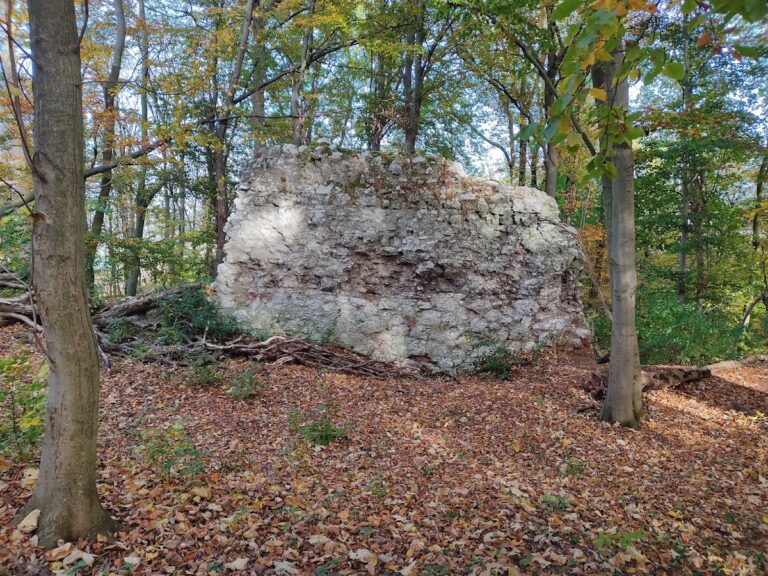
The principal surviving structure is the eastern half of the bergfried, the main fortified tower of a medieval German castle, used for defense, refuge, and the display of lordly authority. The original tower was round, about 33 metres high and 15 metres in external diameter. Its walls reached 3.5 metres in thickness, and the six-storey structure contained a spiral staircase within the wall. The eastern half survives to a height of 34.5 metres and is considered one of the largest surviving bergfried remains in Germany. The western half had already been dismantled by 1654, probably for building stone.
Castle defenses and outer areas
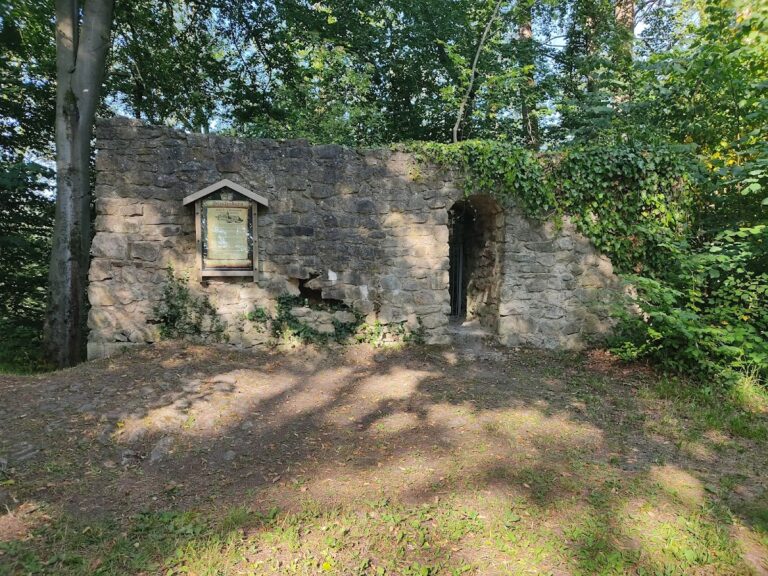
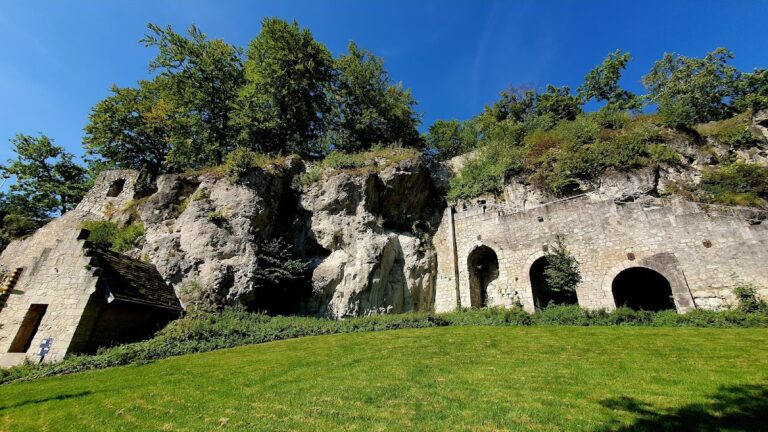
A neck ditch once protected the castle across the spur and is now filled. A small terrace to the west marks the outer bailey, the castle’s fortified external enclosure. Above the ditch on the eastern side, a short section of the core castle’s enclosing wall survives.
Residential building
At the southwest corner of the castle site, wall arches and pillars probably indicate the position of the palas, the principal residential and representative building of a medieval castle.
Nearby sites