Dendera Temple Complex: A Multiperiod Religious Center in Egypt
Site at a Glance
- Rating
- 4.8
- Popularity
- Medium
- Country
- Egypt
- Primary era
- Classical
- External website
- Open
- Eras represented
- Classical
- Civilizations
- Egyptian, Ptolemaic, Roman
- Site type
- Religious
- Remains
- Temple
On this page15 sections
History
The Dendera Temple Complex is an ancient Egyptian religious site in Egypt, developed over many periods and dominated by the Temple of Hathor, whose present building began in 54 BC during the late Ptolemaic period. The complex lies about 2.5 kilometres southeast of Dendera, in the area associated in antiquity with the sixth nome of Upper Egypt, an administrative district south of Abydos. Its long development reflects the continuation of Egyptian religious traditions through Ptolemaic rule and Roman provincial government.
Early foundations and Ptolemaic construction
Dendera was occupied and developed from the Middle Kingdom onward. It is distinct from the Dendera Necropolis, where tombs date from the Early Dynastic Period, the formative era of unified Egyptian kingship, through the First Intermediate Period, a time of political fragmentation before the Middle Kingdom. Evidence indicates that an earlier building stood at the temple site around 2250 BC. Construction may have begun under Pepi I, a king of Egypt’s Sixth Dynasty, and been completed under his son, Merenre Nemtyemsaf I. A temple also existed here during the Eighteenth Dynasty, part of the New Kingdom, around 1500 BC.
The earliest surviving building in the complex is the mammisi, or birth house associated with the divine birth of a god, raised by Nectanebo II. He ruled from 360 to 343 BC as the last ruler of Egypt’s Thirtieth Dynasty and the last native pharaoh before Macedonian and Ptolemaic rule. The original Temple of Hathor continued to be modified from the Middle Kingdom until the beginning of the reign of the Roman emperor Trajan. The existing temple was begun under Ptolemy Auletes, also known as Ptolemy XII, the father of Cleopatra VII.
Roman rule and Egyptian religious tradition
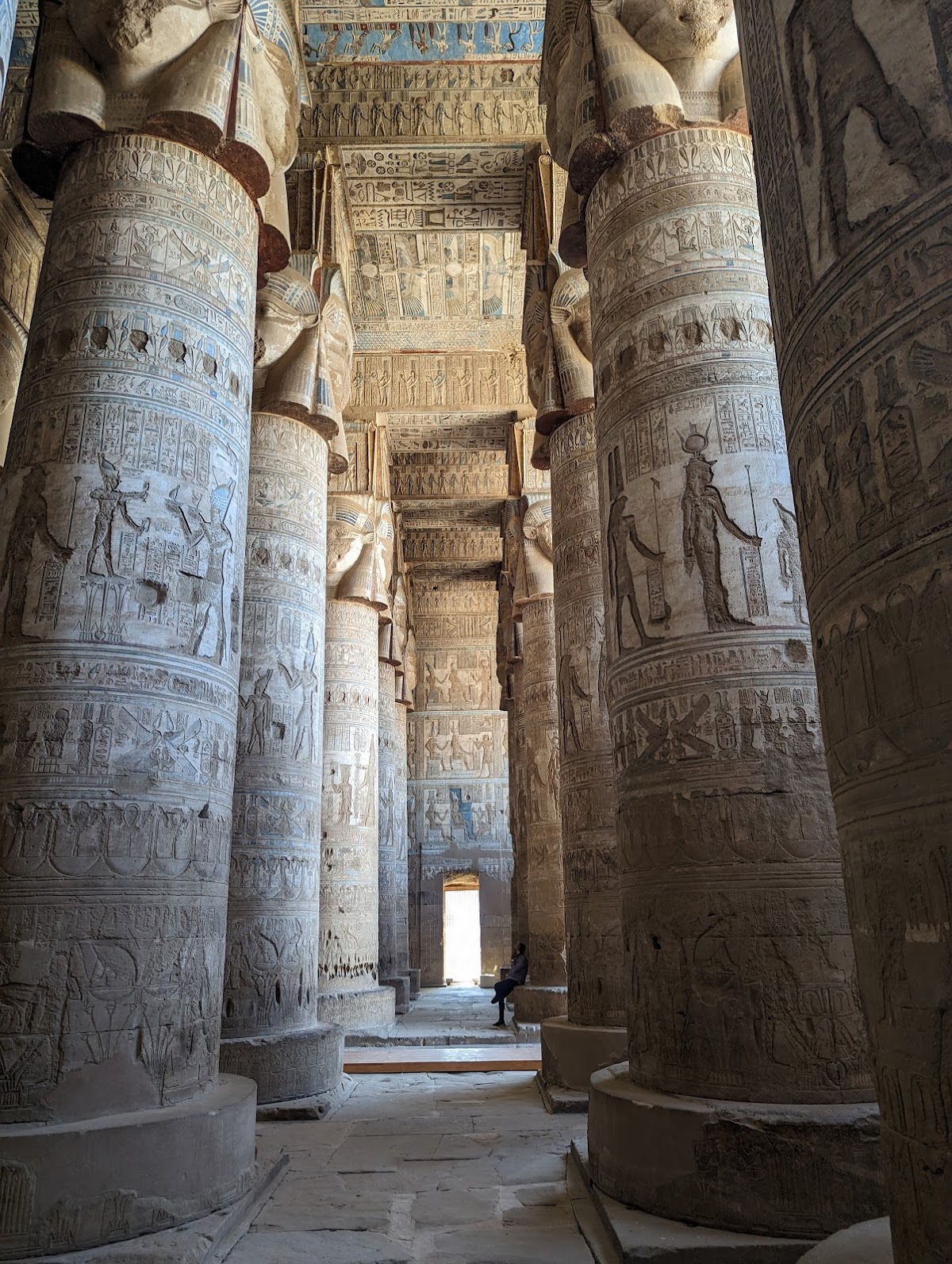
The Temple of Hathor continued to grow after the Ptolemaic period. Its hypostyle hall, a large roofed space supported by many columns, was built under the Roman emperor Tiberius. The propylaeum, or monumental entrance structure, carries images of Trajan and Domitian presenting offerings. These rulers were Roman emperors, yet Egyptian temples commonly represented Roman sovereigns through pharaonic imagery. The Roman mammisi, built during the reigns of Trajan and Marcus Aurelius, contains many scenes of Trajan offering gifts to Egyptian deities and presenting himself in the role of an Egyptian pharaoh.
Reliefs at Dendera also connect the temple with the final generations of Ptolemaic rule. The rear exterior wall shows Cleopatra VII Philopator, the last active ruler of the Ptolemaic Kingdom, with her son Ptolemy XV Philopator Philometor Caesar, known as Caesarion and fathered by Julius Caesar. Ten dead deities appear in or on the Temple of Hathor. Their presence has been linked with the nine dead deities represented at the Temple of Horus in Edfu, a possible reflection of the traditional relationship between Hathor and Horus, a major Egyptian god associated with kingship.
Rediscovery, restoration, and continuing excavation
The Dendera zodiac, a sculpted relief from the late Greco-Roman temple, was removed from the ceiling in 1820 by Frenchmen and later replaced by a copy. It remains uncertain whether the removal was authorized by Muhammad Ali Pasha, the ruler of Egypt at the time. Another tradition places the removal in 1822 and attributes it to an antiquities thief using the name Claude Le Lorraine, who allegedly sold the relief to the King of France. Jean-François Champollion, the French scholar who deciphered Egyptian hieroglyphs through the Rosetta Stone, dated the zodiac to the Ptolemaic period. Egyptologists now place it in the first century BC. The original is held in the Louvre, while a copy occupies its former position.
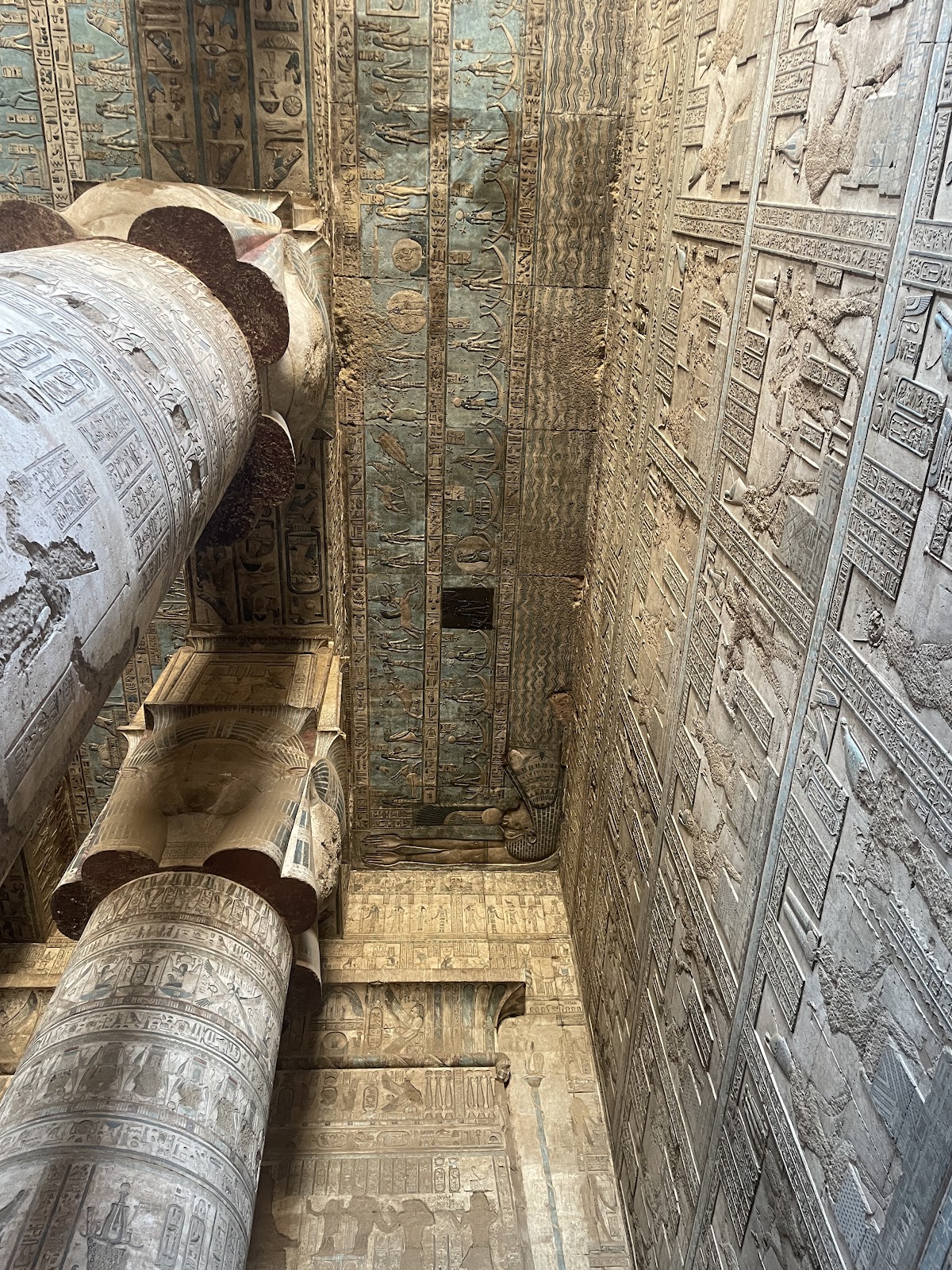
The Supreme Council of Antiquities began restoration and maintenance work at the complex in 2005. Work stopped in 2011 and resumed in 2017 after scientific, archaeological, and experimental studies. By March 2021, the second restoration phase had cleaned the Great Pillars Hall and recovered the original colours and clarity of painted scenes on its walls and ceilings. A cooperative project begun in 2019 with a French archaeological delegation also sought to convert the temple courtyard into an open museum. In March 2023, excavation uncovered a limestone sphinx thought to have been made in the image of the Roman emperor Claudius.
Remains
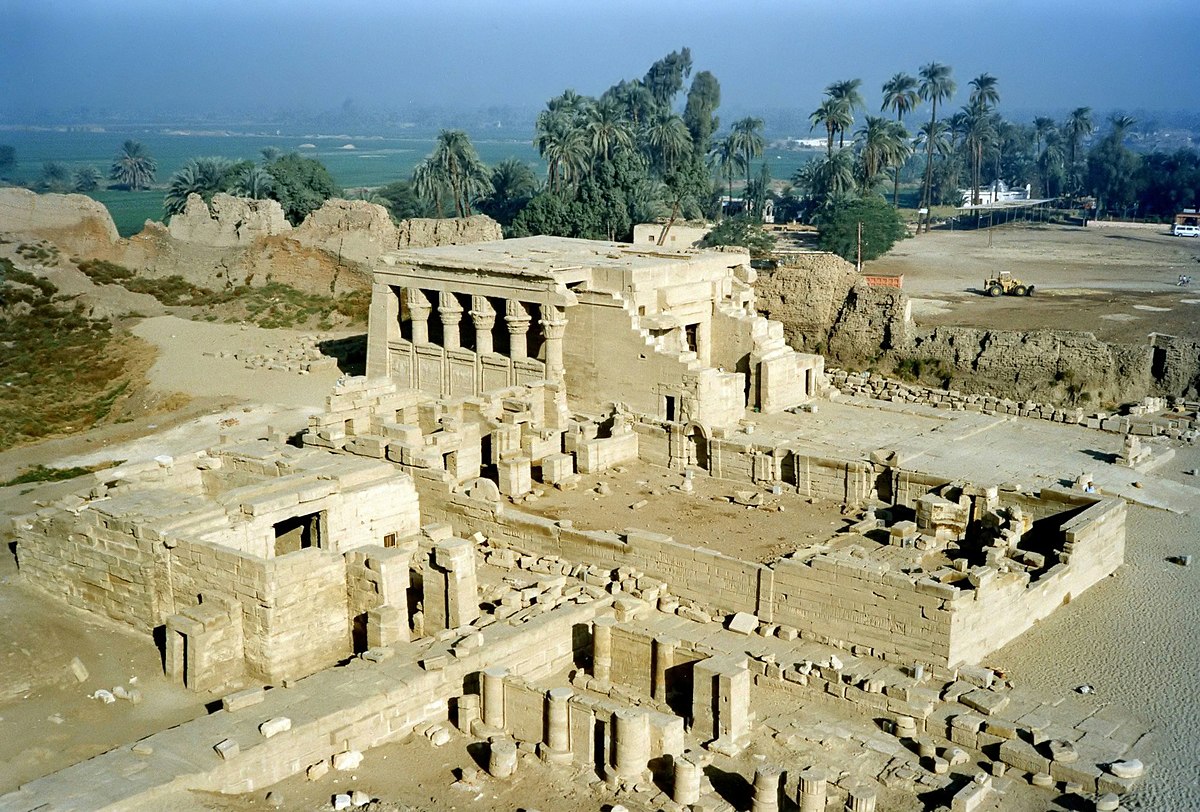
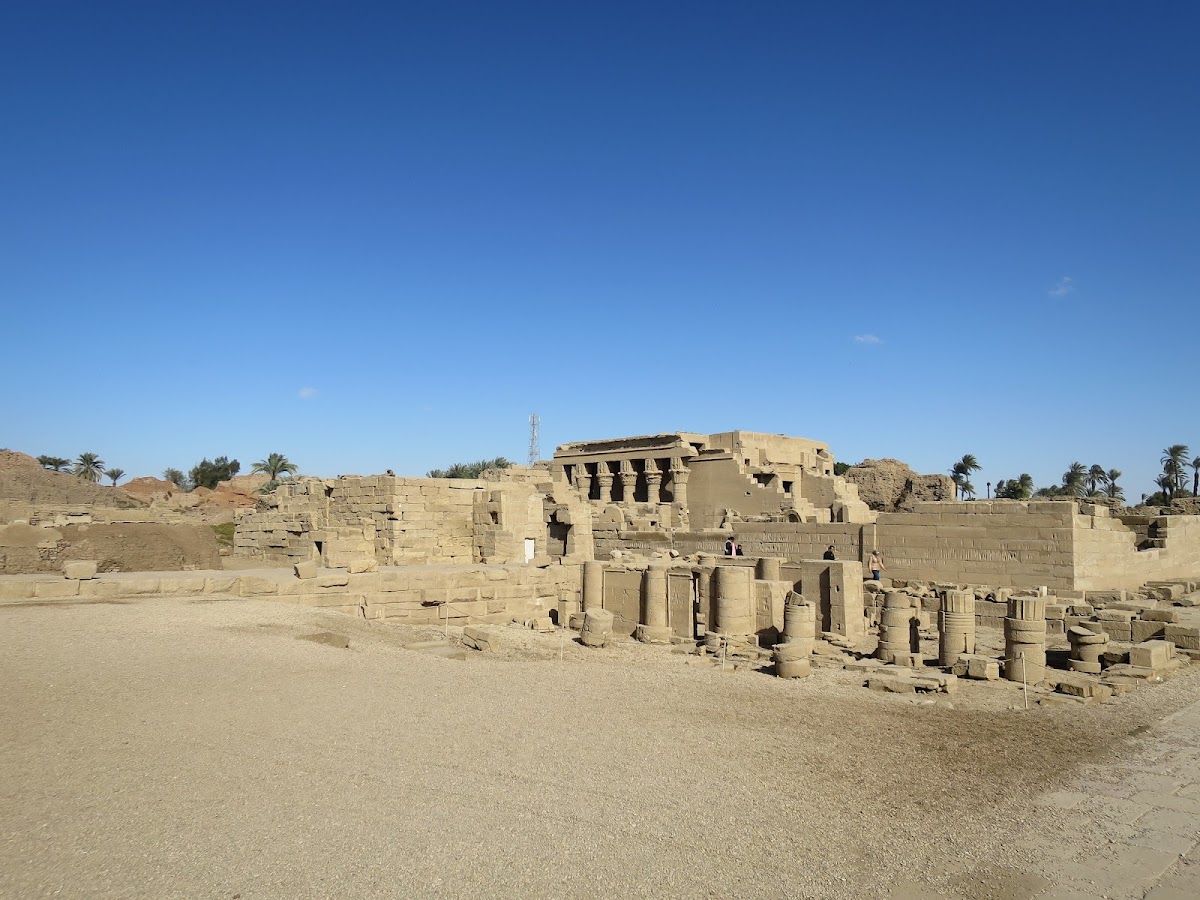
The entire complex is enclosed by a substantial mudbrick wall and contains buildings raised over successive periods. Its principal remains include the Temple of Hathor, the Temple of the Birth of Isis, the Sacred Lake, a healing sanatorium, two mammisi buildings, a basilica, a barque shrine, the gateways of Domitian and Trajan, and the Roman kiosk. Together, these structures form a religious and ceremonial complex whose surviving architecture spans Egyptian, Ptolemaic, and Roman phases.
Temple of Hathor
Main temple
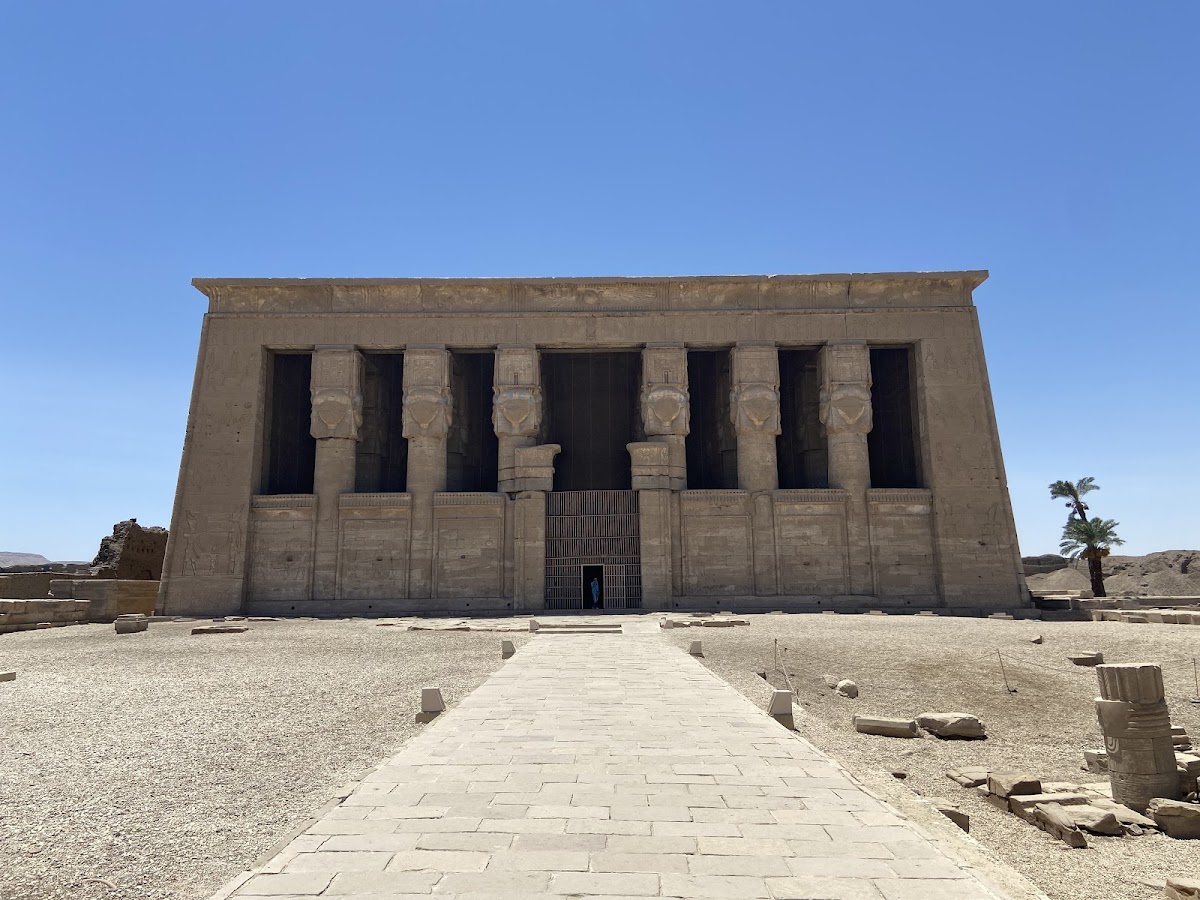
The Temple of Hathor is the dominant structure at Dendera. Its present form belongs chiefly to the late Ptolemaic and Roman periods, with the hypostyle hall added under Tiberius. The exterior rear wall carries the relief of Cleopatra VII Philopator and Caesarion. The temple also preserves scenes of Roman emperors making offerings to Egyptian gods, including the images of Trajan and Domitian on the propylaeum.
Crypts and underground chambers
Twelve chambers lie within the temple’s subterranean crypts. Their reliefs extend to the reign of Ptolemy XII Auletes and associate the spaces with the storage of vessels and divine images. An opening in the floor of the Flame Room leads into a narrow chamber whose walls represent the objects kept there. In a second chamber, Pepi I is shown offering a statuette of Ihy, regarded as the son of Hathor, to four representations of the goddess. A crypt reached from the Throne Room shows Ptolemy XII with jewelry and offerings for the gods.
Roof reliefs and processional stairway
The Dendera zodiac is fixed to the temple ceiling in copy form. Its sculpted figures include Taurus as a bull and Libra as scales, forms that remain recognizable in modern zodiac traditions. A processional staircase rises to the roof, with ritual scenes on its walls. The steps show wear from long use and an apparent accumulation of material that led to the informal name “the melted stairs.”
Reliefs of Harsomtus
Several stone reliefs known as the “Dendera light” reliefs show Harsomtus, a deity associated with emergence and creation, as a snake rising from a lotus flower. In six examples, the figure is placed inside an oval container called a hn, which may represent the womb of Nut, the sky goddess. The interpretation of this container as an incandescent light bulb with a cord and filament is a modern pseudoarchaeological reading and is not supported by the relief’s ancient religious context.
Birth houses, ritual spaces, and other remains
Mammisi buildings
The mammisi of Nectanebo II is the oldest surviving building in the complex. The later Roman mammisi dates to the reigns of Trajan and Marcus Aurelius and contains reliefs of Trajan presenting offerings to Egyptian deities. Among them are scenes of the emperor offering to Hathor and Ra-Harakhte, a composite solar deity associated with Ra and Horus. The reliefs portray Trajan in pharaonic form.
Sacred Lake and sanatorium
The Sacred Lake supplied water for sacred rituals and everyday use. Nearby, the sanatorium functioned in a manner comparable to a Roman bathhouse, but bathing and overnight stays were connected with healing dreams. The water was considered sacred and was used to bless inscriptions on statues believed capable of curing diseases.
Barque shrine and entrances
The barque shrine served as a resting place for statues of the gods when they were carried outside the temple during festivals. The complex also includes the gateways of Domitian and Trajan, a Roman kiosk, a basilica, and the Temple of the Birth of Isis. These buildings form part of the successive architectural phases enclosed by the mudbrick perimeter wall.
Limestone sphinx
The limestone sphinx found in 2023 has a slight grin and dimples. Its head wears a nemes, the striped royal headcloth, with a cobra-shaped uraeus, the rearing cobra emblem worn on a pharaoh’s forehead, at its tip. The sculpture is thought to have been created in the image of the Roman emperor Claudius.