Valley of the Queens: A New Kingdom Royal Necropolis in Egypt
Site at a Glance
- Rating
- 4.5
- Popularity
- Medium
- Country
- Egypt
- Primary era
- Bronze Age
- Eras represented
- Bronze Age, Classical, Medieval
- Civilizations
- Byzantine, Egyptian, Roman
- Site type
- Burial
- Remains
- Necropolis
On this page19 sections
History
The Valley of the Queens is a New Kingdom necropolis on the west bank of the Nile at Luxor, Egypt, built and used by the ancient Egyptians from approximately 1560 to 1130 BCE. Anciently called Ta-Set-Neferu, a name interpreted as “Place of Beauty” and possibly “Place of the Royal Children,” it served queens, princes, princesses, and other high-ranking officials. Its position near Deir el-Medina, the settlement of the workers who made the royal tombs, and the Valley of the Kings connected it to the wider burial landscape of western Thebes.
Origins and the Eighteenth Dynasty
The reason for choosing this valley as a burial ground remains uncertain. Its proximity to the royal cemetery and the workers’ settlement may have influenced the decision. A sacred grotto dedicated to Hathor stood at the entrance, and it may have been associated with the renewal of the dead. Paleolithic stone tools found during an expedition led by Ernesto Schiaparelli also indicate prehistoric activity in the area.
One of the earliest royal burials was probably the tomb of Princess Ahmose, daughter of King Seqenenre Tao and Queen Sitdjehuti. The tomb may date to the beginning of the Eighteenth Dynasty or to the reign of Thutmose I. During this dynasty, the valley held the burials of royal princes and princesses as well as nobles, including a head of the stables and a vizier. The subsidiary valleys were also used, particularly during the Thutmosid period.
Royal women of the Nineteenth Dynasty
Use of the valley became more selective during the Nineteenth Dynasty, when its tombs were reserved for royal women. Wives of Ramesses I, Seti I, and Ramesses II were buried there. Several tombs were prepared before an owner had been chosen, with the name of the royal woman added after her death. Queen Satre’s tomb, QV38, was probably the first Nineteenth-Dynasty tomb prepared in the valley. Work may have begun under Ramesses I and ended under Seti I.
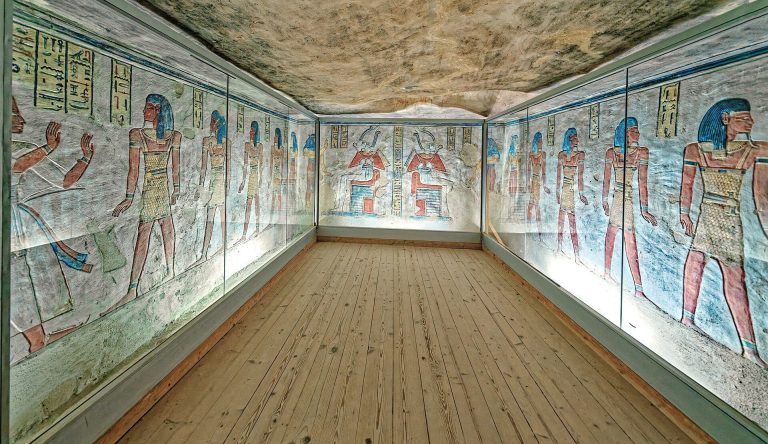
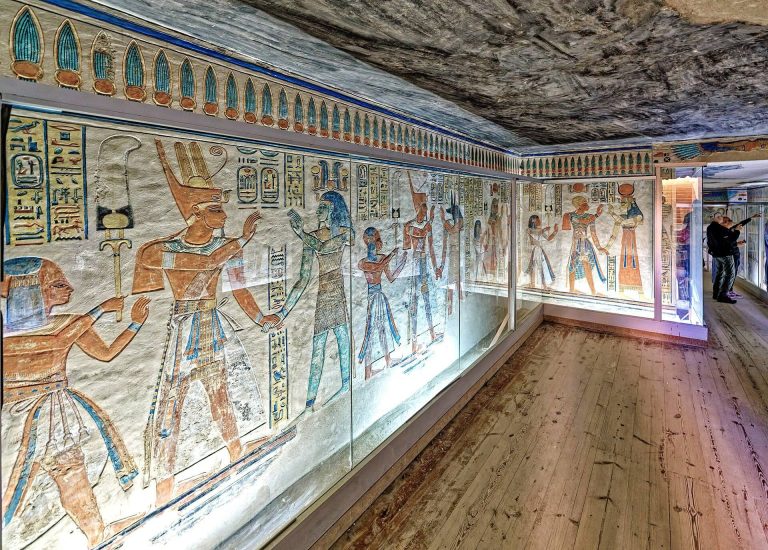
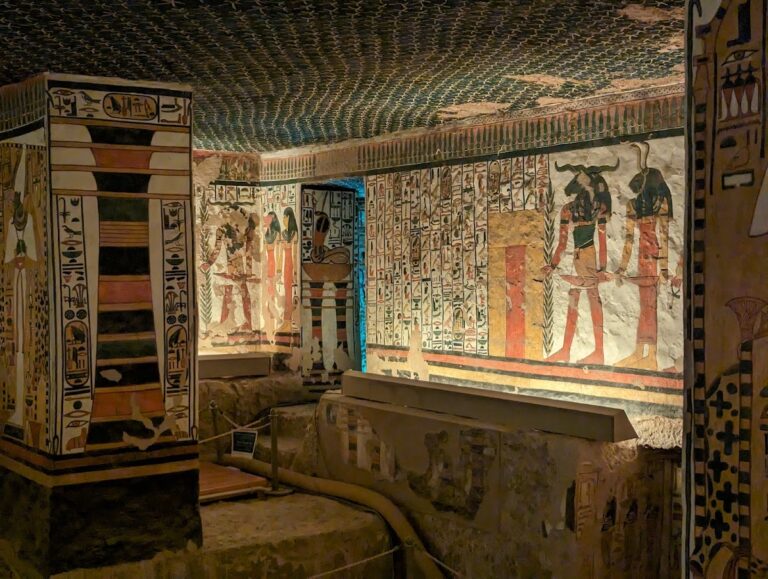
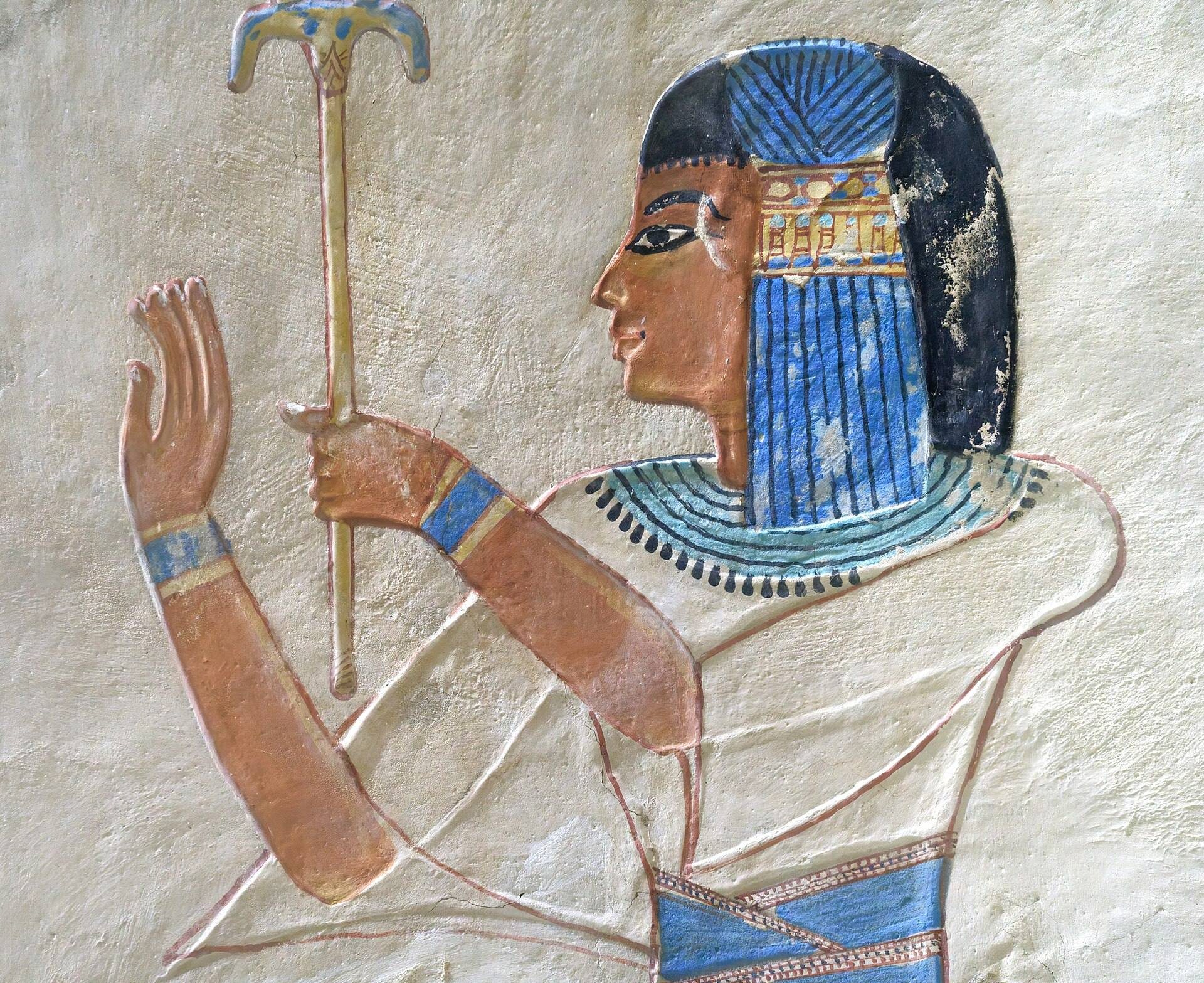
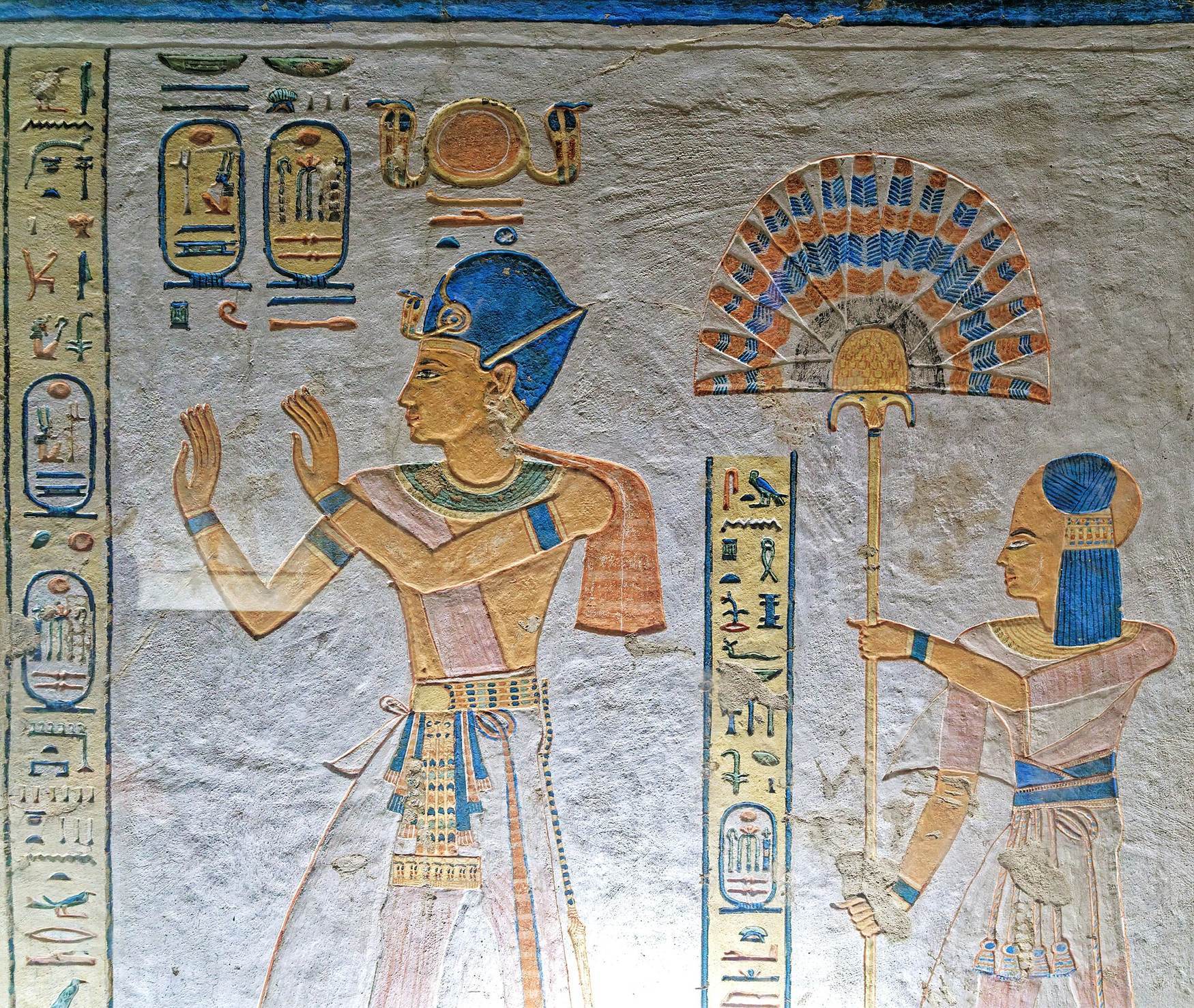
The tombs of this period had elaborate decorative programmes modeled on the grandeur of the royal tombs in the Valley of the Kings, though on a smaller scale. Their decoration relied heavily on scenes from the Book of the Dead and generally did not show the queens’ husbands. The rock-cut tomb of Queen Nefertari, QV66, preserves polychrome reliefs and is among the best-known monuments in the necropolis.
The Twentieth Dynasty and the end of royal burial
The valley remained heavily used during the early Twentieth Dynasty. Tombs were prepared for the wives of Ramesses III and, unlike the practice of the preceding dynasty, for several royal sons. Construction continued at least into the reign of Ramesses VI. The Turin Papyrus records the creation of six tombs during that reign, although their occupants are unknown.
Economic pressures affected the necropolis during the Twentieth Dynasty. Workers went on strike during the reign of Ramesses III, and tomb robbery was recorded near the end of the dynasty. After the Twentieth Dynasty, the valley ceased to function as a royal burial ground as political authority in Egypt became divided. The priests of Thebes took control of the tombs and redistributed them as family concessions.
Reuse from the Third Intermediate Period to the Roman era
From the Twenty-Second Dynasty through the Late Period, many tombs were altered for repeated burials. Some contained hundreds of mummies. Earlier tombs, sarcophagi, canopic vessels, ushebtis, and amulets were often appropriated for later occupants. A canopic vessel preserved the dead person’s internal organs, while an ushebti was a small funerary figure intended to work for its owner in the afterlife. The later funerary equipment was generally more modest, but it retained strong symbolic meaning.
During the Third Intermediate Period, the reused tombs housed members of the lower-ranking Theban elite, including junior priests, singers of Amun, estate overseers, gardeners, flower cultivators, florists, and perfumers. Animal disturbance to some mummies found in modern times suggests that certain tombs may have remained open after plundering.
Little is known about the Ptolemaic period. Evidence includes an ostracon from the reign of Ptolemy III or Ptolemy IV, two coins of Augustus from QV80, and a graffito dated to about 122 BCE, during the reign of Ptolemy VIII. During the Roman period, especially in the second century CE, the necropolis was extensively reused by people from Djem, western Thebes, and nearby villages. The tombs were under the authority of Djem, identified with Greek Memnonia, and were enlarged or reorganized as family burial concessions became crowded.
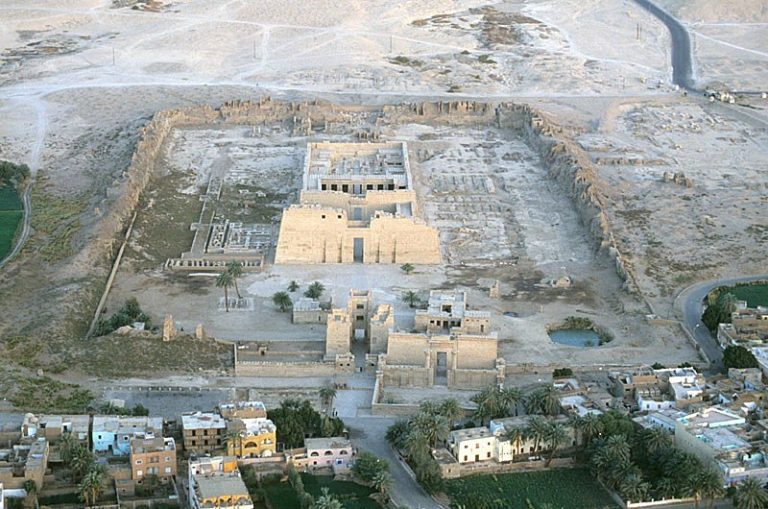
Roman burial activity included human and animal interments, particularly of ibises and falcons. At QV53, the remains of 276 people affected by bubonic plague were embedded in lime. Under the emperor Antoninus Pius, a sanctuary dedicated to Montu-Re, lord of Heliopolis of the South, was built against the pharaonic tomb QV95 at the entrance to the valley. It appears to have served as an annex to the Temple of the Tomb of Djem at Medinet Habu, which was also enlarged during his reign.
Christian transformation and modern archaeology
During the second half of the fourth century CE, the valley became a refuge and place of meditation for Christian anchorites and hermits. Tombs and natural shelters were converted into chapels and dwellings. Deir er-Rumi, meaning “Monastery of the Greeks,” was built over the Roman sanctuary with stone blocks taken from nearby pharaonic monuments. The Christian settlement in the western Theban valleys continued until the seventh century.
QV1, once classified as a pharaonic tomb, was probably excavated during the Coptic period as a refuge for a hermit. Other shelters were established in the Valley of Prince Ahmose and the Valley of the Dolmen, while Coptic graffiti and ostraca occur in the Cave Cascade and lateral valleys. In QV60 and QV73, pharaonic wall paintings were covered with plaster and overlaid with red Christian symbols.
Modern exploration began with Jean-Jacques Rifaud in the early nineteenth century and Giovanni Battista Belzoni around 1816. Robert Hay excavated in 1826, followed by John Gardner Wilkinson in 1828, Jean-François Champollion and Ippolito Rosellini in 1829, Karl Richard Lepsius in 1844, and Heinrich Karl Brugsch in 1854. Ernesto Schiaparelli and Francesco Ballerini carried out the first systematic excavation in three campaigns from 1903 to 1906. Ballerini established the tomb-numbering system still used today.
Their work covered the main valley, the Valley of Prince Ahmose, the Valley of the Three Pits, Deir er-Rumi, and the sanctuary of Ptah and Meretseger in the Valley of the Dolmen. A later Italian mission led by G. Farina conducted two short campaigns before work ended in 1937. A major Franco-Egyptian campaign began in 1970 under Christiane Desroches Noblecourt and later Christian Leblanc. Between 1984 and 1994, the work expanded to include inscription recording, architectural and photographic documentation, clearance of the numbered tombs, and exploration of the site’s post-pharaonic history.
A severe flood in 1994 damaged numerous tombs and led to emergency intervention by the Supreme Council of Antiquities and the French National Centre for Scientific Research. The Getty Conservation Institute and the Supreme Council of Antiquities treated the wall paintings in Nefertari’s tomb between 1986 and 1992 through emergency treatment, consolidation, cleaning, environmental monitoring, and repeated condition assessments. In 2006, the two institutions began work on a comprehensive conservation and management plan for the valley. Together with the Valley of the Kings and nearby Thebes, the Valley of the Queens was inscribed on the UNESCO World Heritage List in 1979 as part of Ancient Thebes with its Necropolis.
Remains
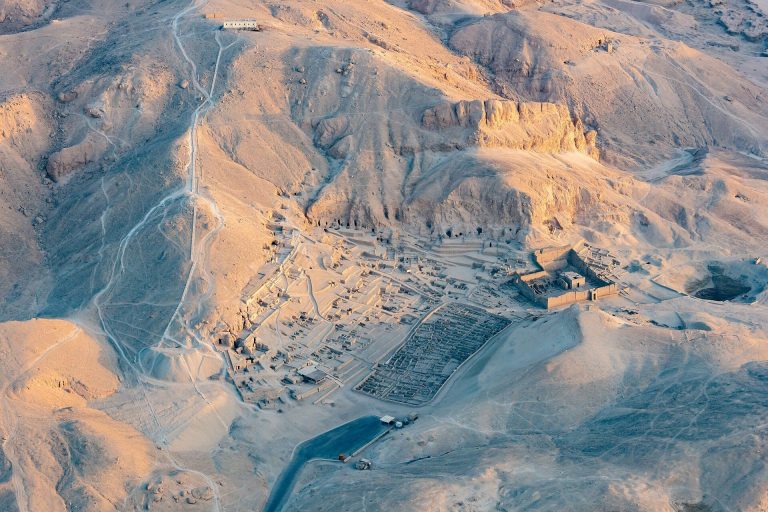
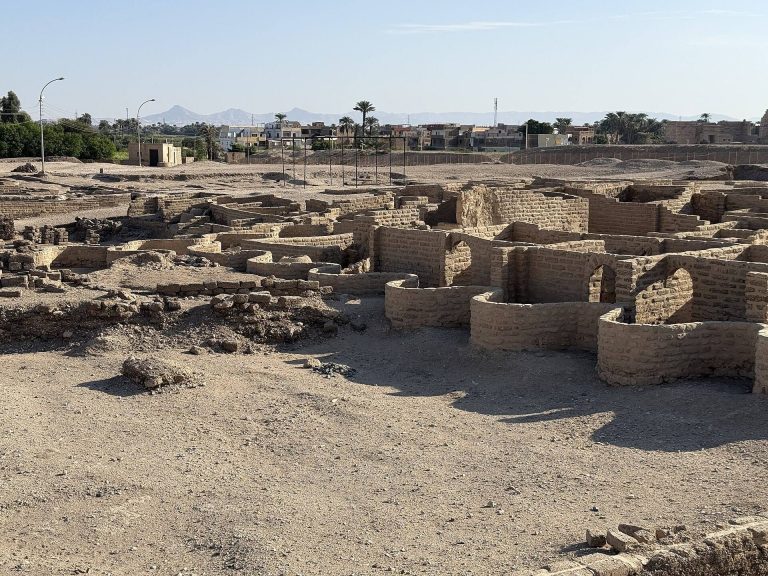
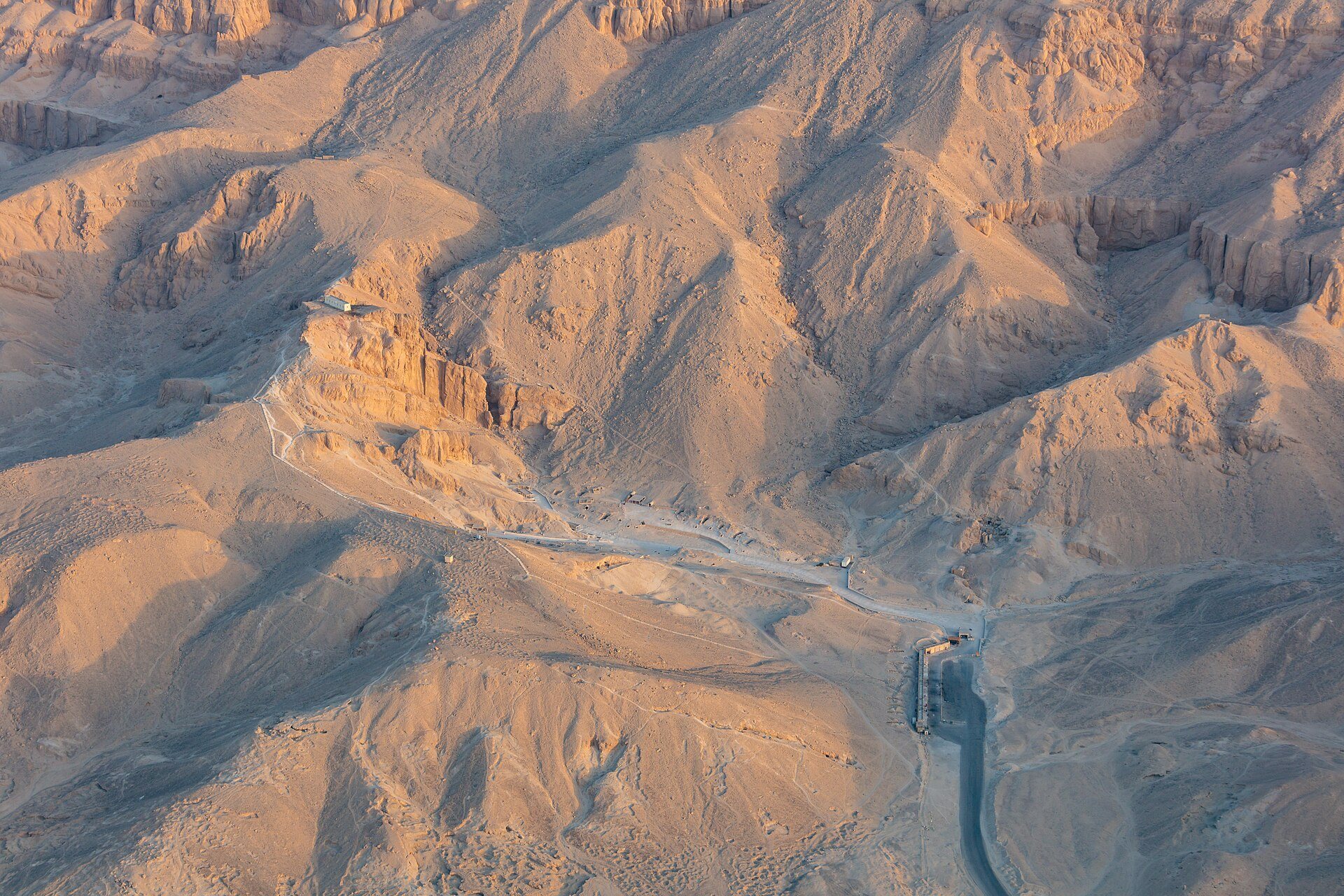
The site consists of a principal wadi, a valley channel that can remain dry except during sudden or seasonal floods, and several subsidiary valleys. The main wadi contains most of the tombs, with inventories giving approximately 89 to 91 tombs; Schiaparelli recorded 79 during the early twentieth-century excavations. The valley lies south of the Valley of the Kings, about one kilometre north of Medinet Habu and west of the great temple of Thutmose III. Its rock consists of limestone, marl, clay, chalk, gypsum, and shale. Unstable clay, flash floods, rockslides, tectonic movement, groundwater, and salt have all affected the tombs and their painted surfaces.
Valleys and early tombs
Subsidiary valleys
The Valley of Prince Ahmose contains QV88 and QV98 and takes its name from QV88, the first tomb found there. The Valley of the Rope contains QV92, QV93, and QV97; its name is linked to the discovery of Coptic ropes. The Valley of the Three Pits contains QV89, QV90, QV91, and QVA to QVL. Most of its tombs date to the Thutmosid period, and its name comes from the three shaft tombs QV89 to QV91.
The Valley of the Dolmen contains an old route used by workers traveling from Deir el-Medina to the Valley of the Queens. A small rock-cut sanctuary dedicated to Ptah and Meretseger stands along it. Ptah was associated with creation and craftsmanship, while Meretseger was connected with the Theban necropolis and its sacred mountain. The Great Cascade Valley takes its name from the stream or torrent that formed there during the rainy season.
Eighteenth-Dynasty tombs
Eighteenth-Dynasty tombs were generally simple, with a chamber reached through a burial shaft. Some were enlarged for more than one burial. The tomb of Princess Ahmose belongs among the earliest monuments in the valley. Other Eighteenth-Dynasty tombs include QV8, QV17, QV72, QV76, QV82, and QV88. QV30 belonged to Nebiri, a head of the stables, while QV46 was the tomb of the vizier Imhotep.
Several canopic-vessel fragments once associated with the valley, including pieces linked with Henut, Menkheperre, Nebetnehat, and Ti, actually came from shaft tombs at Wadi Bairiya, about 4.5 kilometres northwest. This distinction separates those objects from the material found within the Valley of the Queens itself.
Royal tombs of the Nineteenth and Twentieth Dynasties
Nineteenth-Dynasty tombs
Nineteenth-Dynasty royal tombs were cut individually for queens and princesses. Their decorative schemes included scenes from the Book of the Dead and adapted the visual richness of the Valley of the Kings. Eighteen tombs from this dynasty are currently identified. Three were unfinished, while six were anonymous or unused. QV38, the tomb of Queen Satre, was probably the first prepared in the valley during this period. Other tombs were made before their royal occupants had been selected, and the owner’s name was added later.
Queen Nefertari’s tomb
QV66, the rock-cut tomb of Queen Nefertari, contains polychrome reliefs that remain intact. Its paintings received intensive conservation between 1986 and 1992, including consolidation, cleaning, environmental monitoring, and condition assessment. The tomb’s treatment formed part of the wider effort to address salt, groundwater, unstable rock, flooding, human-generated humidity and carbon dioxide, accidental contact, and other threats to decorated burial chambers.
Twentieth-Dynasty tombs
Twentieth-Dynasty tombs introduced a straighter plan, with long, narrow corridors leading to the burial chamber and lateral rooms. Sixteen tombs from this dynasty are currently identified, including eight unfinished examples and one unused tomb. A Nineteenth-Dynasty tomb was later reused for Douatentopet, wife of Ramesses IV. QV51, identified with Iset, mother of Ramesses VI, may have been begun under Ramesses III and completed under Ramesses VI.
Roman and Coptic remains
Roman reburials
Roman occupants enlarged many earlier shaft tombs and filled their corridors and chambers with dense reburials. QV15, QV16, QV34, and QV39 each contained more than one hundred mummies in arrangements resembling catacombs. Burial equipment included painted linen shrouds showing ritual scenes and protective deities, portrait faces or moulded cartonnage, terracotta sarcophagi, jewellery, amulets, funerary beds, and pottery. Cartonnage, a moulded material made from layered textile or papyrus hardened with adhesive and plaster, was found in QV15, QV33, and QV73. Terracotta sarcophagi came from QV13 and QV53.
QV53 and the Roman sanctuary
QV53 contains the remains of 276 plague victims embedded in lime, together with a lime kiln in front of the tomb. At the mouth of the main valley, the Roman sanctuary at QV95 was built against a pharaonic rock-cut tomb. The later church at Deir er-Rumi was aligned east to west, with its apse, the curved end containing the principal sanctuary, to the west. A rocky spur partly concealed the church near the valley entrance.
Coptic chapels and shelters
Coptic reuse changed the appearance of the necropolis through new burial pits, dense reburials, chapels, hermit shelters, plaster coverings, Christian symbols, and stone blocks taken from earlier monuments. QV60 and QV73 preserve particularly clear examples of pharaonic paintings covered by plaster and marked with red Christian symbols. QV1 was probably created as a Coptic-period hermit refuge rather than as a pharaonic tomb. Further shelters occupied the Valley of Prince Ahmose, the Valley of the Dolmen, the Cave Cascade, and the lateral valleys.
Geological damage and conservation
The valley’s physical setting has repeatedly affected the survival of its tombs. Clay deposits expand and contract during flooding, while shrinking clay and tectonic activity have caused rockslides. Faulting and later slumping tilted the original horizontal strata and exposed deposits of anhydrite, gypsum, and halite. Halite, the mineral form of rock salt, enters the tombs through groundwater. As water dissolves and then recrystallizes the salt, painted plaster and rock surfaces deteriorate. The exact composition of the ancient plasters varies between tombs, with differences in colour, hardness, and quantity.
Conservation measures have included protective shelters, wooden flooring, plexiglass shields, controlled movement, and air-circulation systems. Fibres settling on floors and lighting, graffiti, touching, accidental impacts, humidity, and carbon dioxide all contribute to deterioration and can increase fire risk. Bat colonies occupy some open tombs, where urine and droppings damage rock, plaster, and paintings. QV15, QV48, and QV78 have been retained for bat colonies because of their ecological importance. These pressures have made the preservation of the decorated tombs, especially QV66, an ongoing part of the site’s modern history.