Museo Archeologico di Venafro: An Archaeological Museum in Italy


Site at a Glance
- Rating
- 4.5
- Popularity
- Very Low
- Country
- Italy
- Primary era
- Classical
- External website
- Open
- Eras represented
- Iron Age, Classical
- Civilizations
- Roman, Samnite
- Site type
- Museum
On this page18 sections
History
Museo Archeologico di Venafro is an archaeological museum in Venafro, Italy, established in June 1931 to preserve and present discoveries from the ancient settlement and its surrounding territory. Its collections illuminate the area’s Samnite history and later importance under Rome, while also including a notable medieval and early modern religious artwork.
Foundation and early collection
The museum was created after archaeological material was accidentally uncovered slightly more than a decade earlier during construction on the slopes of Monte Santa Croce. Capitals, cornices, statues, and other remains were found, including two large male figures from the Julio-Claudian period. They were initially identified as Augustus, the first Roman emperor, and Tiberius, his successor. The original discoveries were transferred to the National Archaeological Museum of Naples, where they stayed until the museum in Venafro opened.
After its foundation, the collection expanded through discoveries made in Venafro and the surrounding territories. The displays came to represent the area’s development from the Samnite period, when the Samnites were an ancient Italic people living in central and southern Italy, through the Roman period.
Samnite Venafro
The oldest and most substantial Samnite evidence comes from a necropolis found in the countryside of Pozzilli. It belonged to a settlement used from the sixth century BC to the second half of the fourth century BC. The graves contained spears, javelins, fibulae, one sword, and imported pottery, including dark bucchero, a fine pottery with a dark surface, made in Capua, and red bucchero produced between northern Campania and southern Latium. The spread of these ceramics points to economic activity sustained by trade and commerce.
In later phases, black-glaze pottery became more common. Some burial assemblages also became more standardized, forming complete sets connected with symposium customs derived from Greek culture.
Roman civic and funerary life
Roman remains reflect both public and private life. They include evidence from public buildings, houses, the Roman theatre, and imperial-period necropolises. Funerary inscriptions and simple stone markers bearing only the deceased person’s name reflect the Roman practice of placing burials beside roads beyond urban areas.
The funerary monument of Tilla Eutychia is linked with the only known Venafran priestess. A priestess was a woman serving in an officially recognized religious cult. Tilla Eutychia was consecrated to one of the two cults attested in the city, those of Magna Mater, a Roman form of the Great Mother goddess, and Bona Dea, a goddess associated with female religious rites.
The aqueduct and Augustan regulation
The so-called Edict of Augustus was drafted between 17 and 11 BC, during the construction of Venafro’s Roman aqueduct. The aqueduct carried water from the Volturno springs to the city along a route more than thirty kilometres long. Its regulations covered construction and use, water distribution, and the magistrates responsible for settling disputes. The rules were therefore set down during the same period as the aqueduct works.
The statue known as the Venus of Venafro was found in 1958 during agricultural work in the countryside. It probably belonged to a fountain serving a wealthy residential building of the Augustan period. Regulations in the Edict of Augustus also governed the use of the fountain.
War, relocation, and re-establishment
The museum closed during the Second World War after the convent buildings were used to accommodate displaced people and as school classrooms. In the 1970s, the Molise Superintendency re-established the museum after the municipality of Venafro donated the former Monastery of Santa Chiara to the Italian state. The museum has remained in that complex.
Since December 2014, its administration has been part of the Molise Museum Complex, which became the Regional Museums Directorate in December 2019. The former monastery now houses displays on the ground floor and second floor, bringing together material from the area’s ancient settlements, public buildings, residences, and burial places.
Remains
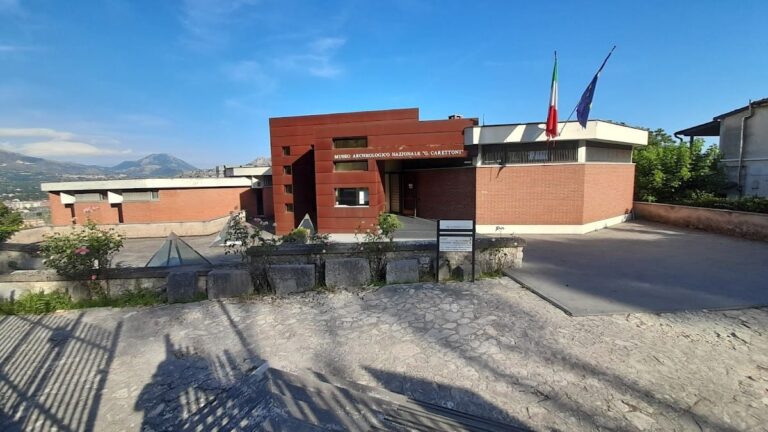
The museum occupies the former Monastery of Santa Chiara, including its convent spaces and cloister. Its archaeological presentation extends across the ground floor and second floor, combining architectural fragments, sculpture, funerary monuments, inscriptions, and objects from the Samnite and Roman territories around Venafro.
Samnite burial evidence
Reconstructed tomb 55
A complete reconstruction of Samnite tomb 55 from the Pozzilli necropolis presents the arrangement of a burial from the settlement used between the sixth century BC and the second half of the fourth century BC. The numerous bucchero vessels placed with the burial indicate the comparatively favourable social position of the deceased. The tomb forms part of the museum’s presentation of weapons, ornaments, and pottery associated with Samnite funerary practice.
Roman buildings and theatre
Architectural decoration
Capitals, cornices, marble ornaments, and architectural friezes come from Roman public and private buildings in the area. The collection also contains sculptures of draped figures and fragments from the Roman theatre of Venafro. Together, these pieces represent the carved stonework and sculptural decoration associated with civic buildings, houses, and theatrical space.
Roman funerary monuments
Inscriptions and roadside markers
Imperial-period funerary material includes inscribed monuments and simple funerary cippi, stone markers associated with burials. Some carry only the name of the deceased, and they were set into the ground beside roads outside the city. These objects are displayed with other funerary inscriptions from the area’s burial contexts.
Tilla Eutychia and Q. Servilius
The monument of Tilla Eutychia is itself a funerary cippo. Another funerary feature is represented by the colossal head of a Gorgon, a funerary symbol, associated with a monument dedicated to Q. Servilius. The two pieces convey different aspects of Roman commemorative practice through their forms, inscriptions, and symbolic imagery.
Water supply and the Venus of Venafro
The Aquaria Tablet
The Aquaria Tablet is a large inscribed stone marker connected with the Roman aqueduct of Venafro. It preserves regulations for building and using the water system, distributing its supply, and deciding which magistrates had authority in disputes. Other cippi displayed with it stood beside the conduit and carried instructions requiring the passage alongside the water channel to remain unobstructed.
The Venus of Venafro
The Venus of Venafro is an Antonine-period marble statue, belonging to the phase of the Roman Empire associated with the Antonine emperors, generally dated from AD 96 to 192. It copies the Venus Landolina, one of antiquity’s renowned images of Venus. The statue probably formed part of a fountain serving a wealthy Augustan-period residence.
Alabaster altar-piece
A second-floor room contains an alabaster altar-piece originally installed in the chapel of the Church of the Annunciation. It is an intact polyptych, an artwork made from multiple connected panels, produced in England. Its survival provides a later religious element within a museum otherwise centered largely on the ancient history of Venafro and its territory.