Castle of Sedan: A Medieval Fortress and Princely Residence in France


Site at a Glance
- Rating
- 4.5
- Popularity
- Medium
- Country
- France
- Primary era
- Medieval
- External website
- Open
- Eras represented
- Medieval, Early Modern, Modern
- Civilizations
- French
- Site type
- Military
- Remains
- Castle
On this page18 sections
History
The Castle of Sedan is a medieval fortress and former princely residence in Sedan, France. It grew from a Benedictine priory whose church was probably founded in the eleventh century, and its first castle was developed around 1424 during the Hundred Years’ War, the prolonged conflict between the English and French crowns from 1337 to 1453. Its position beside the Meuse gave the La Marck family control over territory between Sedan and Maastricht and placed the fortress along an important regional trade route.
From priory to fortress
The original religious site was the Benedictine Priory of Saint Martin, which depended on Mouzon Abbey and was mentioned in 1306. Around 1424, Évrard II de La Marck-Arenberg took possession of the site and built a manor around the church over approximately six years. The church then became the castle chapel. Évrard supported Charles VII of France against the English and used the new stronghold to control land along the right bank of the Meuse.
After Évrard’s death in 1440, his son Jean de La Marck strengthened the fortress and doubled its area. Évrard’s grandson Robert II de La Marck carried out the most extensive works of this early period. The first castle was created before the fortress had fully adapted to artillery, which was increasingly changing the character of siege warfare.
Sixteenth-century expansion
The fortress resisted unsuccessful sieges by Archduke Maximilian in 1495 and Charles V in 1521. Charles V was the Habsburg emperor whose territories included the Spanish Netherlands and who campaigned against French interests. Medieval defenses were modernized in 1530, followed by further artillery works during the sixteenth century.
Henri II granted the La Marck lords the title of sovereign princes, placing Sedan within a small political territory governed by a prince rather than within an ordinary province of the French kingdom. From 1530, the princely residence was built along 100 metres of the rampart facing the town. A Renaissance pavilion in the style of Philibert Delorme was made for Robert IV de La Marck and Françoise de Brézé, while the Governor’s Residence was built in 1536.
Around 1550, earth-filled artillery terraces were formed between the ramparts and a new wall taken from the lower courtyard. These works increased the curtain-wall thickness from 4.5 metres to 26 metres and brought the earthworks up to the level of the surrounding high ground. Eighteen small troop lodgings were inserted into the fill. Four bastions, projecting defensive works that allowed artillery and defenders to cover the walls and nearby approaches, were completed during this period: the Governor’s Bastion in 1557, Fourchu Bastion in 1559, and the Ladies’ Bastion and King’s Bastion in 1572.
Princely rule and annexation
Henri de la Tour d’Auvergne built the Palace of the Princes, also called the Lower Castle, in the early seventeenth century. The earlier fortified residence was then abandoned as the principal princely home. Henri, later known as Marshal Turenne, was born at Sedan Castle in 1611. He became one of France’s principal military commanders.
The fortress surrendered to Henri IV in 1606 after a siege. The Principality of Sedan was absorbed into France after the Battle of Marfée in 1641 and the failure of a conspiracy against Richelieu in 1642. Frédéric-Maurice de La Tour d’Auvergne, the last prince of Sedan, surrendered the castle to Louis XIII. He was imprisoned, and a treaty in September 1642 transferred the principality to the French crown.
French military occupation
After the annexation, Marshal Fabert became the first governor of Sedan for the French king. In 1650, he commissioned the Fabert Stores for grain storage. The castle was converted into a garrison, and in 1699 Vauban built the Princes’ Gate to accommodate advances in artillery. Vauban was the leading military engineer of Louis XIV’s reign, and the gate was his only intervention at Sedan Castle.
Napoleon Bonaparte visited the castle in 1803 and ordered the princes’ armor collection to be transferred to Paris. Some of the armor is now displayed at the Army Museum. In 1822, Saint Martin’s Church was demolished so that its former space could become a cannonball store, later described as a cannonball park. An artillery platform was added above the twin towers in 1828.
War, decline, and later use
On 1 September 1870, during the Franco-Prussian War, the 1870–1871 conflict between France and the North German Confederation and its allies, including Prussia, the Army of Châlons was defeated at the Battle of Sedan. Prussian and Saxon forces had surrounded the army. Napoleon III raised a white flag over the castle to request an end to hostilities. The capitulation was signed at the Château de Bellevue between Frénois and Glaire, and Napoleon surrendered the following day at nearby Donchery.
After the battle, the fortress lost its military status and its bastion network was destroyed. Dynamite tests against the Governor’s Bastion and Fourchu Bastion in 1873 left both structures extensively breached. During the First World War, the German army used the castle as a military hospital. From January 1917 to November 1918, the citadel also served as an internment camp for thousands of French and Belgian civilians condemned by German authorities to forced labor. Known locally as “the Bagne,” it recorded more than a thousand deaths, although the exact number is uncertain.
The French Army transferred the castle to the city of Sedan in 1962. Restoration campaigns followed, and the complex became the home of a municipal museum and a hotel. The High Castle, meaning Sedan’s upper fortified complex in contrast to the Lower Castle or Palace of the Princes, was designated a French historic monument by decree on 4 January 1965. A violent storm on 14 July 2010 damaged and partly lifted the large southern roof. Castle staff and volunteers saved most of the collections stored partly in the attics, and a replacement roof was completed for the 2012 season. In 2023, the castle was voted France’s favorite monument.
Remains
The castle occupies a rocky promontory beside the Meuse, at a position formerly flanked by the Bièvre and Vra streams. It also stood where the Meuse intersected with the Copper Route, a historical regional trade route. The fortified complex is enclosed by walls, extends across approximately 35,000 square metres, and rises through seven levels. Its walls are more than seven metres thick, with the thickest section approaching 27 metres. Small protective shutters or covers, known as huchettes, were fitted to the crenellations.
Early fortress and entrance
Priory core and medieval castle
The earliest castle had a roughly triangular plan centered on Saint Martin’s Church. A rectangular residential keep, already part of the priory, was incorporated into the fortress, while a western round tower was later enlarged into the Great Tower. This arrangement preserves the connection between the religious foundation and the first fortified residence.
Twin-tower entrance
The entrance was formed by two twin towers and a gatehouse made up of two smaller round towers with a projecting watch structure. Wooden hoardings, which were projecting timber galleries used for defense, strengthened the entrance towers. A portcullis, or vertically sliding fortified gate, and a breteche, a projecting structure for attacking people immediately outside the wall, added further protection.
Artillery defenses
Ramparts and troop lodgings
The sixteenth-century artillery transformation is visible in the massive earth-filled terraces between the original ramparts and the lower-courtyard wall. Their construction expanded the curtain wall from 4.5 metres to 26 metres in thickness, and eighteen small troop lodgings were built inside the earthwork. The terraces brought the defensive platform to the height of the surrounding ground.
Bastions and hornworks
The fortress retains four sixteenth-century bastions: the Governor’s Bastion, Fourchu Bastion, the Ladies’ Bastion, and the King’s Bastion. Their completion dates range from 1557 to 1572. Hornworks, external fortifications made of projecting defensive works in front of the main line, were later placed before the bastions. The final defensive campaign involved Marin Fourre, Marc-Aurèle Pazin, also known as Marco Aurelio de Pasino, and Jean Errard of Bar-le-Duc. The Governor’s and Fourchu Bastions were extensively breached by nineteenth-century dynamiting and remain largely opened out.
Residences and storage buildings
Princely and governor’s residences
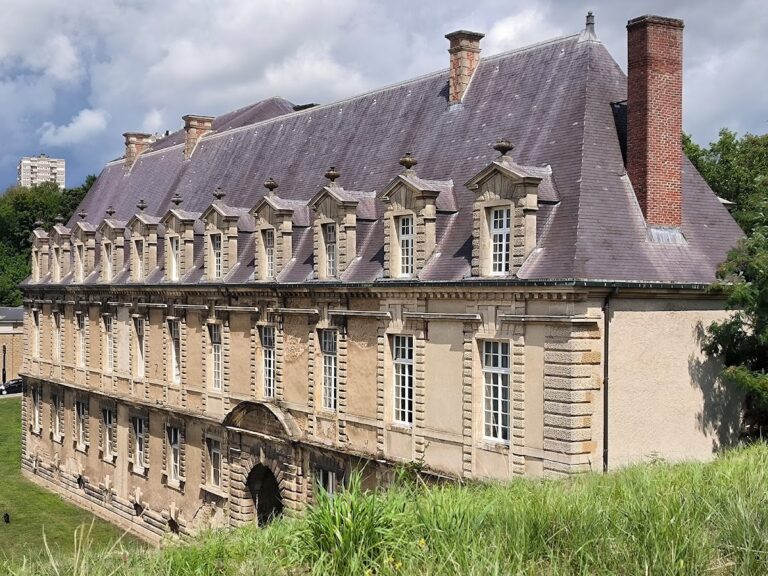
The seigneurial residence and guard residence date from before the middle of the sixteenth century. The princely residence built along the town-facing rampart included a Renaissance pavilion associated with the style of Philibert Delorme. The Governor’s Residence followed in 1536. Together, these buildings reflect the expansion of the fortress from a medieval stronghold into a fortified princely complex.
Fabert Stores
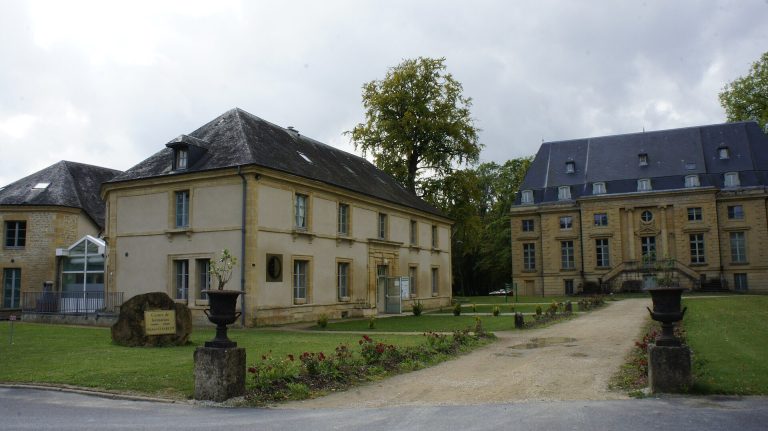
The six-level Fabert Stores were constructed in 1650 to hold grain for the garrison. The buildings now accommodate the castle hotel, retaining their place within the fortified enclosure while serving a later function.
Cannonball park and artillery platform
The space created by the demolition of Saint Martin’s Church in 1822 became a cannonball store or park. The artillery platform above the twin towers was added in 1828, showing the continued military adaptation of the complex after its medieval and princely phases.
Museum collections
The municipal museum occupies part of the castle and includes a model of nineteenth-century Sedan installed in spring 2012, largely made by Jean-Jacques Dromby. A room devoted to the 1870 war contains Prussian helmets, other weapons, and a sketch of Louis Braun’s panorama of Sedan. The fortified enclosure also contains a hotel and restaurant.