Burg Ellhofen: A Medieval Castle Ruin in Bavaria


Site at a Glance
- Rating
- 3.8
- Popularity
- Very Low
- Country
- Germany
- Primary era
- Medieval
- Eras represented
- Medieval
- Civilizations
- Holy Roman Empire
- Site type
- Military
- Remains
- Castle
On this page8 sections
History
Foundation and lordship
Burg Ellhofen is a medieval hilltop castle ruin in Germany, about 1 kilometre south of Ellhofen within the Bavarian market town of Weiler-Simmerberg. The Lords of Ellhofen began building it at the end of the thirteenth century because their earlier castle near the present-day Tobelmühle had become too small and inconvenient. The lordship itself is first documented in 1287.
By 1418, the castle held lower judicial jurisdiction, meaning authority over lesser civil and criminal cases below the level of higher territorial courts. In 1446, Rudolf von Ellhofen was killed by Swiss Confederates at Ragaz. His death ended the male line of the family, and his sisters sold the property to Rudolf von Weiler.
Changes of ownership and destruction
Burg Ellhofen passed to the Counts of Montfort-Rothenfels in 1462. In 1475, Wilhelm von Neidegg, a wealthy patrician from Ravensburg, bought the castle and the village of Ellhofen for 1,600 gulden.
The German Peasants’ War, a widespread uprising in the German lands during 1524 and 1525, brought destruction to the castle. Burg Ellhofen was plundered and devastated in 1525. After the male line of the Neidegger family died out in 1562, the lordship was sold to the Teutonic Order, a medieval religious and military order that also administered territorial property.
Swedish forces burned Burg Ellhofen in 1634 during the Thirty Years’ War, the European conflict fought from 1618 to 1648 through interconnected religious, dynastic, and territorial struggles. The castle was probably uninhabited after the fire.
Dismantling and protection
The ruin passed to Bavaria in 1806. In 1853, it was deliberately dismantled so that its stone could be used to enlarge Ellhofen church. Other stones went into the fire wall of the present Burghof and the church in Simmerberg. They were probably also used in the Amtshaus built in 1552, which is now the Gasthof Adler. Burg Ellhofen is protected as an architectural heritage monument in Bavaria.
Remains
Layout and surviving fabric
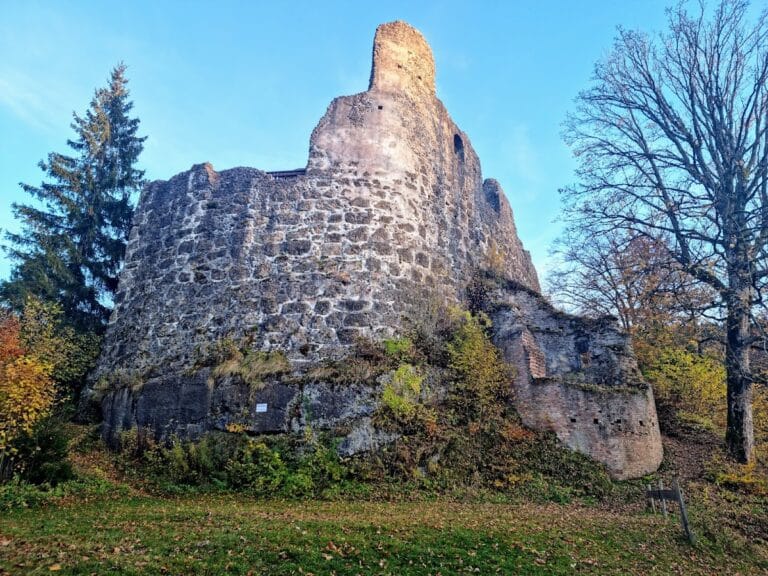
The ruin occupies a small hill at about 760 metres above sea level above the valley of the Ellhofer Tobelbach. Two probably hand-dug double ditches bound the hill. The castle buildings and enclosing walls formed a fairly regular square, measuring 18 metres on each side. With the projecting outer defensive enclosure, or zwinger, and the access route included, the complex measured 28 metres in length and 18 metres in width.
Defensive enclosure
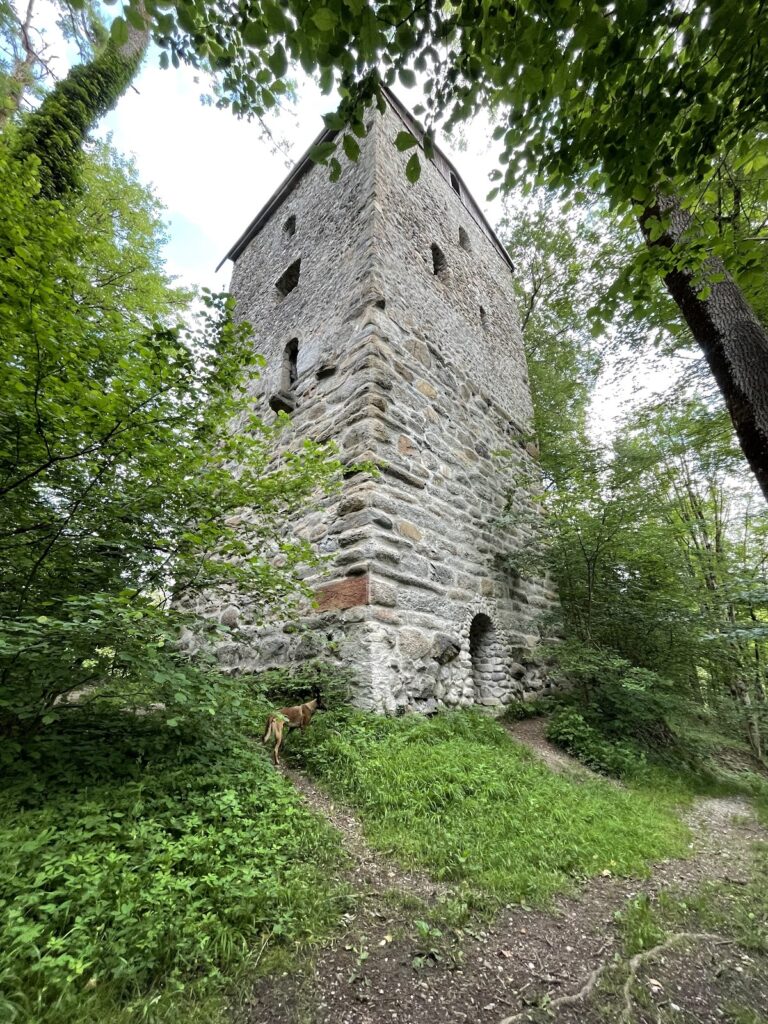
The enclosing walls and the zwinger, an outer defensive passage between fortification lines, formed part of the castle’s strongly defended medieval arrangement. The surviving wall masonry gives a limited but tangible indication of the former enclosure. One remaining wall section measures 6 metres long and 2.5 metres high, and carries a commemorative plaque.
Defensive tower and service yard
Surviving masonry can be assigned to a square bergfried, the principal defensive tower of a medieval German castle, on the western side, as well as to the castle’s main buildings. The former service yard has also survived and is now inhabited, preserving part of the complex’s working area within the later settlement.