Frohberg Castle: A Medieval Hill Castle Ruin in Switzerland

Site at a Glance
- Rating
- 3.8
- Popularity
- Very Low
- Country
- Switzerland
- Primary era
- Medieval
- Eras represented
- Medieval
- Civilizations
- Holy Roman Empire
- Site type
- Military
- Remains
- Castle
On this page6 sections
History
Frohberg Castle is a medieval hill castle ruin in Aesch, Switzerland, probably founded by the Schaler family during the second half of the thirteenth century. Its position above the route over the Platten Pass placed it between the Birseck and Laufental areas, while its concentration of neighboring castles reflects the political rivalry of the Schaler and Münch noble families.
Foundation and decline
The castle first appears in written evidence in 1292, when Conrad I Schaler was recorded as “de Vroberg.” Although Frohberg controlled an important route, its location among the nearby strongholds of Schalberg, Engenstein, and Münchsberg suggests that competition between local noble families influenced its construction more than the collection of road tolls.
The castle’s early history remains uncertain. Historian Werner Meyer proposed that the stronghold may never have been fully completed. Carl Roth argued that it was damaged by the Basel earthquake of 1356 and then left unrepaired, but the precise sequence of construction, damage, and abandonment has not been established.
A bishop’s fief and the changing name
During the fourteenth century, Frohberg and its associated lands and rights became a bishop’s fief, meaning property held from a bishop in return for loyalty and service. The counts of Thierstein-Pfeffingen held the fief and incorporated its lands into the lordship of Pfeffingen, which was administered from nearby Pfeffingen Castle. Their interests appear to have focused on revenues and jurisdiction, including tax collection and court rights, rather than on maintaining the costly ruin.
The original name, “Vroberg,” gradually developed in local usage into Tschäpperli and Tschöpperli. These forms probably derived from the corresponding place-name for the rear of the Klus valley, itself associated with “Tschopp.” The ruin has not undergone archaeological investigation or structural securing, so interpretations of its history remain provisional. It is listed as a class B Swiss cultural property of regional significance.
Remains
Fortifications and approach
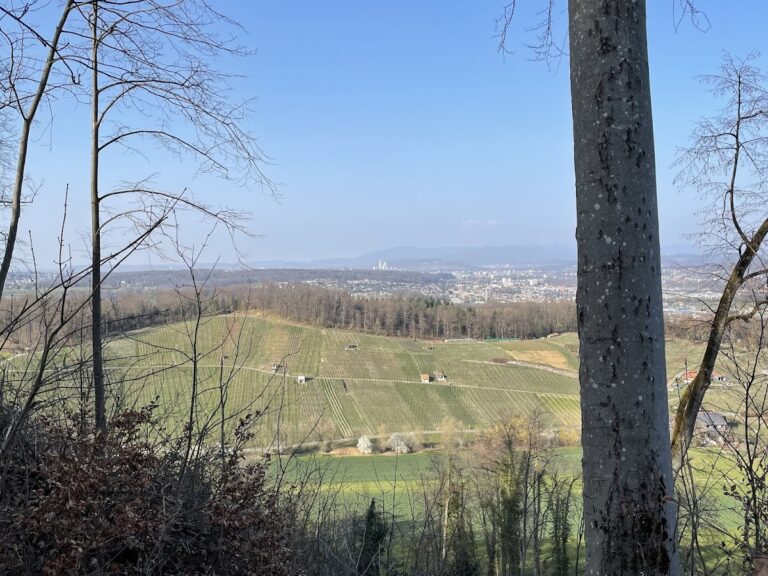
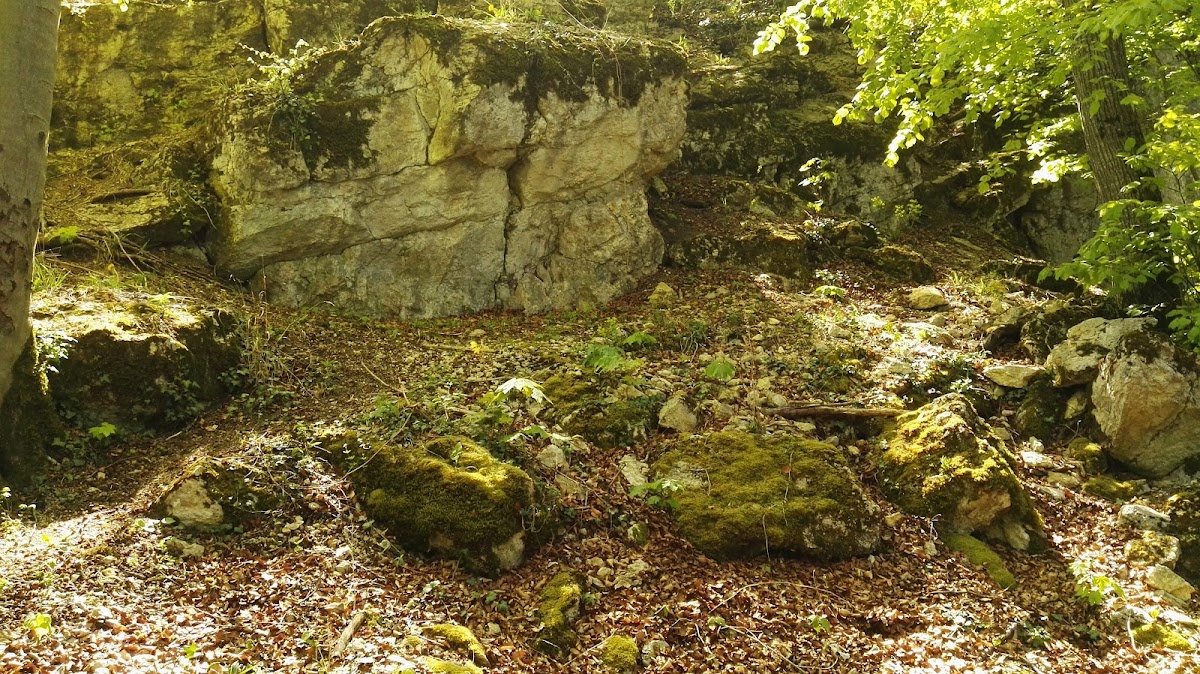
Frohberg occupies a rocky ridge at about 493 metres above sea level, at the upper end of the Klus valley beside the old route over the Platten Pass. The extensive site comprises a main castle and several approach defenses. A deep natural ditch protects the western and northern sides, while an artificial neck ditch, a trench cut across a narrow ridge approach, guards the east. Walls and ditches occupy the southern side, where agricultural plowing has heavily disturbed the defenses. Outworks, defensive installations outside the main castle, remain visible to the northwest and northeast.
Main castle
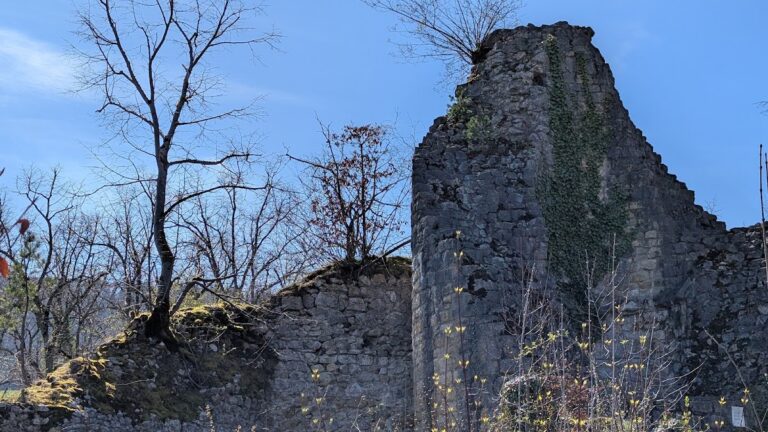
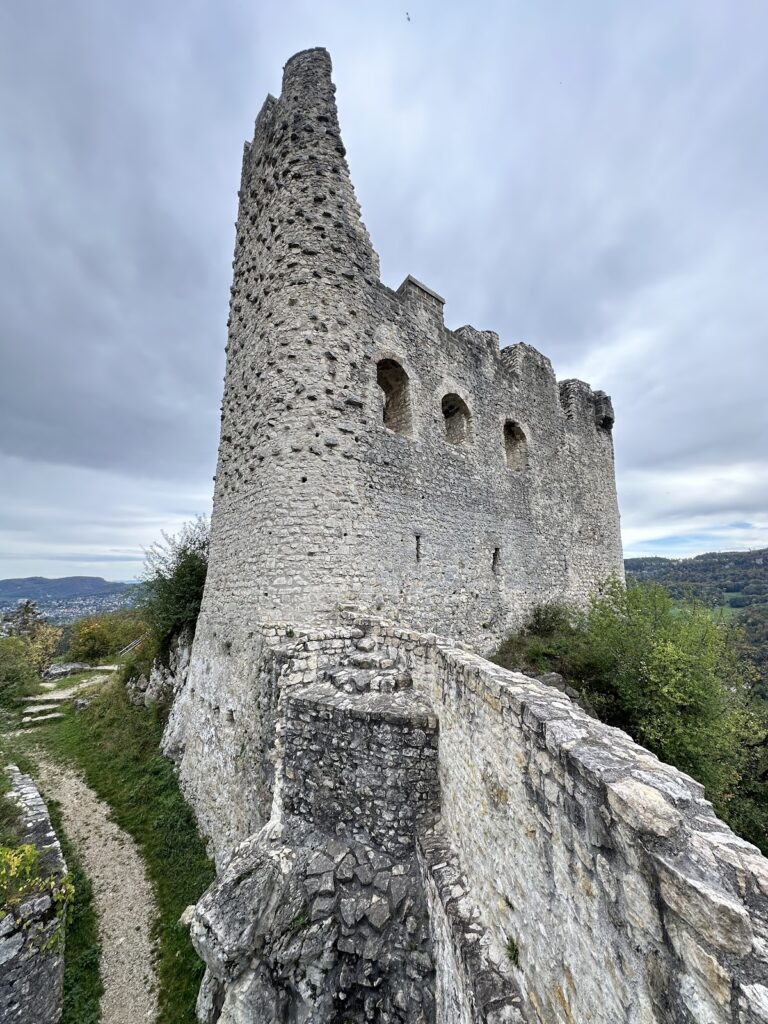
The main castle consisted of a residential tract enclosed by a curtain wall, the defensive wall surrounding a castle. The wall follows the irregular edge of the rocky ledge, and its roughly worked stone blocks survive in places to a thickness of up to 3 metres. The residential tract had two parts. Its smaller western building had an irregular floor plan and served as a residential tower, a fortified tower intended partly or primarily for habitation. An elongated building immediately east of the residential tract probably combined economic and residential functions.
The principal entrance was probably on the northwest side. Access may have used a ramp rising from the ditch or a bridge supported by a natural rock at the ditch edge. A further entrance through the eastern outwork is also possible. Together, the surviving walls, ditches, and building remains show a stronghold adapted to the narrow ridge and to the approaches through the Klus valley.