Castell de Pals: A Medieval Castle in Pals, Spain
Site at a Glance
- Rating
- 4.6
- Popularity
- Very Low
- Country
- Spain
- Primary era
- Medieval
- External website
- Open
- Eras represented
- Medieval
- Civilizations
- Crown of Aragon
- Site type
- Military
- Remains
- Castle
On this page8 sections
History
Castell de Pals is a ninth-century medieval castle in Pals, Spain, in the historic town of Baix Empordà. Its earliest written mention dates to 889, when a charter of the Carolingian king Odo, associated with Sant Pau de Fontclara monastery, referred to it as the Castle of Mont Aspre. A document from 1065 called it “the castle of Mont Aspre, also called Pals.”
Early lordship and comital control
In 994, the counts of Barcelona and Girona, Ramon Borrell and Ermessenda, donated the castle and Sant Pere Church to the Diocese of Girona, the region’s principal bishopric. After feudalization began in the early eleventh century, a process that organized land, authority, and military obligations through lordship and vassalage, the local allodial lords were Quixol and her husband Gausfred. Allodial lords held land directly rather than as feudal dependants.
Their son Bernat Gausfred, lord of Pals after 1041, sold the castle in 1065 to the counts of Barcelona, Ramon Berenguer I and Almodis. His descendants continued to hold it as feudal tenants, owing obligations to a superior lord. Oliver Bernat, the son of Bernat Gausfred, later left his property in Barcelona to Sant Feliu de Guíxols monastery and bequeathed the castle and town of Pals to his daughter Ermessenda.
Grants, purchases, and royal authority
In 1190, Alfonso the Chaste granted the castle, together with its customary laws and usages, to Ramon de Vilademuls. It later passed to Viscount Ramon de Turena through a lifetime grant from King Peter II. The viscount swore homage and became the king’s vassal. In 1230, during the reign of James I, the lordship passed to Bernat de Santa Eugènia, lord of Torroella de Montgrí. His daughter Sança de Santa Eugènia, married to Viscount Guerau VI of Cabrera, purchased the castle from the sovereigns.
Pals subsequently followed the same changes of ownership as the Barony of Torroella until James II incorporated it into the crown in 1311. The bishop and cathedral chapter of Girona purchased Pals in 1321, but James II recovered control and granted the town and castle for life to his wife, Elisenda de Montcada. A contemporary document valued the castle’s revenues at about 5,000 sous.
In 1338, Peter IV confirmed Pals’s incorporation into the crown and its right to exercise high and low justice. The hearth count of 1359 recorded 43 households in Pals, including 30 belonging to the king. Peter IV temporarily granted the town and castle to the lord of Cruïlles in 1380, but Pals was again recorded as a royal possession seven years later.
Destruction and later protection
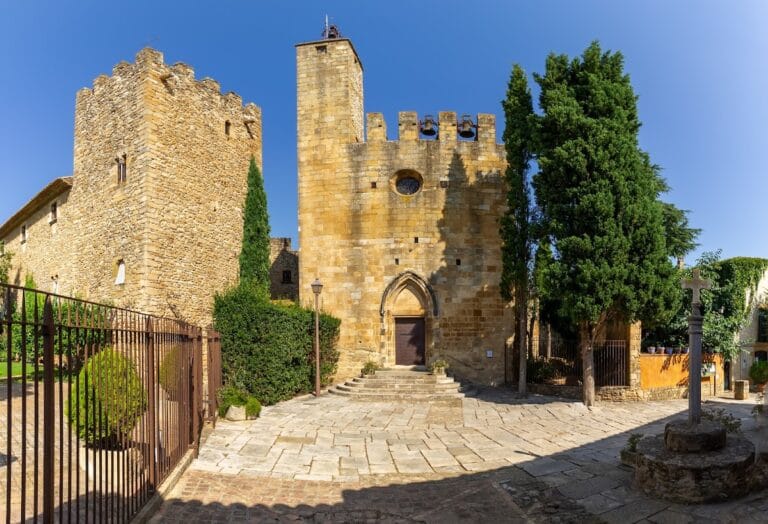
During the fifteenth-century war against King John II, the castle fell into very poor condition. In 1478, John II authorized the reuse of its stones to rebuild the town walls and Sant Pere Church, while ordering that the keep be preserved. A keep is the principal fortified tower of a castle. After a belfry and clock were added, the surviving keep became popularly known as the Tower of the Hours.
Castell de Pals is protected as a Cultural Asset of National Interest and as a Spanish Cultural Asset of Interest in the historic-monument category. The Spanish designation dates from 1988. Its heritage references include RI-51-0006004 and the Catalan architectural-inventory identifier 1172.
Remains
Surviving tower and castle fabric
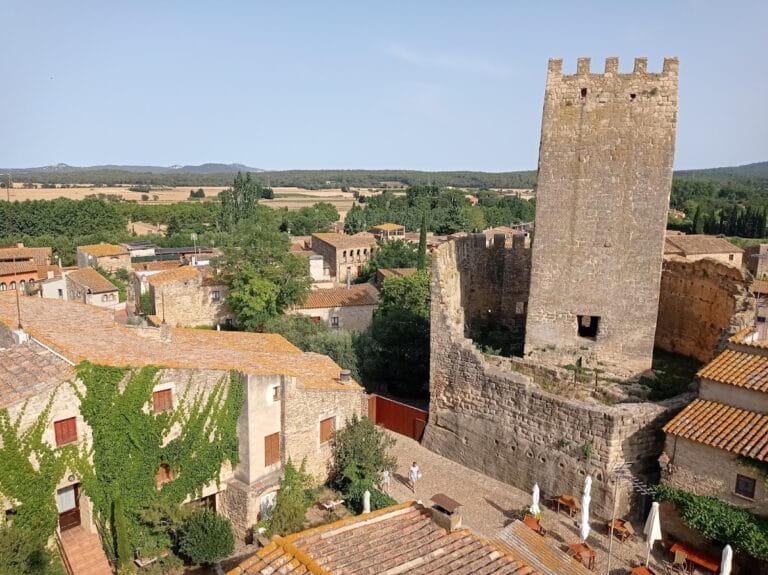
The surviving keep forms the principal remnant of the castle. Dating from the twelfth century, it is a circular stone tower about 7 metres in diameter and approximately 15 metres high, standing on a podium of natural rock. Visigothic-period tombs were found in the rock at its base. The walls are nearly 2 metres thick and consist of medium-sized, slightly squared stone blocks. The tower is described as one of the best-preserved towers in the Empordà.
The Tower of the Hours
The interior is divided into two levels. The lower level is about 5.5 metres high and covered by a false dome with a central opening, while the upper level rises about 6.5 metres and also has a domed covering. The entrance lies approximately 7 metres above ground at the upper level and faces east. It ends in a round-headed arch made from ten wedge-shaped stones, or voussoirs. Two holes beside the threshold probably held the beams of a wooden platform reached by a wooden ladder or rope.
A small belfry crowns the tower. Added in the fifteenth century, it contained the clock that gave the structure its popular name, the Tower of the Hours. The belfry remains part of the tower’s surviving form and reflects the building’s later use after the wider castle was destroyed.
Remains of the former castle
Rows of masonry from the former castle survive in the lower walls of some houses at the southern end of Carrer de la Torre. Further remains were found in a house west of the tower, including a chamber covered by a barrel vault, a continuous semicircular vault extending along a room. Two arched bridges and limited additional fragments also survive, preserving parts of the castle beyond the keep.