Fortezza Rohan: A Seventeenth-Century Fortress in Switzerland

Site at a Glance
- Rating
- 4.5
- Popularity
- Very Low
- Country
- Switzerland
- Primary era
- Early Modern
- Eras represented
- Early Modern, Modern
- Civilizations
- French, Swiss
- Site type
- Military
- Remains
- Fort
On this page8 sections
History
Fortezza Rohan is the ruin of a seventeenth-century Baroque fortress in Switzerland, east of Susch near Zernez. Duke Henri II de Rohan established it in 1635 during the Thirty Years’ War, the Bündner Wirren, and campaigns to recover the Valtellina, an Alpine valley south of Graubünden. It served as a rear defensive position against Spanish and Austrian forces and is regarded as one of the most important surviving historical witnesses to seventeenth-century Graubünden.
An Earlier Castle and the 1635 Fortress
A medieval castle complex at Chaschinas was recorded in 1578 as the ancestral castle of the Cazins family of Susch. Possible remains of that complex may have been removed when the present fortress was built, although excavation would be needed to establish whether earlier settlements existed at the site.
The surviving fortification was constructed between 19 and 27 May 1635 by Captain Borel de la Roque-Servière and Jörg Jenatsch. The exceptionally short building period was later questioned, but a calculation made during the 1990 stabilization found that eight days of work would have required about 200 laborers. The builders had 600 workers available. They obtained stone from the demolished castle ruins, collected sand from a deposit still visible immediately below the fortress, and requisitioned lime putty from the municipality, parish, and individual households. The people of Susch opposed these demands, and Jenatsch criticized them in a letter.
Later Alterations and Preservation
A quadrangular building that still stood in the 1930s was destroyed during the Second World War, when modern military installations were added to the Susch-Zernez defensive position. Those installations were later removed. In 1985, the Pro Fortezza Rohan association was founded to prevent further deterioration through restoration and to make the fortress accessible to the public. Stabilization work in 1990 also reconstructed or replaced several defensive elements and clarified aspects of the fortress’s original appearance. Fortezza Rohan is classified as a Swiss cultural property of national significance.
Remains
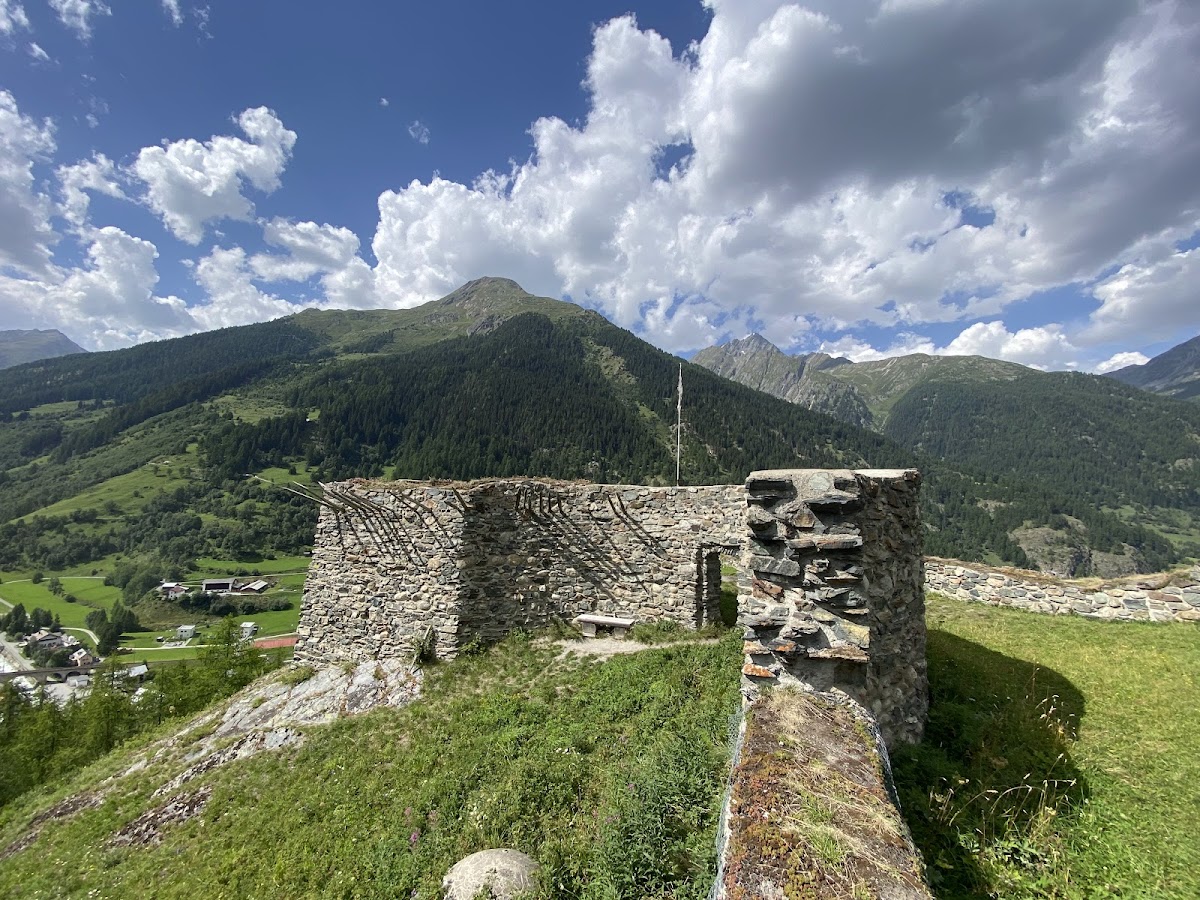
Fortezza Rohan stands on Chaschinas hill above Susch in the Engadin, at approximately 1,553 to 1,559 metres above sea level. The ruin follows a star-shaped plan. Surviving sections of the walls rise about 2.5 to 5 metres, and the enclosing walls are approximately 0.5 to 1.5 metres thick. Pebbles and rubble stone form the masonry, while a wooden wall walk formerly ran below the wall crest. During stabilization, its horizontal support beams were replaced with larch wood.
Defensive Structures
Outer Defences
Numerous anti-assault stakes project diagonally upward from the outer faces of the walls. They were intended to hinder the placement of assault ladders. About 80 percent of the stakes were newly set into the masonry in larch wood during the 1990 stabilization. The work also reconstructed the battlement section above the gate of the outwork, a detached forward defensive section outside the main enclosure, using drawings dated 1675.
Round Tower
A two-storey round tower occupies the south-western corner of the fortress. It contains a basement room, and a gun may have stood on its platform. The stabilization works added a gun embrasure, an opening through which a cannon could be fired, to the round tower.
Central Division and Gates
A central wall divided the fortress into two approximately equal sections through a passage. The main gate stood in the south-eastern section. The connecting gate between the outwork and the main fortification had been destroyed when an artillery-observation structure was installed, but it was reconstructed during stabilization. Two fallen segmental gate arches were also restored as part of the work.