Castle Ried: A Medieval Fortress and Customs Station in South Tyrol
Site at a Glance
- Rating
- 4
- Popularity
- Very Low
- Country
- Italy
- Primary era
- Medieval
- Eras represented
- Medieval, Modern
- Civilizations
- Holy Roman Empire
- Site type
- Military
- Remains
- Castle
On this page9 sections
History
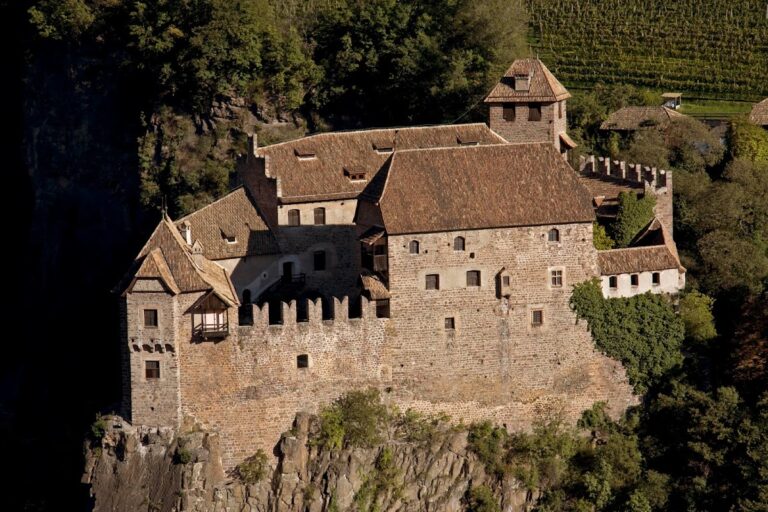
Castle Ried, also known as Castel Novale, is a medieval castle in Sill, Italy, built around 1200 at the entrance to the Sarntal, north of Bolzano. Its position in a basin where the valley briefly widens gave the site strategic importance. The castle is regarded as one of the few castle complexes in the region never to have been conquered.
Origins and Noble Ownership
Heinrich de Riade was associated with the castle in 1225, linking the site with the Lords of Ried. Their family coat of arms showed a black rooster on a gold field. Around the middle of the thirteenth century, the complex grew to include residential buildings, a fortified outer enclosure, and a chapel.
By the late thirteenth century, Castle Ried belonged to the noble Wangen family. The castle left Wangen ownership through a sale in 1307 and thereafter entered the sphere of the Tyrolean ruling house.
Habsburg Administration and the Customs Road
When the Habsburgs, a European ruling dynasty, succeeded the Tyrolean counts as rulers of Tyrol in 1363, Habsburg-appointed officials administered Castle Ried and its associated court. Lenhart Ortwegker held the position of court administrator in 1465. This office carried delegated judicial and administrative authority over the district.
From 1501, King Maximilian I used Castle Ried as a customs station on the newly established road through the Sarntal. The Liechtenstein family held the complex in 1509. In 1549, Christoph Khuepacher, a councillor and court secretary to Emperor Maximilian II, purchased the castle from Stephan Stoß.
On 1 October 1558, Khuepacher received permission to use the name “von und zu Ried” and to add the arms of the extinct Lords of Ried to his own coat of arms. His partly ennobled family later used the name Kuepach zu Ried, Zimmerlehen und Haselburg.
Refuge, Restoration, and Modern Associations
At the end of the sixteenth century, Petre Schiopul, also called Peter the Lame, took refuge at Castle Ried after fleeing the Turks. Vienna assigned the castle to him as a residence. He remained there until his death, and his gravestone is preserved in the Franciscan church in Bolzano.
In the nineteenth century, the Barons of Ingram acquired Castle Ried, restored it, and enlarged it in a more palatial manner. The castle later became connected with a violent episode in Bolzano’s political history. A trade-fair procession planned for spring 1921 was intended to continue to Castle Ried, but fascist attacks caused the plan to be abandoned. This event became known as Bolzano’s Bloody Sunday.
The Italian name Castel Novale was created by Ettore Tolomei and later adopted by the Italian government during its Fascist-era Italianization campaign in South Tyrol. Castle Ried remains privately owned and serves as a residence.
Remains
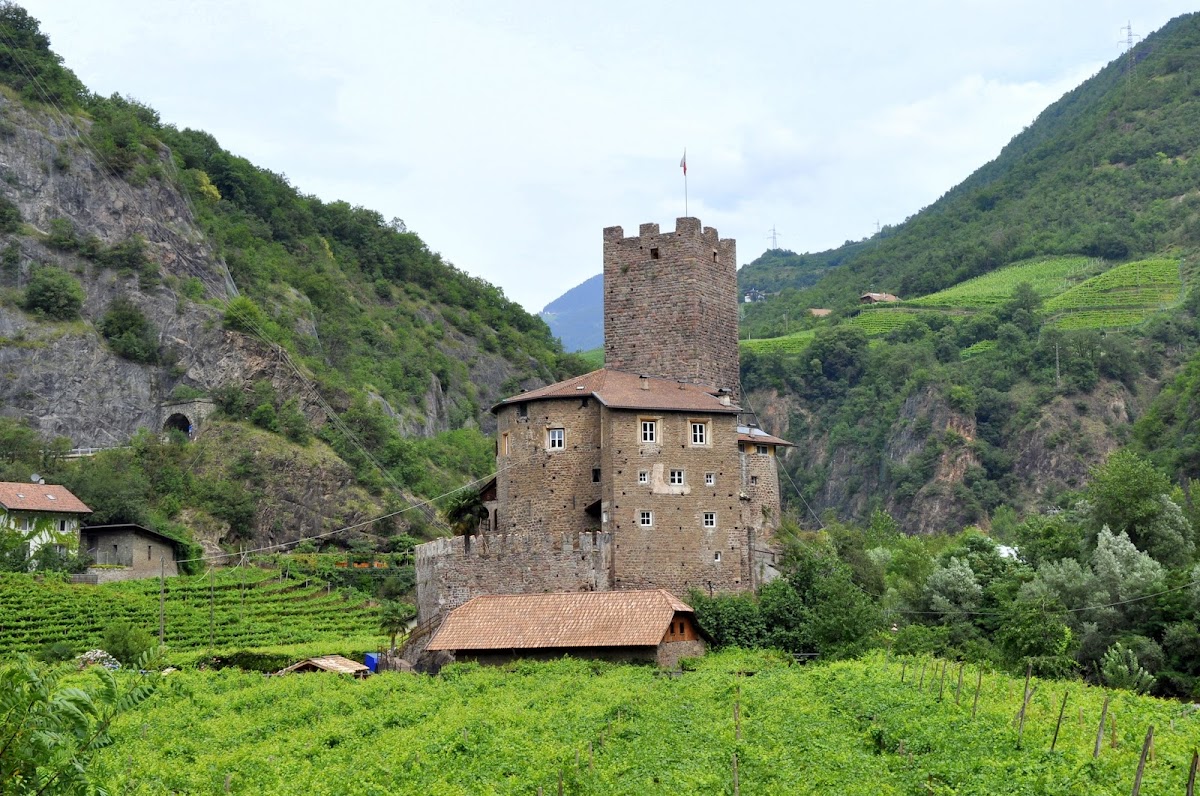
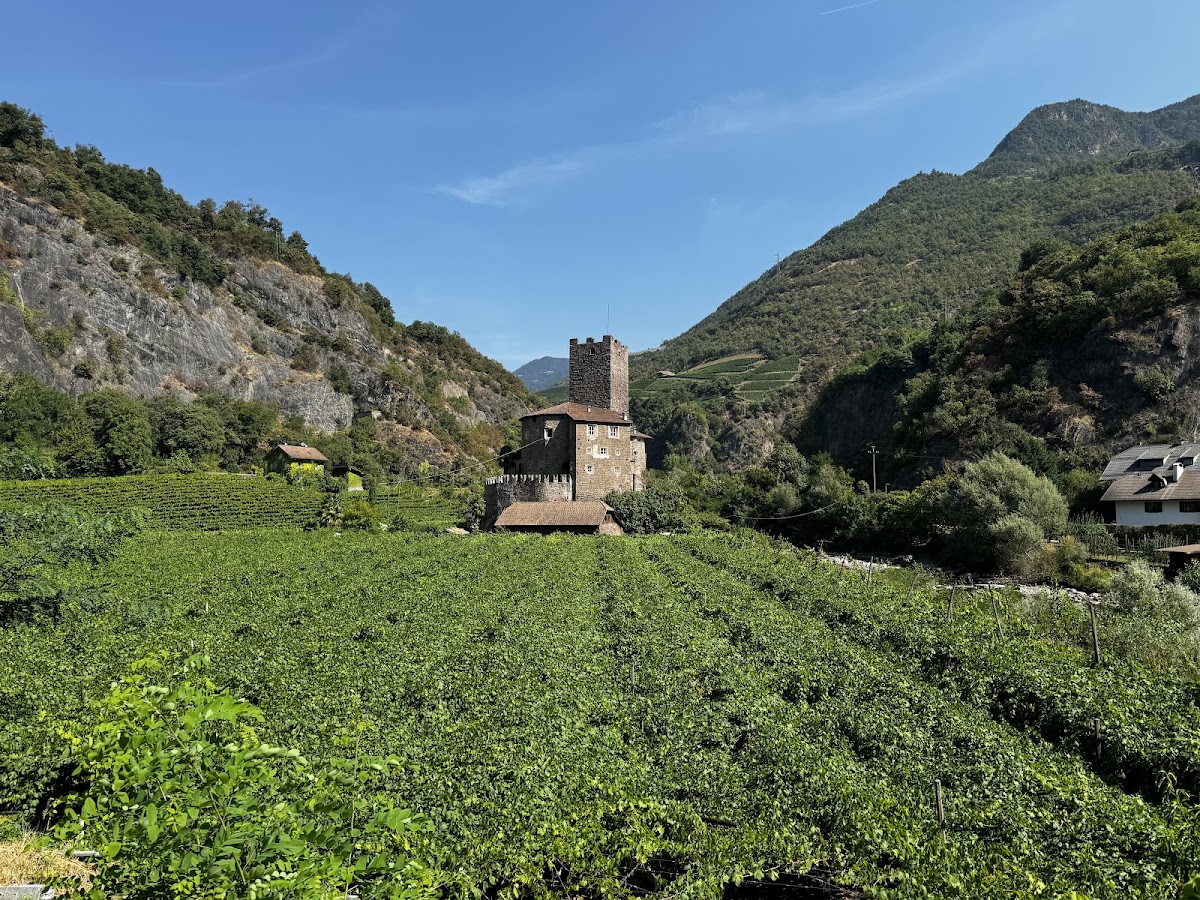
Castle Ried is a relatively small medieval complex on the right bank of the Talfer at the entrance to the Sarntal. It occupies a small basin behind Runkelstein Castle, where the valley broadens temporarily before narrowing again. The site was formerly surrounded by water, as the Talfer once flowed around and against its walls. The river now runs less than approximately 20 metres away.
Castle Complex
Residential Buildings
The residential buildings form part of the medieval complex enlarged around the middle of the thirteenth century. They remain within a well-preserved castle that later underwent restoration and enlargement in the nineteenth century. The present complex serves as a private residence.
Defensive Outer Enclosure
A defensive outer enclosure, an additional fortified area outside the main wall, was added during the thirteenth-century expansion. It contributed to the castle’s protected layout and survives as one of the documented components of the complex.
Castle Chapel
A chapel was also incorporated into the complex during the enlargement around the middle of the thirteenth century. It forms part of the surviving group of residential, defensive, and religious structures at Castle Ried.