Ballylahan Castle: A Medieval Tower House in Ireland


Site at a Glance
- Rating
- 4.3
- Popularity
- Very Low
- Country
- Ireland
- Primary era
- Medieval
- External website
- Open
- Eras represented
- Medieval
- Civilizations
- Norman
- Site type
- Military
- Remains
- Castle
On this page7 sections
History
Foundation and Destruction
Ballylahan Castle is a tower house in Ballylahan, Ireland, constructed in 1260 by Jordan de Exeter, Sheriff of Connacht, after the Anglo-Norman conquest of Ireland. A tower house was a fortified residence that combined domestic accommodation with defensive features. As sheriff, Jordan de Exeter held a senior administrative and law-enforcement office within the territory. The castle became the ancient seat of the MacJordans, a Gaelic-Irish clan associated with the area.
In 1316, Fedlim Ó Conchobair, King of Connacht, attacked the castle. His forces captured it and almost completely destroyed it, shaping the ruined condition in which the site survives.
Protection
Ballylahan Castle is state-owned and protected as a National Monument of Ireland, a designation for places valued for their archaeological or historic importance. It is listed under reference number 325.
Remains
Layout and Surviving Fabric
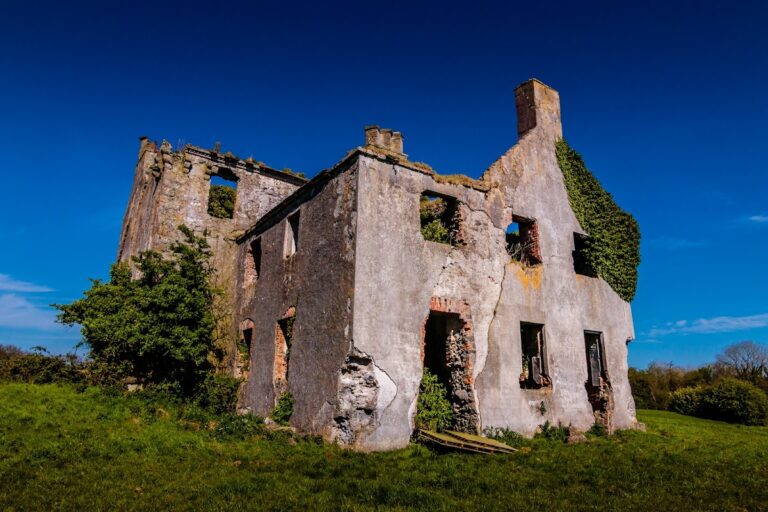
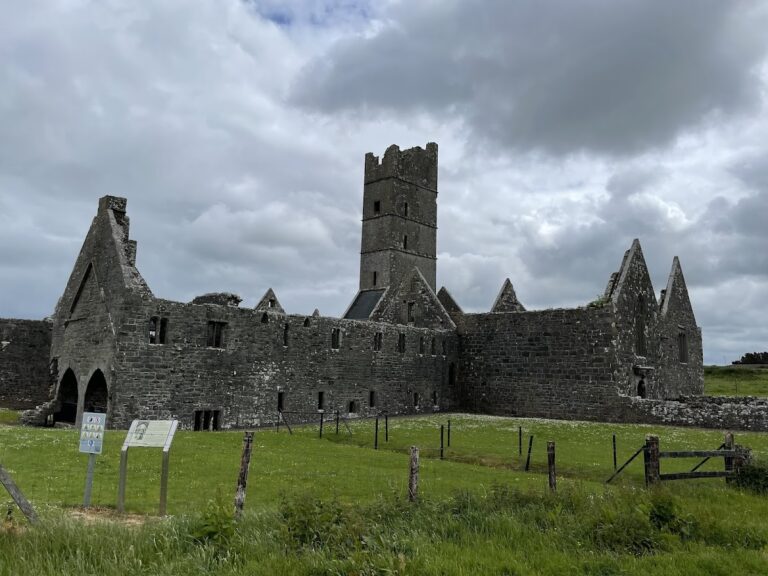
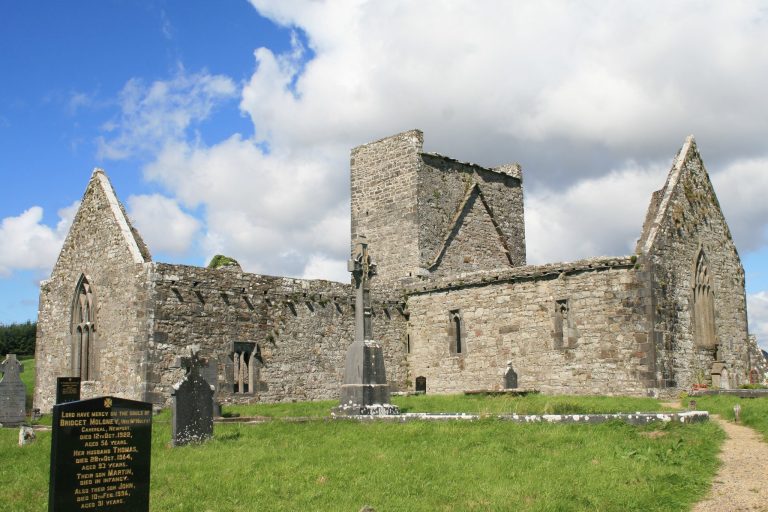
The ruined tower house stands 2.3 kilometres northeast of Strade on the south bank of the River Moy. The surviving structure reaches 12 metres in height. Its entrance court formed an irregular hexagonal bawn, an enclosed defensive yard surrounding the tower house. Evidence of additional buildings is especially substantial along the western wall, while the enclosure retains a pronounced base-batter, or thickened sloping lower wall, particularly at its northwest corner.
Entrance and Circular Towers
The main entrance was positioned on the eastern side of the castle and flanked by two circular towers. One survives as a ruin, while substantial foundations mark the position of the other. Together, these remains define the approach to the enclosed courtyard.
Bawn and Associated Buildings
Beyond the entrance, the irregular hexagonal bawn organized the castle’s enclosed ground. Building remains are concentrated along the western wall, and the pronounced base-batter strengthened the lower defensive line, with its clearest surviving expression at the northwest corner.