Federaun Castle Ruins: A Bamberg Fortress in Austria


Site at a Glance
- Rating
- 3.9
- Popularity
- Very Low
- Country
- Austria
- Primary era
- Medieval
- Eras represented
- Medieval, Early Modern, Modern
- Civilizations
- Holy Roman Empire
- Site type
- Military
- Remains
- Castle
On this page13 sections
History
Federaun Castle Ruins are the remains of a Bamberg bishopric fortress in Austria, above Villach and the Gail crossing on the historically important road to Tarvis. The ecclesiastical principality centered on Bamberg held lands and fortifications in Carinthia, and its bishops used Federaun to protect the Villach Basin toward Italy, the Gail Valley, the bridge, and the imperial road. Emperor Frederick I granted Federaun and permission to build a fortress to Bishop Eberhard II of Bamberg at Pavia on 14 February 1160. The main castle was constructed in the late twelfth century in the Romanesque period, a medieval architectural style known for heavy masonry and rounded arches.
Foundation and Bamberg Rule
Federaun quickly became one of the Bamberg bishopric’s most powerful fortresses in Upper Carinthia. Its position above the road and bridge gave the bishops a base for protecting movement through the region and for managing the associated estates and rights. Bishop Hermann II issued documents at the castle in 1174, 1176, and 1177. In 1212, Bishop Eckbert recorded at Federaun a donation by the knights Sigfrid and Amelrich of Federaun to Arnoldstein Abbey. During the same year, Wisla, the widow of Rudolf I of Federaun, established a foundation for St. Catherine’s parish church at Ossiach.
Siege, Occupation, and Reconciliation
The fortress became involved in a dispute between Bishop Eckbert of Bamberg and Duke Bernhard of Spanheim. In spring 1233, Heinrich of Finkenstein-Ras, who supported the duke, besieged and destroyed Federaun. During the conflict, Eckbert was captured through deception and held at his own castle by Heinrich and his allies.
Federaun remained contested in the following decades. In 1253, Rudolf III of Ras, Reimbert of Glanegg, and Cholo of Leunburg described it as their property. Rudolf had occupied the fortress unlawfully from 1253 or possibly earlier, until Bishop Heinrich I captured him in 1255. Rudolf then swore reconciliation, gave up claims to the castle, its towers, the estate beside the bridge, and the right to provide escorts along the road. He also swore allegiance to the bishop and became captain of Villach. Fees collected from travelers and residents of Villach probably helped create later stories that portrayed him as a robber knight, while the surviving documents present him as a high-ranking nobleman connected with the Spanheim family and the Carinthian aristocracy.
In 1278, “homesteads” on the castle hill that Rudolf IV had inherited from his grandfather were restored, but he again renounced claims to Federaun. Bamberg granted him a fief in Villach as compensation, apparently to make the renunciation final. A castle fief was property or income granted in return for service connected with a fortress. At Federaun, such grants could include a tower, a residence, or administrative responsibilities.
Pledges, Reconstruction, and Expansion
The Bamberg bishops later used Federaun in financial and political arrangements. In 1311, Bishop Wulfing pledged several Bamberg possessions in Carinthia, including Federaun, to King Henry VII of Bohemia and Poland for fifteen years in return for 5,000 marks of silver. In 1335, the fortress and the offices of Symbichl, Weinzuerle, and Reynuczenampt were pledged to the Villach citizen Otto Würer. Count Ulrich of Pfannberg redeemed the pledge in 1339.
An earthquake in 1348 severely damaged the castle. Federaun was rebuilt soon afterward and was again assigned to Bamberg officials or granted as a pledge. Heinrich of Weißbriach, its burgrave, spent 50 marks on construction at the castle in 1350. A burgrave was an official responsible for a castle’s administration and defense.
Federaun’s defenses included structures at the Gail as well as the main fortress. A record from 1383 described Bamberg’s possessions there as the castle and two towers on the river. Towers below Federaun had already been mentioned in 1255. In 1333, Heinrich Putigler received a lifelong castle fief that included a tower near Federaun. Ebringer of the Thuren built Thurnegg in 1353, and Berthold of Dietrichstein built the bridge tower. These towers served as castle residences and helped control the route.
The Khevenhüller Administration
Hans I Khevenhüller received custody and administration of Federaun in 1416 for an initial four-year term and undertook to invest 500 Hungarian gulden in the castle. His son Hans II formally succeeded him in 1429 and lent the Bamberg bishopric 4,000 Hungarian gulden, with 2,000 intended for work at Federaun. The castle was probably expanded during this period. Disputes later arose under Hans III Khevenhüller, and the bishopric bought out the family’s interests and released him from his duties as burgrave in 1456. Gandolf of Khünburg served as administrator from 1467 to 1492.
Federaun regained importance at the end of the fifteenth century and was expanded further around 1476. During the conflict between Emperor Maximilian I and Venice in 1511, the administrator of Federaun and the Canal Valley was ordered to raise troops and secure the Malborghetto pass. The Bamberg bishopric still regarded the fortress as important in 1556, when it proposed and partly carried out structural improvements.
Decline and Nineteenth-Century Reuse
The castle’s decline probably began before the seventeenth century. Around 1680, the Khevenhüller Chronicle already depicted Federaun as a ruin. Its later history brought a new, very different use. In 1861, the Villach merchant and industrialist Anton Lorenz Moritsch built a shot tower in the southeastern corner of the lower bailey and transformed the remaining grounds into a Romantic pleasure garden. A shot tower was a tall structure for making round lead shot by allowing molten lead to fall and solidify into pellets. The grounds included flower beds, a pavilion, a grotto, and planted trees.
Moritsch sold the grounds and factory to the Bleiberger Bergwerksunion eight years later. Lead production ended in 1886–1887, and the factory buildings were demolished in 1889 apart from a few minor remnants. The ruin passed to the Neuscheller, Teppner, and Feldner families in 1905, later to the Austrian Federal Forests, and is now part of Dobratsch Nature Park. The tower keeper’s house remained inhabited until the beginning of the twentieth century.
Remains
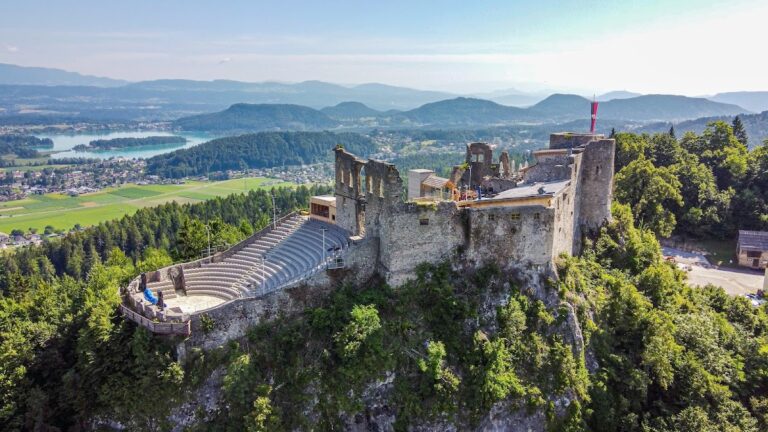
Federaun occupies a western spur of the Graschelitzen southwest of Villach, with steep rock faces reinforcing its position above the Villach–Tarvis road and the place where the route crossed the Gail. The castle covered about 5,000 square metres, placing it among the larger castles in Carinthia. Its late-twelfth-century core stood on the western part of the ridge, while later construction extended the complex eastward and westward. The resulting fortress had a central enclosure and two extensive outer baileys, enclosed areas outside or alongside the main stronghold.
Romanesque Core Castle
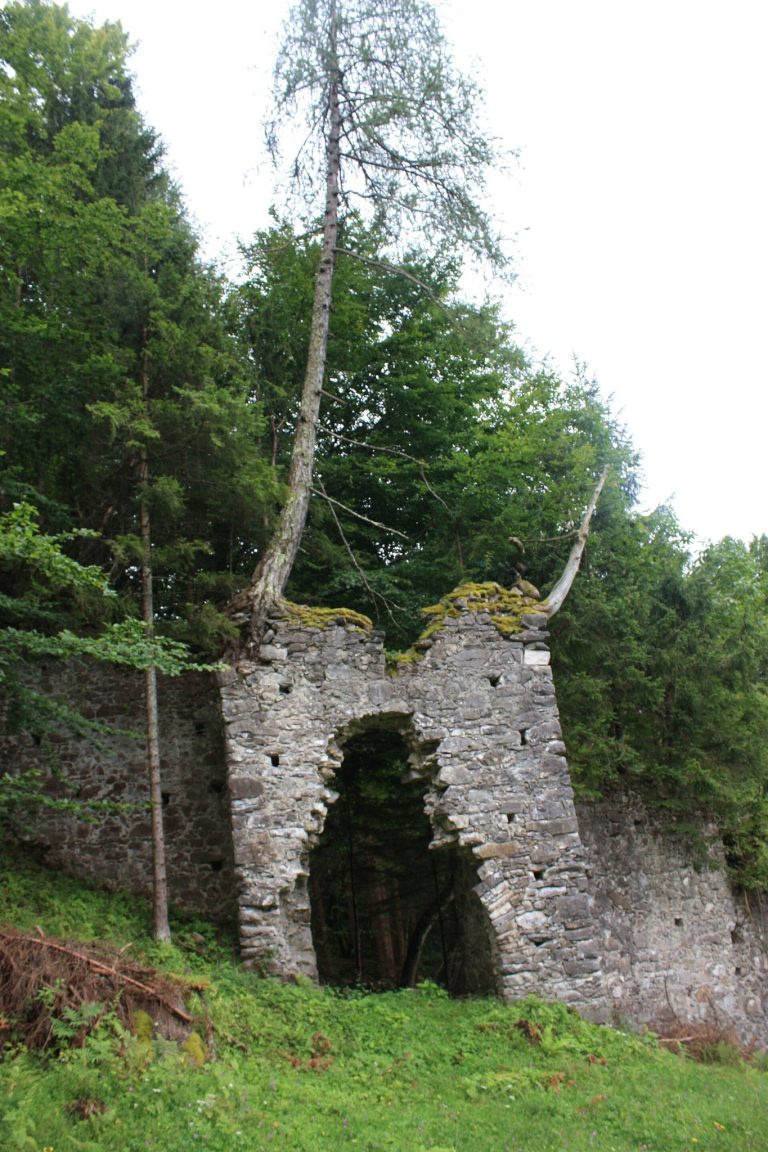
The core castle forms an irregular square of approximately 26 by 26 metres. Buildings once bordered its inner courtyard, while the northern and western curtain walls survive to considerable height. These walls were built from limestone rubble laid in distinct horizontal courses. A keep is presumed to have occupied the northeastern corner, and its foundations remain. The visible wall fabric and the surviving barrel vault probably belong to nineteenth-century work. A finely built conical cistern survives in the main courtyard, providing a notable feature of the central enclosure.
Eastern Tower and Upper Bailey
The twelfth- and thirteenth-century fortress consisted of the western core castle and an eastern tower joined by a curtain wall. This arrangement formed a larger upper bailey. The eastern tower site now contains the remains of a three-storey shell tower dating from the fourteenth century. A shell tower has a largely open or hollow interior toward the protected side. Its surviving masonry represents one of the later stages in the development of the ridge-top fortress.
Eastern Lower Bailey
The extensive lower bailey east of the core castle was probably built in the fourteenth century. Its entrance crossed a substantial neck ditch by means of a drawbridge. A neck ditch is a deep defensive ditch cut across the approach to a fortified height. The gate structures have disappeared and probably stood near the present entrance. A visible building remnant northwest of that entrance probably dates from the early modern period, adding a later phase to the eastern approach.
Northwestern Forework
A further forework occupied the northwest side of the castle. It contained at least two towers, and one tower survives together with several sections of masonry. This outer defensive area extended the fortress beyond the central enclosure and formed part of the complex’s later, enlarged arrangement.
River Defenses and Thurnegg
Federaun’s control of the Gail crossing was reinforced by towers positioned below the main castle. Thurnegg stands on a rock above the river, where it served to block the road before being converted into a residential tower. It is the surviving example of the bridge and road defenses associated with Federaun. The tower’s position connects the river crossing with the fortress’s wider defensive system.
Shot Tower and Pleasure Garden
Moritsch’s shot tower stood in the southeastern corner of the lower bailey from 1861. The surrounding grounds were arranged as a Romantic pleasure garden with flower beds, a pavilion, a grotto, and planted trees. The industrial phase brought factory buildings into the former castle grounds, most of which were demolished in 1889. Minor remnants and the tower keeper’s house preserve elements of this later history alongside the medieval masonry.