Dinzlschloss: A Renaissance Palace and Cultural Centre in Villach


Site at a Glance
- Rating
- 4.7
- Popularity
- Very Low
- Country
- Austria
- Primary era
- Early Modern
- External website
- Open
- Eras represented
- Early Modern, Modern
- Civilizations
- Habsburg, Holy Roman Empire
- Site type
- Domestic
- Remains
- Castle
On this page8 sections
History
Dinzlschloss is a Renaissance palace in Villach, Austria, enlarged around 1550 by Siegmund Khevenhüller as a hunting residence. The property stood at the site of a free Khevenhüller estate documented from the fifteenth century and was originally known as Martineck. It lay within the ecclesiastical jurisdiction of the Archdiocese of Bamberg.
The Khevenhüller estate
Augustin Khevenhüller probably acquired the property before Siegmund expanded it into a Renaissance palace. The Khevenhüllers were a prominent noble family associated with Carinthia. Their ownership is also recalled by the coats of arms displayed above the main entrance.
Changing ownership
Hans Widmann, a merchant from Venice, was recorded as the owner around 1622. In 1637, the property passed by inheritance to Anton Grotta von Grottenegg, who was married to Susanna. The Grotta family was followed by Johann Paul Christoph von Grössing, a nobleman from Klagenfurt who also owned Rotenthurn and Kellerberg castles. He sold Mörtenegg to Princess Dorothea von Porcia in 1720 but probably reacquired it. By 1734, the castle belonged to Johann Christoph von Grössing, parish priest of Obervellach.
Ownership changed repeatedly in the late eighteenth century. Anton Stieger held the castle in 1767 and 1786, Rochus Loidl owned it in 1770, and Sebastian Pogtsch held it in 1796. Johann Georg Maxer owned the property from 1806 to 1874, after which it passed to his widow, Maria.
The Dinzl bequest and later use
The estate entered the possession of the Dinzl family in 1874, giving the residence its alternative name, Dinzlschloss. In the 1940s, Else Dinzl, also identified as Else Eipek-Dinzl, bequeathed the castle to the City of Villach on the condition that it be used for cultural purposes.
British troops occupying the castle after the Second World War caused severe damage, after which Villach carried out major restoration work. From 1953, the building served as an artists’ hostel and cultural centre. Between 1953 and 2004, it also housed apprentices for the Carinthian provincial government. It is now used for youth and cultural activities. Mörtenegg is protected as a monument by the Republic of Austria under protection number 35035.
Remains
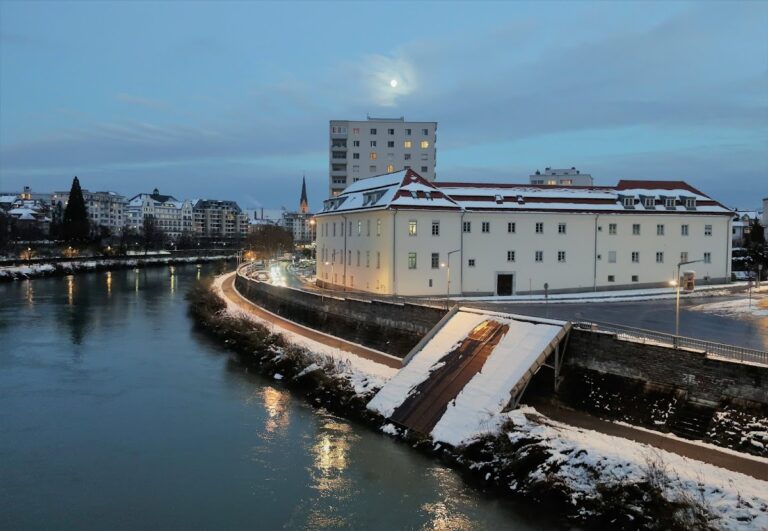
Dinzlschloss is a substantial, medium-sized cubic or rectangular building with three storeys in St. Martin, a district of Villach. A park surrounds the castle and contains sculptures and artworks by Johann Feilacher, Gerhard Leeb, Herbert Mehler, Heinz Ortner, and Franz Schneeweiß.
Main building
The principal façade faces east and was remodelled in the eighteenth century. Two-storey corner oriels frame it. An oriel is a projecting upper-storey window or room, often supported by the building below. The main entrance has a round-arched marble portal, a small balcony, and a round-arched door. Above it are the coats of arms of Siegmund Khevenhüller and his wife, Katharina von Gleinitz. Three sundials were uncovered on the façade in 1985.
Defensive towers
Two round defensive towers stand on the street-facing side, in front of the main complex. Sixteenth-century wall paintings were uncovered in the north-eastern tower in 1978, adding evidence of the castle’s earlier decorative treatment.
Interior rooms
The vaulted entrance hall has ornamental marble capitals, and a stone relief panel of a Pietà dated 1509 is mounted on its left wall. A Pietà is a Christian devotional representation of the Virgin Mary mourning the dead Christ. The central ground-floor hall has a groin vault, a ceiling formed by the intersection of two barrel vaults. The large upper-floor hall contains ornamental capitals and a portal bearing the Khevenhüller coat of arms.
The southern oriel room has a Baroque stucco ceiling dated to around 1720. Baroque was a European artistic and architectural style associated especially with the seventeenth and eighteenth centuries. Fragments of nineteenth-century wall paintings also survive inside the castle.