Castle of Santo Stefano: A Medieval Coastal Fortification near Monopoli


Site at a Glance
- Rating
- 4.5
- Popularity
- Low
- Country
- Italy
- Primary era
- Medieval
- Eras represented
- Classical, Medieval
- Civilizations
- Crusader, Knights Hospitaller, Roman
- Site type
- Military
- Remains
- Castle
On this page7 sections
History
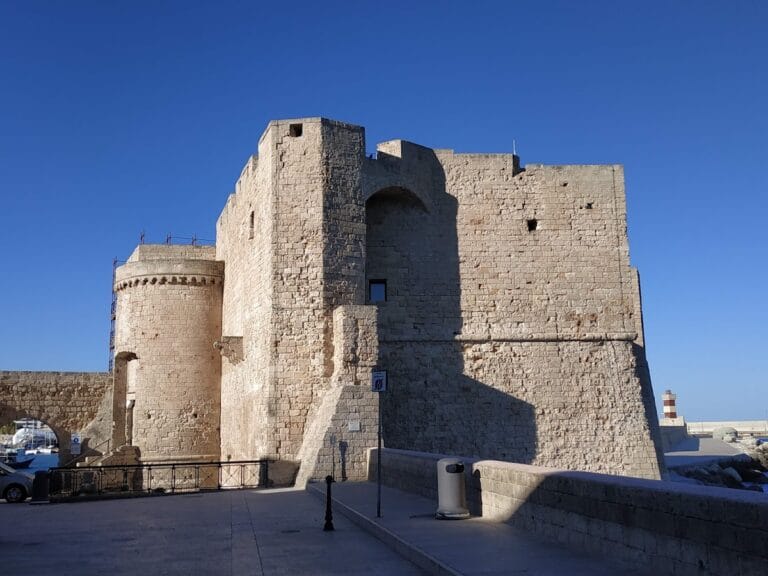
Castle of Santo Stefano, also known as the Abbey of Santo Stefano, is a restored medieval fortification and abbey in Romanesque style on the coast of Italy, outside Monopoli. Its history began with a monastery founded in 1086 by Goffredo, Count of Conversano, a medieval regional noble ruler. The complex later became part of Monopoli’s wider medieval defensive system and supported maritime movement toward the Holy Land.
Late antique and Roman origins
In Late Antiquity, the area was known as Rocca or Turris Paola. Subterranean remains of opus reticulatum, a Roman masonry technique using small stones set diagonally into a concrete wall, indicate an earlier castrum, meaning a fortified Roman settlement or military installation, near Turris Paola. The site was associated with an Adriatic emporium, or possibly a satellite port, of nearby Egnazia, an ancient settlement and port on the Apulian Adriatic coast.
Monastery, fortress, and the Knights of Malta
Goffredo of Conversano established the monastery in 1086, and it became a Benedictine foundation. Benedictines belong to the Order of Saint Benedict, a Western Christian monastic order governed by the Benedictine Rule. A saint’s relic was kept at the monastery, and its presence gave the fortress the name Santo Stefano.
By the end of the thirteenth century, the Knights of Malta, also called the Hospitallers or Knights Hospitaller, moved into the abbey from a house within Monopoli’s walls that had served as a hospital. This religious-military order cared for pilgrims and defended routes connected with the Holy Land. The knights refortified the older coastal stronghold and created the Bailiwick of Santo Stefano of Monopoli in 1435. A bailiwick was an administrative jurisdiction of the order.
The fortified abbey helped the Knights control maritime traffic toward the Holy Land. When winds known as the gregale or greco-levante made the route difficult, the complex became a necessary stopping place for mariners travelling between Bari and Brindisi. The relic was transferred from Monopoli to Putignano on 26 December 1365 because of continuing Turkish and pirate attacks.
Later administration and ownership
During the eighteenth and nineteenth centuries, the surrounding area was incorporated into the chapter of Monopoli Cathedral. After Monopoli’s voluntary annexation, described as the first such city in Apulia, the abbey, its lands, and the castle passed under Bourbon administration. The Bourbon dynasty ruled the Kingdom of the Two Sicilies and related territories in southern Italy. The De Bellis family now owns the castle, as descendants of Saverio De Bellis.
Remains
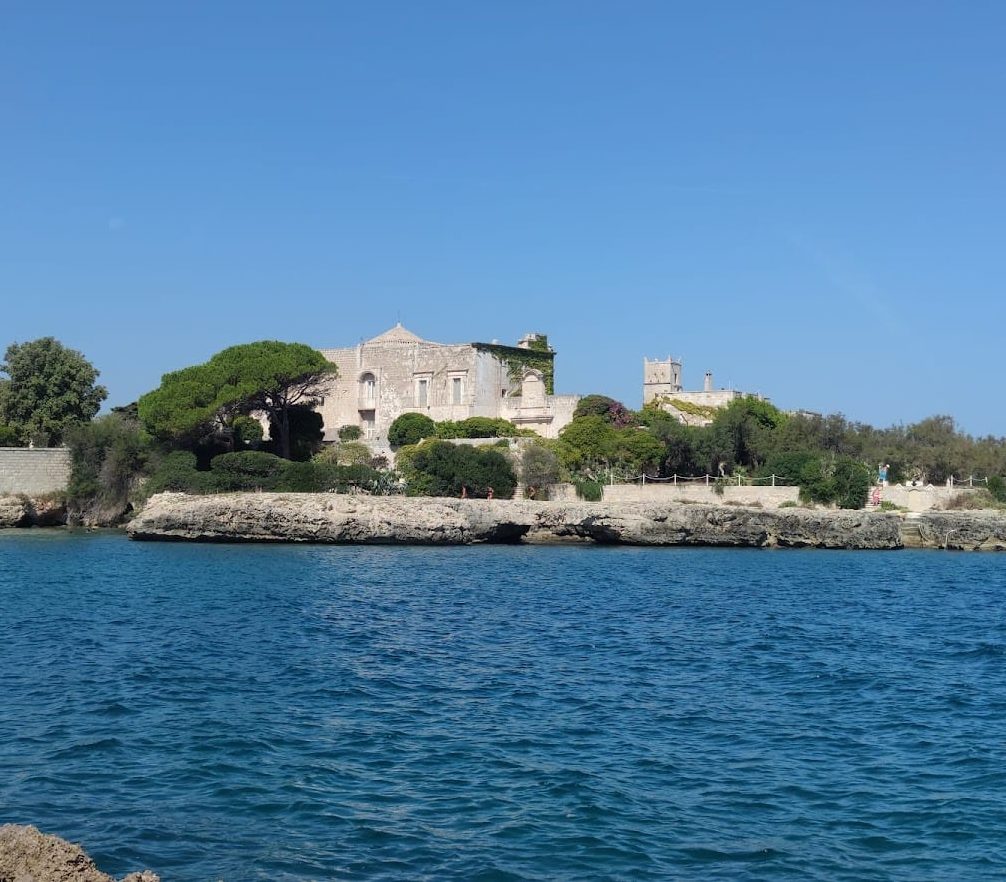
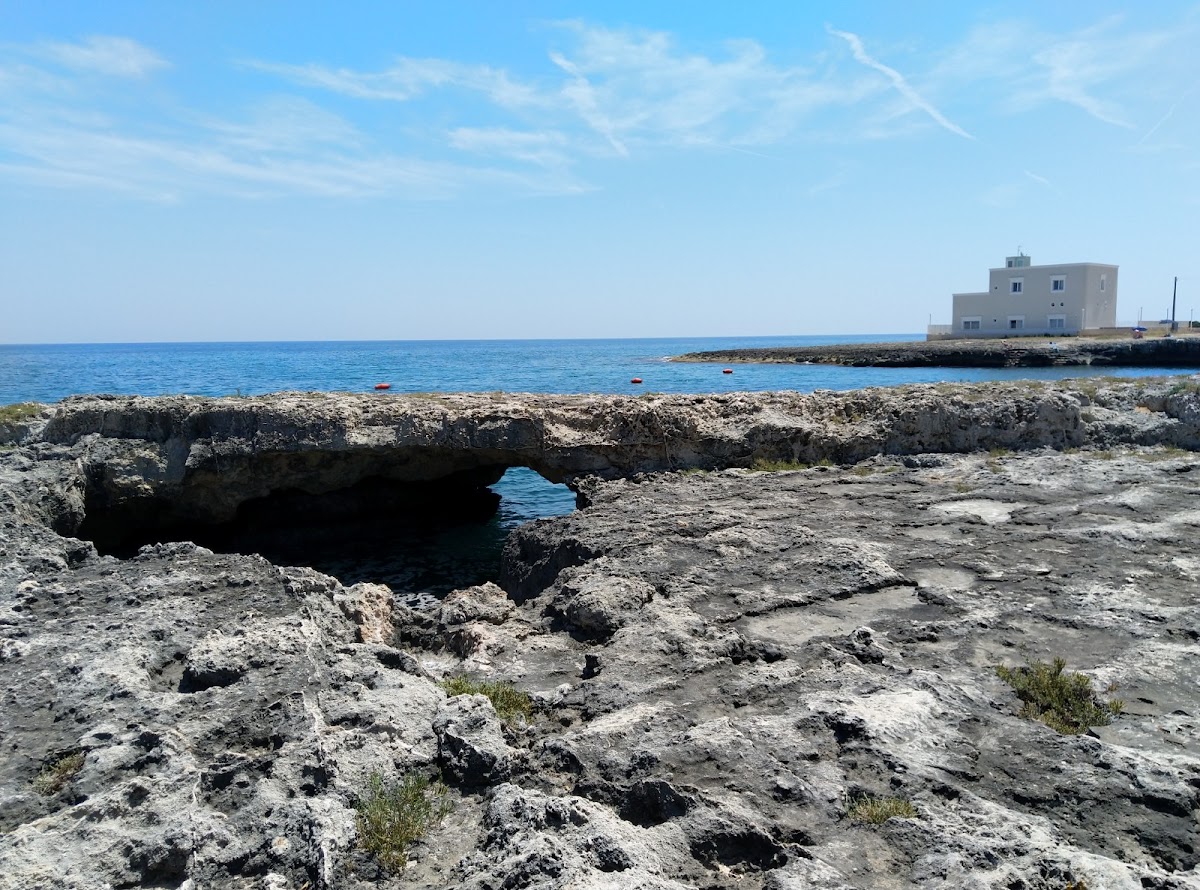
Castle of Santo Stefano occupies a small peninsula projecting between two Adriatic coves. The coves form the natural harbours associated with the present Santo Stefano and Ghiacciolo beaches. The low-lying stronghold stands at approximately one metre above sea level and is built of rubble stone. Its physical form combines the medieval abbey and coastal fortification with features adapted to monastic life, defense, and maritime use.
Coastal defenses and harbours
The moat created by the Knights of Malta remains visible around the fortified complex. The knights also adapted the two coves, one on each side of the monastery-fortress, for ship berthing. Together, the small natural harbours could shelter several ships at the same time and supported their repair and resupply during voyages toward the Holy Land. A groundwater or freshwater well served the monastic-fortified complex.
Subterranean Roman remains
Below the medieval structure, subterranean areas preserve remains of opus reticulatum. The regularly arranged diagonal stonework belongs to the earlier Roman building tradition associated with the castrum near Turris Paola, linking the coastal stronghold to the site’s Late antique setting.