Burg Limberg: A Medieval Hill Castle in Germany



Site at a Glance
- Rating
- 4.4
- Popularity
- Low
- Country
- Germany
- Primary era
- Medieval
- Eras represented
- Medieval
- Civilizations
- Holy Roman Empire
- Site type
- Military
- Remains
- Castle
On this page9 sections
History
Burg Limberg is a ruined medieval hill castle in Germany, built in the thirteenth century at a strategically favorable position between the bishoprics of Minden and Osnabrück. The Bishop of Minden probably established it. Tradition places an earlier castle or fortified installation on the site and associates it with Duke Widukind, the Saxon leader who resisted Charlemagne’s conquest and Christianization of Saxony in the late eighth century.
Ravensberg and the Jülich succession
Around 1300, Limberg became a fief of the Counts of Ravensberg, who expanded the castle. Its first written documentation dates from 1319. When Bernard, the last Count of Ravensberg, died in 1346, Limberg passed with the county to the later Duke of Jülich and Berg.
Fire damaged the castle in 1554, and the complex was subsequently restored. Under the Treaty of Xanten in 1614, an agreement made during the War of the Jülich Succession, a conflict over the inheritance of the Jülich territories, Limberg was assigned to the Elector of Brandenburg.
War, garrison, and decline
During the Thirty Years’ War, Count Palatine of Neuburg captured and held the castle for several years. From 1623, a garrison of thirty men was intended to defend Limberg, but the troops were sent to take part in the siege of Lippstadt. Their departure allowed the Count Palatine of Neuburg to seize the castle. Brandenburg reoccupied it with a small contingent after 1647.
In 1662, the twenty-man garrison was transferred to Sparrenburg, ending Limberg’s use as a military station. The castle remained administered by different pledge-holders and officials, including bailiffs and Droste, an administrative office-holder. By the late seventeenth century, the complex had deteriorated so far that it was barely usable for military purposes.
In 1695, Elector Frederick III, later Frederick I of Prussia, recommended demolishing the uninhabitable Limberg House. He argued that the castle did not stand on a pass and could provide an enemy with a refuge during wartime. The tower nevertheless continued to serve as a prison until 1805. The castle complex was sold in 1832.
Preservation
An association dedicated to preserving the ruins was founded in the 1980s. Burg Limberg is designated as an architectural heritage monument in North Rhine-Westphalia.
Remains
The ruins occupy the 190-metre-high Limberg in the Wiehen Hills, near Börninghausen in the borough of Preußisch Oldendorf. Surviving elements include the principal tower, defensive banks, portions of the residential hall, sections of the surrounding defensive enclosure, and the castle moat.
Castle buildings and defenses
Fortified tower
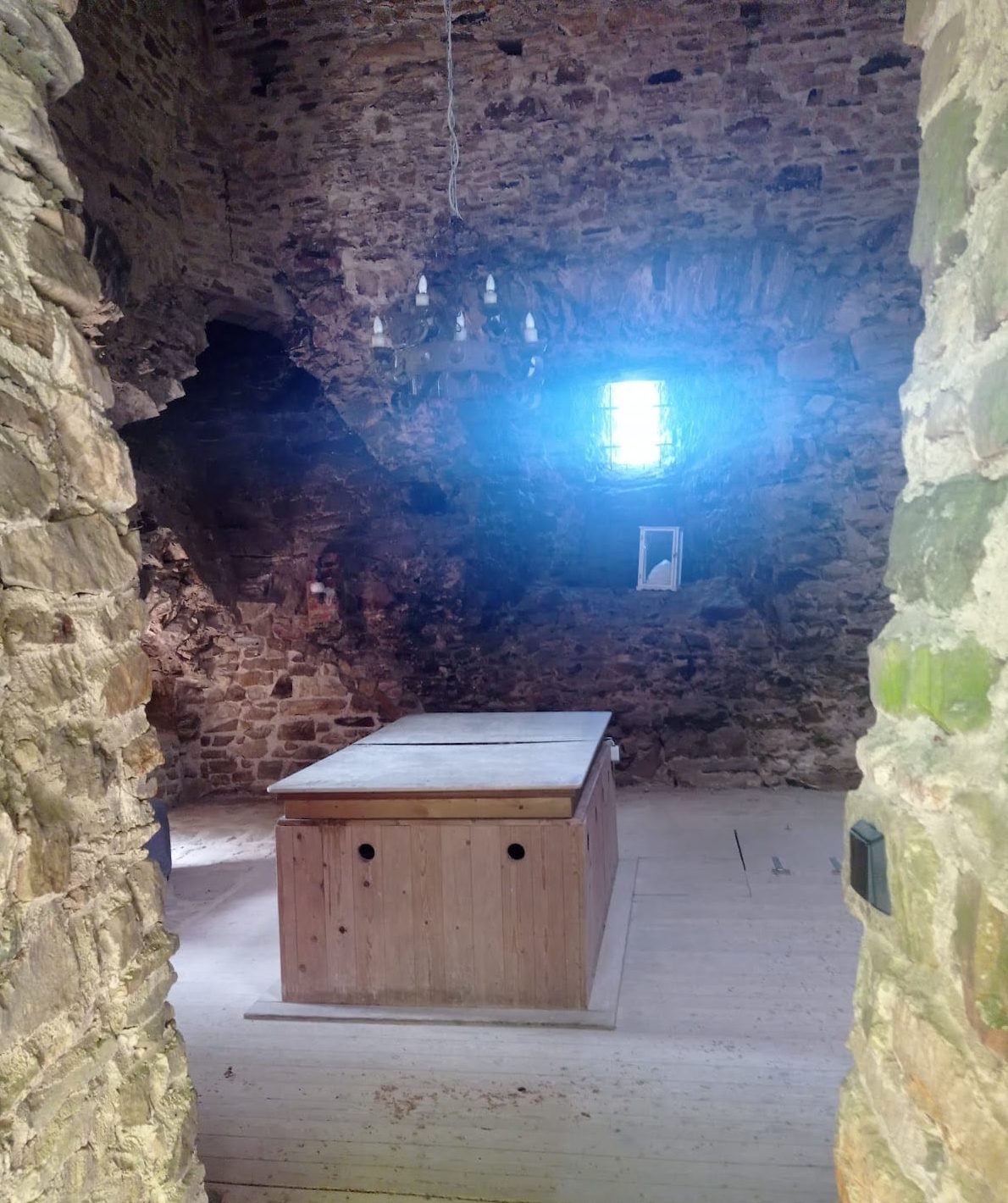
The main surviving structure is a square bergfried, the principal fortified tower of a medieval German castle. It rises twelve metres and has sides twelve metres long. The tower was restored around 1989 and forms the clearest surviving expression of the castle’s defensive architecture.
Walls, banks, and moat
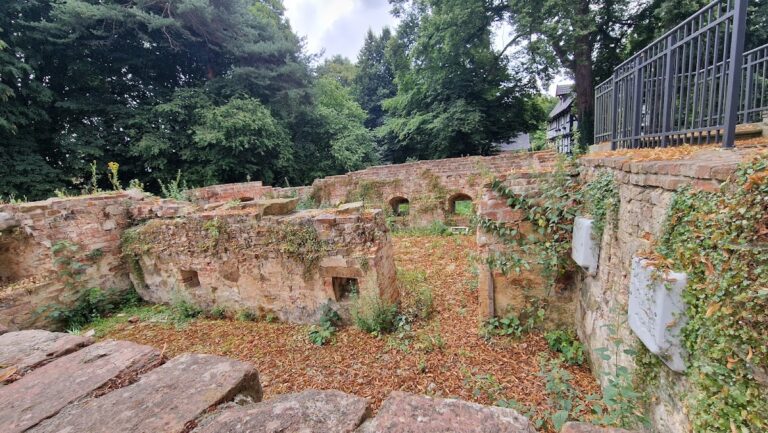
Several defensive banks remain around the ruins, together with wall fragments from the palas, the castle’s principal residential or hall building. Parts of the enceinte, the surrounding defensive wall or enclosure, also survive. The castle moat remains as part of the site’s defensive layout.
Gogerichtslinde
A roughly 600-year-old court lime tree, known as the Gogerichtslinde, stands at the castle. It formerly marked the site of a Gogericht, a regional court responsible for administering justice across a wider rural district. The tree preserves the memory of this judicial function alongside the castle’s military remains.