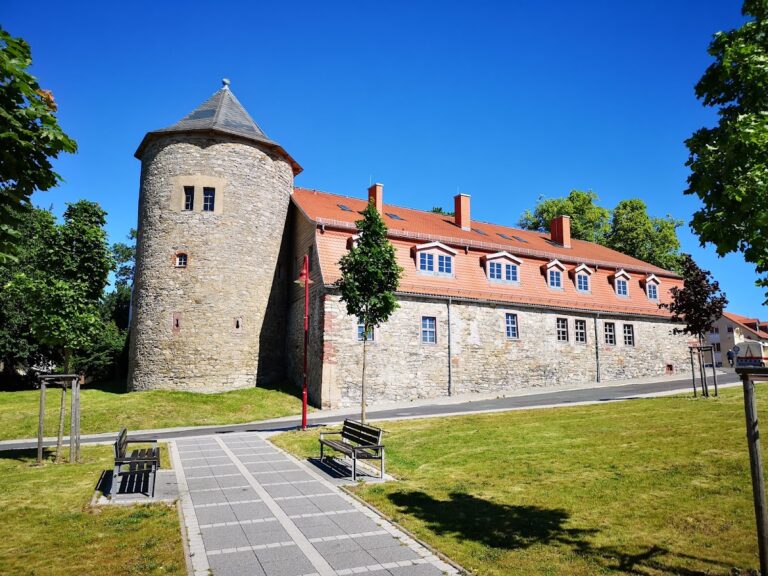
Burg Questenberg: A Medieval Hill Castle in Germany


Site at a Glance
- Rating
- 4.5
- Popularity
- Low
- Country
- Germany
- Primary era
- Medieval
- Eras represented
- Medieval
- Civilizations
- Holy Roman Empire
- Site type
- Military
- Remains
- Castle
On this page11 sections
History
Burg Questenberg is the ruin of a medieval feudal hill castle in Germany, probably built between about 1200 and 1250 by the Counts of Beichlingen. It stands on the Burgberg north of the village of Questenberg in Saxony-Anhalt and became the namesake of the Questenberg noble family.
Beichlingen and Hohnstein rule
In 1275, Fredericus de Questenberg appeared in the entourage of Count Friedrich of Beichlingen as a servus, meaning a dependent retainer. His association with the castle reflects the emergence of the Questenberg family, whose name derived from the stronghold. The Counts of Hohnstein had acquired the castle by 1305, and it was directly mentioned in 1349 as “hus zcuo Questinberg.”
The knight Heinrich von dem Rade and his brothers later received Questenberg and seven associated villages as a fief. A fief was property granted by a superior lord in return for service or loyalty. In 1383, the Counts of Hohnstein sold the lordship to Landgrave Balthasar of Thuringia. The Thuringian landgraves then held the castle and lordship mainly as pledged property, using them as security for financial obligations.
Thuringian and Stolberg administration
From 1424 to 1430, Landgrave Friedrich I pledged the castle and the Questenberg administrative district to Dietrich von Witzleben and his son Friedrich for 450 marks of silver. An administrative district, or Amt, was a territorial unit governed on behalf of a ruler. In 1430, the Thuringian landgraves sold the lordship to the Counts of Stolberg.
The Stolbergs continued to use Questenberg largely through pledge arrangements. The lordship first passed to the Knaut family, then from 1468 to 1486 to the Altmark family von Bertkow, and from 1486 until 1670 back to the Knauts. From 1645, the Stolberg-Wernigerode branch of the dynasty was the feudal lord. In 1718, the lordship passed by purchase to the Counts of Stolberg-Roßla.
Decline and preservation
The castle’s last military use came in 1633, when war commissary Valenthin Rothmehler, a military administrative official, used it to quarter a company deployed against the Harzschützen. These were armed groups active in the Harz during the Thirty Years’ War. The castle had already been described as deserted during the German Peasants’ War, the widespread Central European uprising of 1524–1525. By 1649, its condition had deteriorated so severely that only a few cellars remained usable.
The municipality is the current owner. Because it was unable to undertake the necessary preservation work, a preservation association was founded in October 2013 to secure the surviving fabric and make the castle accessible again. Burg Questenberg is designated as a cultural monument in Saxony-Anhalt.
Remains
The remains occupy the Burgberg at approximately 280 metres above sea level. The surviving medieval hilltop complex consists of the keep, parts of the defensive enclosure, two cellars, and one surviving wall of the palas, the main residential or representational building of a German medieval castle. The keep and wall remains are in structurally very poor condition.
Fortifications
Keep
The keep, the principal fortified tower of a medieval castle, survives as one of the defining elements of Burg Questenberg. Its remaining fabric forms part of the ruin on the hilltop, although the structure is in very poor condition.
Defensive enclosure
Sections of the castle’s curtain wall survive around the former stronghold. These wall remains represent parts of the defensive enclosure and are likewise in a structurally very poor state.
Residential and underground remains
Palas wall
One wall of the palas remains standing. As the principal residential and representational building, the palas formed an important part of the castle’s built complex, and its surviving wall preserves a fragment of that medieval structure.
Cellars
Two cellars are preserved among the ruins. They are the most substantial surviving underground elements identified at the site and were the only parts of the castle still usable when the deteriorated stronghold was described in 1649.
Nearby sites