Barry Castle: A Norman Fortress in Barry, United Kingdom


Site at a Glance
- Rating
- 4.1
- Popularity
- Low
- Country
- United Kingdom
- Primary era
- Medieval
- Eras represented
- Medieval
- Civilizations
- Norman
- Site type
- Military
- Remains
- Castle
On this page7 sections
History
Barry Castle is a Norman fortress in Barry, United Kingdom, established during the Norman conquest period as an earth-and-wood fortification, probably in the late eleventh century. Its construction is associated with the Norman knight Odo. The castle took its name from the nearby island associated with the pre-Norman chapel of St. Barruca. Gerald de Barri, a medieval churchman and writer, stated that his family took its name from the castle and the settlement of de Barri.
From timber fortification to stone castle
During the late thirteenth century, the original timber defenses were progressively replaced with stone buildings. This work is associated with Lucas de Barry. John de Barry later repaired and enlarged the castle, adding a residential hall and gatehouse. The new arrangement formed a small fortified enclosure rather than the earlier earth-and-timber stronghold.
In 1316, during the revolt of Llywelyn Bren against Edward II, the castle was attacked and severely damaged. Llywelyn Bren was a Welsh leader who led a major uprising against English rule in Glamorgan in 1316 and 1317. After the attack, John de Barry repaired and enlarged Barry Castle.
Decline and protection
By the sixteenth century, Barry Castle had been abandoned and was falling into decay. The gatehouse was probably repaired briefly during the English Civil War, but the complex deteriorated again after the conflict. The ruin is now maintained by Cadw, the Welsh government’s historic-environment service, together with the local administration of Barry. It is a Grade II* listed building, a designation for particularly important architectural or historic interest, and a Scheduled Monument, meaning that it has legal protection as an archaeological or historic site.
Remains
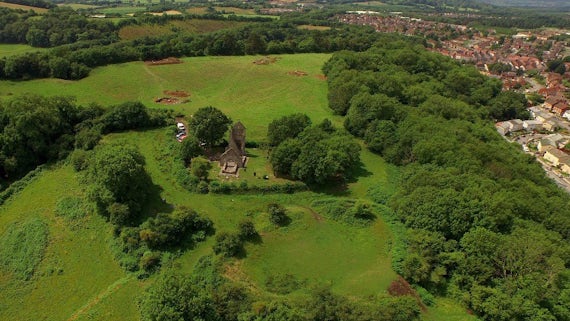
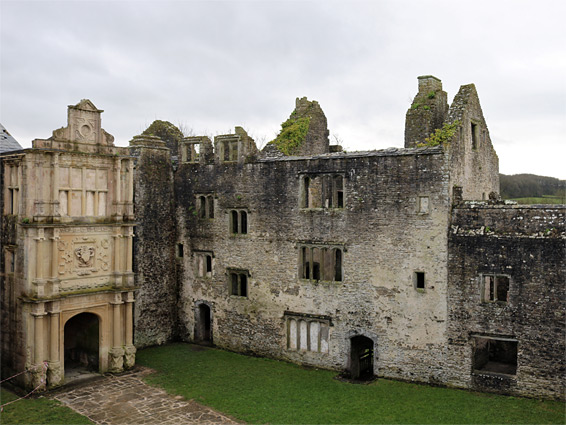
Barry Castle stands on a small hill in central Barry, north of Romilly Park. The earliest fortification occupied an area about 35 metres in diameter and consisted of timber-and-earth defenses surrounded by a protective ditch. The later castle formed a small rectangular enclosure bounded by defensive walls, with stone buildings placed at its north-east and north-west corners and walls enclosing a small courtyard.
Gatehouse and southern building
Gatehouse
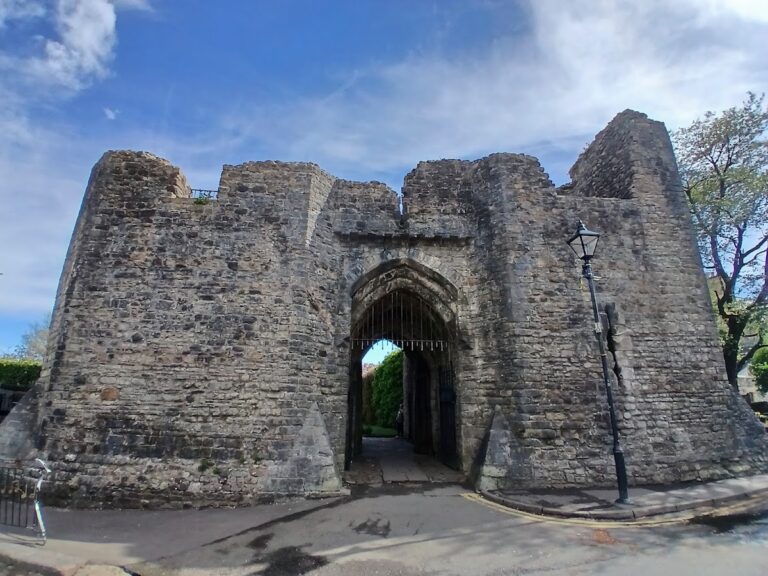
The principal surviving structure is a small, two-storey gatehouse with a vaulted passage through it. Its entrance had a pointed, or ogival, portal, double doors, a portcullis, and a drawbridge. A portcullis is a heavily fortified gate that moves vertically. A small room above the passage probably served as a chapel. The upper floor connected with the adjacent hall building, while a curving passage inside the gatehouse led to the defensive wall-walk.
Southern building
The adjacent southern building contained a residential hall on its first floor, with a fireplace in the north wall. Its ground floor retained arrow slits, narrow openings through which defenders could shoot, and the hall originally had a slate roof. Access from the courtyard may have reached the first floor by an external wooden staircase. The outer wall of this building survives alongside fragments of the northern and eastern walls, an arrowslit, an ogival portal, and a Gothic window.