Château de Luc: A Feudal Fortress and Route-Guarding Castle in France


Site at a Glance
- Rating
- 4.4
- Popularity
- Low
- Country
- France
- Primary era
- Medieval
- External website
- Open
- Eras represented
- Medieval
- Civilizations
- Unclassified
- Site type
- Military
- Remains
- Castle
On this page8 sections
History
Château de Luc is a ruined feudal castle in France, positioned between the historic regions of Gévaudan and Vivarais. Its construction date is uncertain, but the fortress occupied an earlier Celtic site and guarded the Regordane Way, a medieval route linking Auvergne with southern France. Pilgrims traveling toward Saint-Gilles used the route, and the castle also served as a toll gate, giving its frontier position both military and economic importance.
Feudal Ownership
For roughly its first century, the castle belonged to the Luc family. It later passed to regional seigneurs, feudal lords who controlled land and dependants. Through marriage, the lords of Luc became connected with the barons of Randon, one of Gévaudan’s eight baronies, and through that lineage with the House of Joyeuse.
The castle subsequently came into the possession of the Polignac family. Individual sections, however, were held by neighboring lords. One tower belonged to the Agrain des Hubacs family, while another was held by the Bourbal de Choissinet family.
Wartime Fortress
During the Hundred Years’ War, armed bands of mercenaries and freebooters known as routiers besieged Château de Luc in 1380. People who had taken refuge inside the castle were relieved by ten local nobles led by three lords, including Béraud d’Agrain des Ubas. The fortress withstood several sieges during the conflict.
In the sixteenth-century Wars of Religion, the conflicts between Catholics and Protestants in France, the authorities of Gévaudan stationed a garrison at the castle to protect this part of the region. Its military role continued until the first half of the seventeenth century.
Dismantling and Preservation
After 1630, the castle was dismantled at the request of Cardinal Richelieu, the powerful minister of King Louis XIII whose royal policy led to the destruction of several regional fortresses. Châteauneuf-de-Randon and Grèzes were dismantled during the same period. Château de Luc then deteriorated through neglect, including during the period surrounding the French Revolution.
In 1878, local parishioners renovated the keep, the castle’s principal fortified tower, as a chapel and installed a shrine to the Virgin Mary. That year, the English writer Robert Louis Stevenson passed the ruins and described the tall white statue of the Virgin in Travels with a Donkey in the Cévennes. He recorded the tradition that it weighed fifty quintals, a traditional unit whose value varied by place and period, and noted that its dedication was planned for 6 October.
Since 1978, the preservation association Amis du château de Luc has worked to restore and promote the ruins. The commune of Luc owns the castle, which was listed as a historic monument on 10 February 1986.
Remains
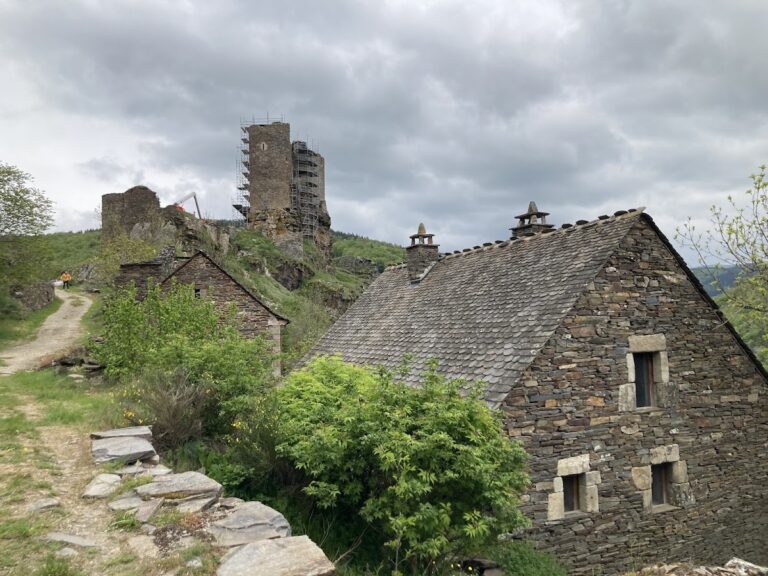
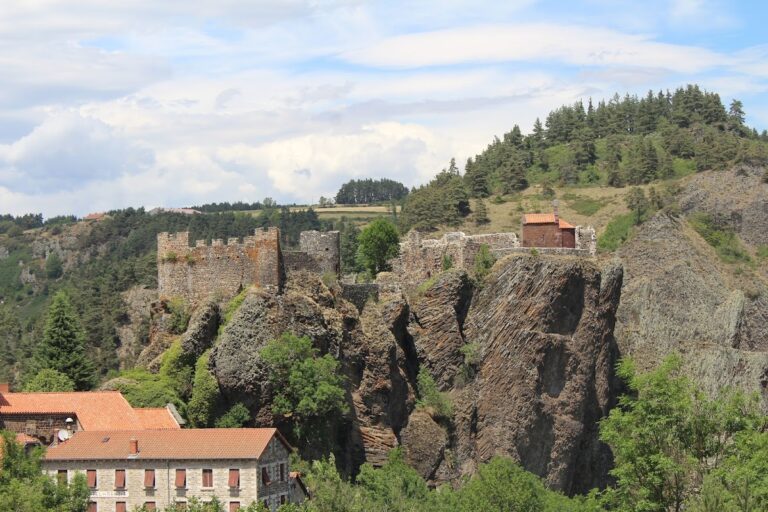
Château de Luc survives as a ruined fortress overlooking the Allier valley. It stands on a site described as Celtic, at the foot of the Mercoire Forest, with the Tanargue massif nearby. The surviving complex includes a rectangular residential block, while the former keep rises as a chapel. Extensive fishbone masonry, formed by diagonal courses of stone laid in alternating directions, remains visible in the residential building’s façades. Together, the ruins convey the former strength of the fortress while also showing the effects of its dismantling after 1630 and later neglect.
Residential and Defensive Structures
Residential Block
The surviving residential block is rectangular in plan. Its façades are extensively built in fishbone masonry, a technique that produces a herringbone-like pattern through alternating diagonal courses of stone. This building forms the principal surviving domestic element of the castle complex.
Keep Chapel
The keep was converted into a chapel in 1878. A tall white statue of the Virgin Mary remains installed at its summit, continuing the religious use given to the fortified tower by local parishioners. The conversion preserved the keep as a prominent surviving part of the ruined fortress.
Nearby sites