Burg Mellnau: A Medieval Hilltop Castle Ruin in Germany


Site at a Glance
- Rating
- 4.4
- Popularity
- Low
- Country
- Germany
- Primary era
- Medieval
- External website
- Open
- Eras represented
- Medieval
- Civilizations
- Holy Roman Empire
- Site type
- Military
- Remains
- Castle
On this page8 sections
History
Burg Mellnau is a medieval hilltop castle ruin above Mellnau, now part of Wetter in Hesse, Germany. It was probably built around 1248 under Archbishop Siegfried III of Mainz, possibly to replace the destroyed Hollende Castle and protect the Wetter collegiate foundation, a religious institution served by a community of canons. The castle was first recorded in 1263 as “Elenhouch” and was usually called “Elnhoch” thereafter, while the name “Mellnau” came into use for the castle around 1500.
Mainz and Hesse
An archbishop was a senior bishop who governed an archbishopric, a major ecclesiastical territory. In the medieval German lands, the Archbishops of Mainz also exercised territorial power. An agreement between the Landgraviate of Hesse and Archbishop Werner of Mainz in 1263 confirmed, among other provisions, that Burg Mellnau would remain within the sphere of the Archbishopric of Mainz.
The castle became involved in the Rhine Toll War, a conflict between King Albert I, the archbishoprics of Cologne, Mainz, and Trier, and the Count Palatine of the Rhine. In 1301, the imperial bailiff Ulrich I of Hanau captured Burg Mellnau. The castle was later pledged several times, until Archbishop Heinrich III of Virneburg redeemed it in 1342. Landgrave Hermann II of Hesse unsuccessfully besieged it in 1381.
Transfer and Decline
After the Mainz collegiate feud, the archbishopric’s share in the Wetter collegiate foundation, together with Burg Mellnau, was pledged to the Landgraves of Hesse in 1464. A landgrave was a high-ranking territorial ruler whose position was broadly comparable to that of a prince. Burg Mellnau thereafter remained Hessian and lost its military importance.
The castle became a fief of the Lords Milchling of Schönstadt. From 1510, castle men, the retainers responsible for occupying and defending a castle, no longer lived there because the Hessian official’s seat was transferred to Wetter. The unused complex gradually fell into decay. During the nineteenth century, its feudal holdings were converted into allodial property, meaning privately held property without feudal tenure, and the castle became private property of the Milchling family. The ruin is included among Wetter’s cultural heritage monuments and is designated as a cultural heritage monument in Hesse.
Remains
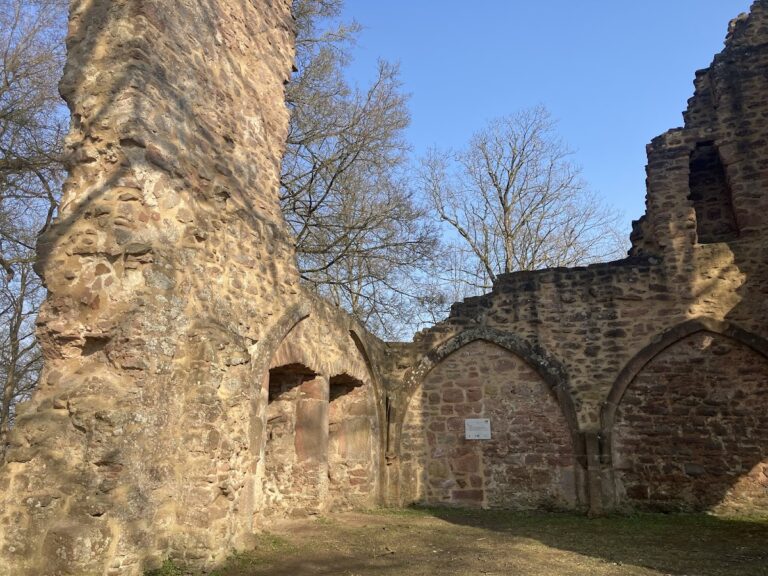
Burg Mellnau occupies a mountain summit above Mellnau. Its medieval core follows an almost oval plan, with a ring wall surviving across much of its circuit. The principal surviving elements are the enclosing defenses, the gate areas, the palas ruins, and a free-standing round keep in the eastern part of the core castle.
Defensive Enclosure and Buildings
Ring Wall and Gates
The ring wall remains preserved to a considerable extent around the almost oval core. On the northern side, at the level of the keep, the wall becomes a shield wall, a particularly strong section designed to protect the most vulnerable side. A later gate complex interrupts the ring wall on the southwest. The original gate stood immediately east of the keep and is now walled up, leaving both the later entrance area and the blocked earlier gate as parts of the surviving ruin.
Palas
The southeast section of the ring wall contains the ruins of the palas, the main residential and representative building of a medieval castle. Its remains form part of the castle core alongside the defensive enclosure and keep.
Keep
The round keep stands free in the eastern part of the core castle. Built in 1329–1331, it rises 19 metres and measures 9.5 metres in diameter, with walls up to 3 metres thick. A castle keep was the principal fortified tower of a castle. Burg Mellnau’s surviving keep now serves as an observation tower.