Burg Caldern: A Medieval Hill-Spur Castle in Germany


Site at a Glance
- Rating
- 3.8
- Popularity
- Very Low
- Country
- Germany
- Primary era
- Medieval
- Eras represented
- Medieval
- Civilizations
- Holy Roman Empire
- Site type
- Military
- Remains
- Castle
On this page11 sections
History
Foundation and stone construction
Burg Caldern is a medieval hill-spur castle in Germany, founded by Count Giso I shortly after 1000. The Giso family, a noble lineage associated with the region, later developed it into a stone tower castle during the second quarter of the eleventh century, possibly around 1030. This form of fortification centered on a substantial tower enclosed by a defensive wall and was characteristic of the high nobility, the upper rank of the medieval aristocracy.
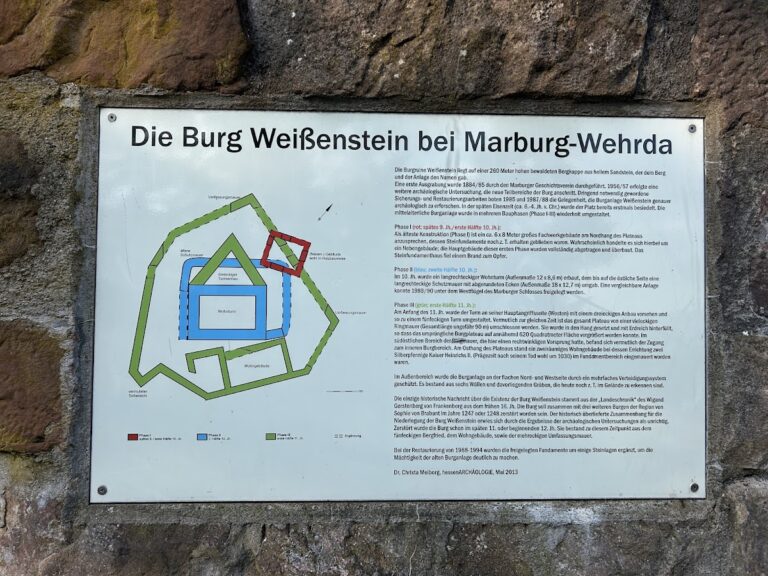
The earliest phase may have involved a wooden fortification, although this remains unproven. The dating of the stone castle rests on excavated finds and comparisons with Burg Weißenstein and Marburg Castle. An earlier interpretation by the medieval archaeologist Rolf Gensen placed the origins of the castle in the late eighth or middle of the ninth century and its abandonment in the eleventh century. Later studies instead placed its foundation after 1000 and associated the finds with eleventh-century castles.
Destruction, later use, and investigation
Burg Caldern and Burg Weißenstein were probably destroyed or abandoned during the first half of the twelfth century, no later than 1137, after the death of Count Giso V. The castle area continued to be used afterward, probably until the late twelfth century and perhaps into the early thirteenth century.
A survey and trial excavations took place in 1974 during a medieval-archaeology training project directed by Gensen. The work showed that the castle occupied the summit of the castle hill and consisted of a rectangular tower surrounded by a ring wall. Animal bones recovered at the site were examined at the University of Giessen in 1986 as part of a doctoral study. They came from cattle, goats, sheep, pigs, geese, chickens, deer, hare, and cat. Pork predominated, while wild game formed only a minor part of the remains.
The aircraft crash memorial
On 2 December 1944, a German fighter aircraft crashed into the hill after being shot down by an American fighter aircraft. The nineteen-year-old pilot was killed. A memorial stone has stood at the crash site since 2007, adding a twentieth-century memorial to the medieval remains.
Remains
Hill spur and defenses
Burg Caldern lies at 319 metres above sea level, approximately 500 metres southwest of Caldern in the municipality of Lahntal, Hesse. The ruin occupies a mountain spur projecting northwest into a side valley of the Lahn. This spur forms a west-northwestern extension of the 411.5-metre Hungert, while the 497.1-metre Rimberg lies about 2 kilometres east-southeast. The castle hill occupies approximately 0.04 hectares.
The elliptical summit has a lower, broader southern elevation and a higher, steeper northern elevation, separated by a depression. The hill falls steeply on every side except toward the southern saddle. On the northern side, rock cliffs are partly vertical and reach up to 7 metres in height. A rampart with an adjoining ditch lies in front of the southern and southeastern sides. A small terrace, approximately 7 metres wide, projects northward from the otherwise almost circular upper part of the hill.
Castle enclosure
The castle had an oval ground plan measuring approximately 28 metres from southwest to northeast and 23 metres from northwest to southeast. Its surviving remains consist mainly of foundations and traces of the ditch. The ring wall was built with mortar and was approximately 1.15 metres thick. It followed the contours of the hill in straight or slightly curved sections, but on the eastern side it shifted about 4.10 metres at a right angle. Because no opening survives there, the entrance may have been reached by a drawbridge, a movable bridge used to cross a ditch or control access.
Tower and excavated objects
Stone tower
The rectangular stone tower measured 9.60 by 7.50 metres externally and 6.60 by 4.50 metres internally. Its walls were 1.50 metres thick. Numerous traces of burning inside the structure were interpreted as evidence for at least one intermediate floor and several upper storeys. The tower formed the central element of the castle’s stone phase and was enclosed by the ring wall.
Small finds and animal remains
Excavations produced a partially preserved bone flute, an iron riding spur measuring 16 centimetres, a decorated circular gaming counter made from antler, a decorated bone plate, and fragments of pottery. Numerous animal bones were also recovered. The range of domestic and wild species, together with the predominance of pig bones, provides material evidence of food use at the medieval castle.
Crash memorial
A memorial stone marks the place where the German fighter aircraft crashed in 1944. It commemorates the nineteen-year-old pilot who died in the crash and remains a separate memorial feature within the historic landscape of Burg Caldern.