Château de Parthenay: A Medieval Castle in France


Site at a Glance
- Rating
- 4.4
- Popularity
- Low
- Country
- France
- Primary era
- Medieval
- External website
- Open
- Eras represented
- Medieval
- Civilizations
- French
- Site type
- Military
- Remains
- Castle
On this page11 sections
History
Medieval development
The Château de Parthenay is a medieval castle in France, developed by the Larchevêque family, powerful lords of the historic Poitou region. Human occupation on the site reaches back to around the tenth to twelfth centuries, while the castle became especially important from the twelfth through the fifteenth centuries.
The first military constructions were built from 1227, during the first half of the thirteenth century. Fortification continued in the following years, creating a stronghold that faced numerous sieges by princes and kings. Further changes were made during the fifteenth century. The castle stood at a strategic crossroads linking the old roads from Poitiers to Nantes and from Thouars to Niort, while a prosperous town developed below it in the valley under the stronghold’s immediate authority.
Demolition and protection
The castle was demolished in 1830, but substantial parts of its defensive system survived. The remaining fortifications were classified as historic monuments by decree on 2 September 1994.
Remains
Setting and fortified settlement
The site occupies the northern end of a large platform about 440 metres long and between 130 and 180 metres wide. The ground falls most sharply toward the valley at this end. Oriented from north to south, the platform extends into a loop of the Thouet and overlooks the river to the east. The upper enclosure also contains bourgeois houses that form a walled settlement, preserving the relationship between the stronghold and the town that grew around it.
Castle and defensive walls
Seigneurial castle
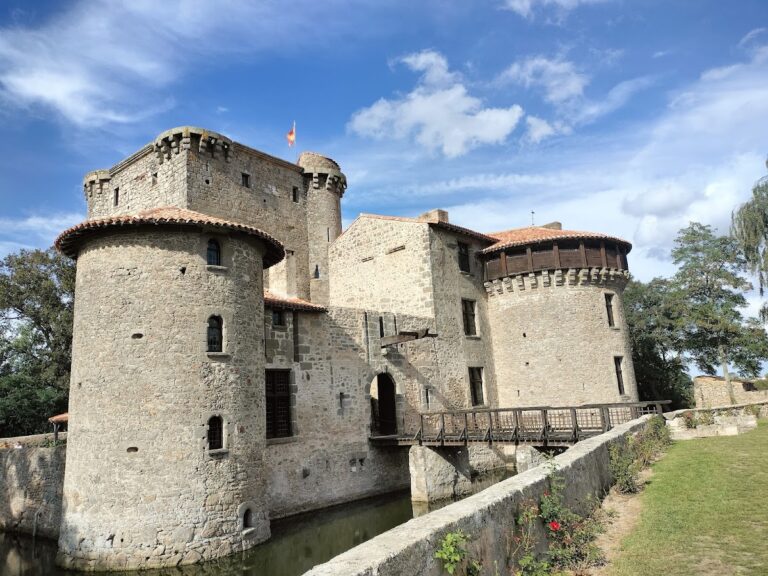
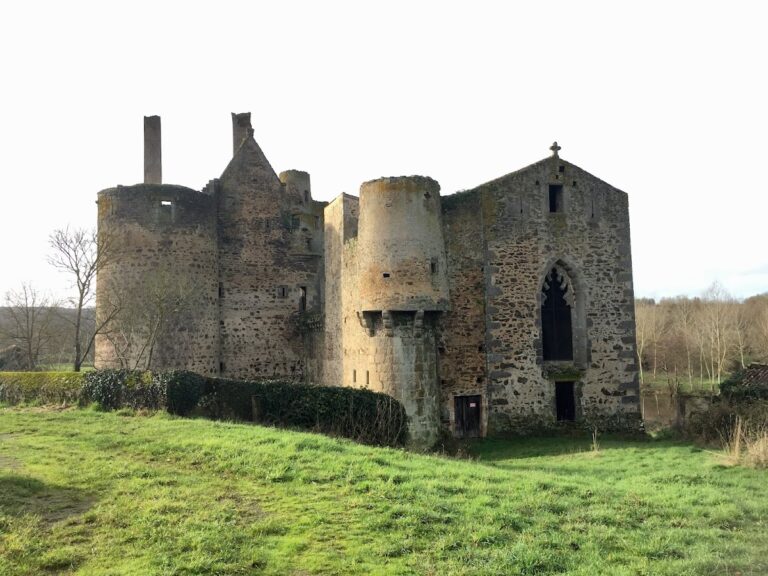
The former seigneurial castle, a castle belonging to a feudal lord, is now ruined, although much of its walls and towers remain visible. A large round tower, possibly the keep, has been restored and is among the best-preserved parts of the complex.
Town ramparts
Sections of the town ramparts survive in reduced form along Boulevard de la Meilleraye, where numerous traces of horseshoe-shaped towers can still be seen. A second enclosure strengthened the first on its eastern and western sides. On the west, remains are visible near Rue du Moulin. On the east, near the calvary on Boulevard de la Meilleraye, the foundations of another horseshoe-shaped tower remain.
Entrances and river crossing
Saint-Jacques Gate
The Saint-Jacques Gate is one of the former entrance gatehouses of the town. It has two almond-shaped towers, machicolations, or projecting openings through which defenders could attack people below, and an entrance covered by a pointed-arch vault, a medieval vault formed by intersecting pointed arches. Surviving rampart sections on both sides overlook the Thouet.
Fortified bridge
The Thouet was crossed by a fortified bridge that retains two almond-shaped towers. Beyond the bridge, the pilgrimage route known as Vaux Saint-Jacques extends along the foot of the citadel.