Château de la Guyonnière: A Fortified Historic Estate in France


Site at a Glance
- Rating
- 4.5
- Popularity
- Very Low
- Country
- France
- Primary era
- Medieval
- Eras represented
- Medieval, Early Modern
- Civilizations
- French
- Site type
- Military
- Remains
- Castle
On this page9 sections
History
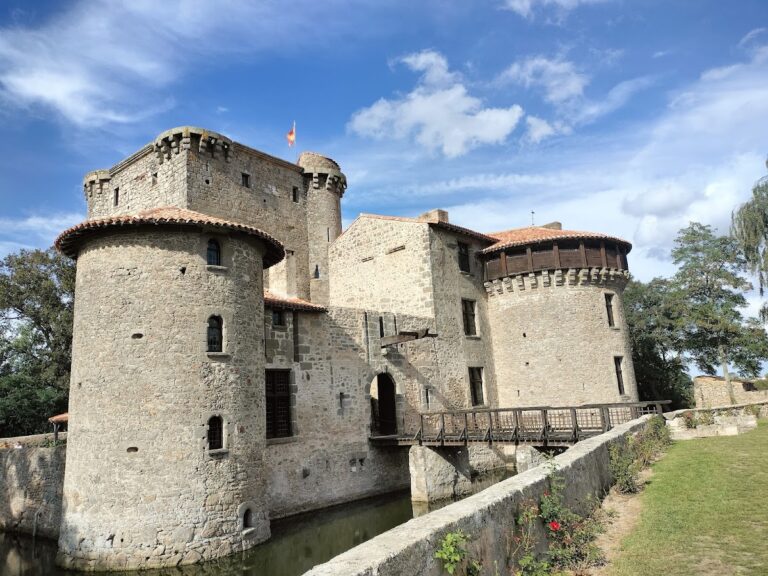
Château de la Guyonnière is a medieval château in Beaulieu-sous-Parthenay, France, whose construction began in the fourteenth century and continued into the sixteenth. Remodelled during the fifteenth and sixteenth centuries, it retained a strongly feudal character and remains associated with its moats, towers, and fortified entrance.
Medieval Origins and Later Remodelling
The château developed between the fourteenth and sixteenth centuries, with substantial changes made during the fifteenth and sixteenth centuries. These alterations reshaped the complex while preserving its fortified character, including the defensive water barriers and towers that define its form.
Heritage Protection and the Garden
The château, its moats, and its chimneys were listed as monuments historiques, a form of national heritage protection in France, on 4 March 1986. In 1987, landscape designer Alain Richet created the contemporary one-hectare garden on the site of a fourteenth-century ouche, a cultivated plot traditionally associated with gardens, orchards, or enclosed agricultural land. The garden has held the Jardin remarquable designation, recognizing gardens of notable historical, aesthetic, or botanical interest, since 2004.
The garden was planned as a setting for musicians, actors, poets, storytellers, mime artists, and other performers. Its enclosure, known as the Clos des Fêtes or Paradise, reflects this continuing artistic purpose within the historic estate.
Remains
Château, Towers, and Moats
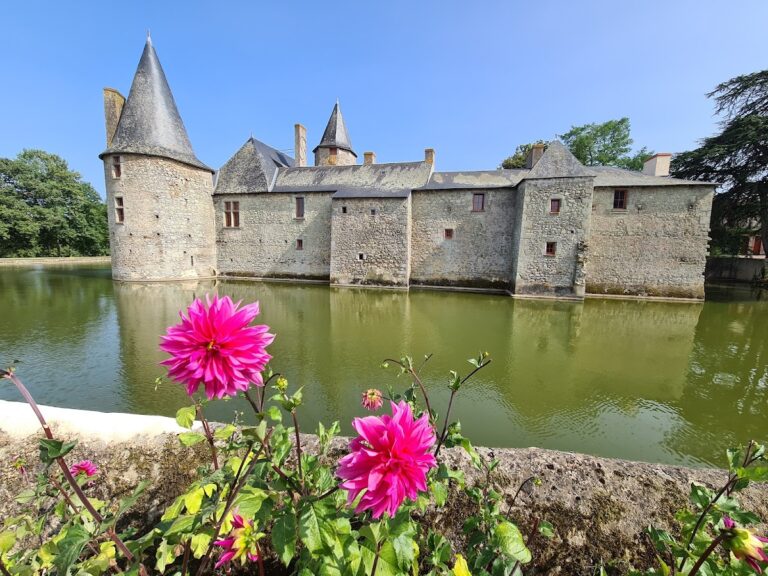
The château forms a quadrilateral flanked by towers and is entered through a fortified gateway. One tower contains a dovecote, a structure for keeping domesticated pigeons traditionally associated with aristocratic or seigneurial estates. Deep moats fed by springs surround both the château and its gardens, which occupy an island enclosed by the water. A functioning pedestrian drawbridge provides access to the gardens as a postern, a small secondary gateway in a fortified enclosure, crossing the moat from a passage between the château and its stables.
Garden Layout
The one-hectare garden is arranged in nine themed enclosures, or clos. Their plantings include fruit, flowers, vegetables, melliferous plants that provide nectar or pollen for bees and other pollinating insects, medicinal and aromatic species, poisonous plants, small fruits, old roses, botanical roses, shrubs, and old fruit trees. Two wooden arbors, bent into shape by heat and covered with vines and rose bushes, connect the enclosures.
Bees and the Clos des Fêtes
The Clos des Abeilles contains four traditionally reconstructed beehives without supers, the additional boxes placed above a hive for storing honey. Their form is based on a fifteenth-century illuminated manuscript, and they stand among melliferous plants. The Clos des Fêtes or Paradise contains a pool and a bench covered with sweet woodruff, violets, and thyme around a very old pear tree. Beneath old trees supporting climbing roses, a shaded stage covered with plants provides a performance area.
Medieval Plant Enclosures
Three enclosures bring together plants associated with varied medieval uses. The Clos des Véroniques contains tansies, burnets, euphorbias, and brizas. The Clos du Saule includes peonies, acanthuses, lilies of the valley, borage, and irises. The Clos des Choux, also called the Clos des Poisons depending on the season, contains sea kale, calamints, aconites, centaureas, columbines, anthemis, and chamomiles.
Specialized Garden Areas
Other parts of the garden include an enclosure devoted to small fruits, two enclosures of collection shrubs, and a butterfly enclosure. Together with the fruit trees, roses, flowers, and useful plants, these areas organize the garden around distinct botanical and seasonal themes within the moated island.