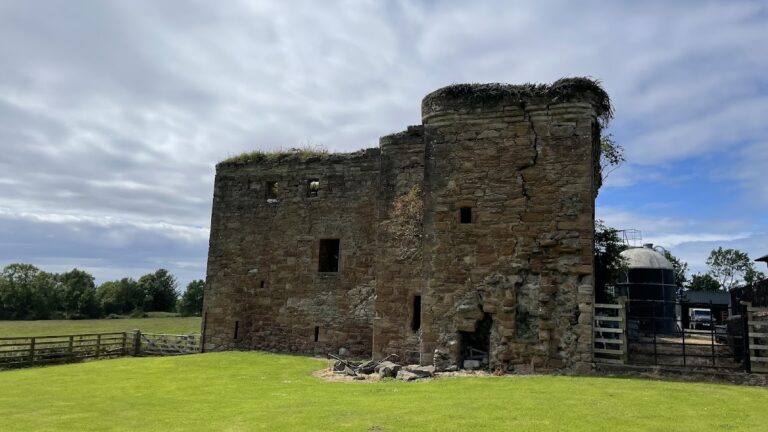
Greenan Castle: A Ruined Tower House on the Ayrshire Coast


Site at a Glance
- Rating
- 4.5
- Popularity
- Low
- Country
- United Kingdom
- Primary era
- Early Modern
- Eras represented
- Medieval, Early Modern
- Civilizations
- Kingdom of Scotland
- Site type
- Military
- Remains
- Castle
On this page8 sections
History
Greenan Castle is a ruined tower house in the United Kingdom, situated on a sea cliff about 4 kilometres southwest of Ayr. The headland was first used for a promontory fort, a defensive enclosure that incorporated the natural protection of a projecting headland, before being adapted into a medieval motte-and-bailey during the twelfth century. The surviving tower is generally described as a sixteenth-century building, although its construction has also been placed in the fifteenth century or at the beginning of the seventeenth century.
Early Defences and Medieval Lords
The earliest fortified enclosure at Greenan covered about 1 acre, or 0.4 hectares. Its four curved ditches helped protect the landward approach, while a single causeway provided access across them. The headland was later reused as a motte-and-bailey, a fortified mound with an enclosed lower courtyard. A record from 1190 names Roger de Scalebroc as the holder of the castle.
Greenan was associated with the Lords of the Isles, the medieval rulers of the Hebridean and western Scottish territories governed through the Lordship of the Isles. In 1476, John, Earl of Ross and Lord of the Isles, forfeited the lands after being accused of treason against James III, the Scottish king. James IV later granted the lands to William Douglas, son of Archibald, Earl of Angus, in 1493.
The Kennedy Family and the Tower House
By 1588, Greenan had passed to the Kennedy family, a prominent Scottish aristocratic and landholding family. The property then moved through several members of the clan before coming to Thomas Kennedy, Earl of Cassillis, in 1766. The tower house was probably erected during this broad period of Kennedy ownership, but its precise construction date remains uncertain.
An entrance lintel carries the initials “JK,” the date 1603, and the initials “FMD.” These are associated with John Kennedy of Baltersan and his third wife, Florence MacDowell, who held Greenan at that time together with Greenan Mill and salmon-fishing rights on the River Doon.
The 1602 Murder
Greenan was connected with a violent clan dispute in 1602. On 12 May, Sir Thomas Kennedy of Culzean and his servant, Lancelot Kennedy, left the castle for Edinburgh after spending the previous night with John Kennedy of Baltersan. Near St Leonards, a group including several Kennedys and other local men ambushed them, and Sir Thomas was killed.
The attack was carried out in retaliation for the death of the young Laird of Bargany at the Battle of Brockloch in December 1601. The Muirs of Auchindrain were later executed for their part in the murder. Sir Walter Scott, a nineteenth-century Scottish novelist, poet, and dramatist, later drew on the episode for his short play An Ayrshire Tragedy.
Decline and Protection
Residential use of Greenan Castle appears to have ended around 1766, after which the building became a ruin. The castle was placed in Scotland’s Category B listed-building classification on 14 April 1971. This status protects structures considered of regional or more than local architectural or historical importance.
Remains
Cliff-top Defences
Greenan Castle stands on the top of a sea cliff, with the headland forming part of its natural defence. Four concentric curved ditches, each about 3 metres wide, cut across the headland and mark the earlier defensive enclosure. They leave a single causeway as the route of access across the earthworks.
Tower and Courtyard
The surviving tower house measures approximately 10 by 8 metres and rises through four storeys. A tower house was a fortified residence arranged vertically over several levels, combining accommodation with defence. Traces of a walled courtyard survive beside the tower, together with associated outbuildings that were probably a stable and a kitchen block. The small tower had no kitchen within its walls, making these adjoining structures important to the understanding of the castle complex.
The courtyard is also associated with the departure of Sir Thomas Kennedy and Lancelot Kennedy before the 1602 ambush. Its survival preserves a physical part of the setting connected with that event, while the entrance lintel retains the initials, date, and family associations of the early seventeenth-century occupants.