Dunure Castle: A Medieval Stronghold on Scotland’s Carrick Coast



Site at a Glance
- Rating
- 4.7
- Popularity
- Medium
- Country
- United Kingdom
- Primary era
- Medieval
- Eras represented
- Medieval, Early Modern
- Civilizations
- Kingdom of Scotland
- Site type
- Military
- Remains
- Castle
On this page15 sections
History
Dunure Castle is a ruined medieval stronghold in the United Kingdom, standing on Scotland’s Carrick coast near the village and harbour of Dunure. It is associated with the late thirteenth century, although the surviving fabric is principally fifteenth- and sixteenth-century. The earliest charter for the surrounding lands dates to 1256. Traditionally, the castle has been attributed either to the Danes or to the Mackinnons, who were said to have received it from Alexander III as a reward for bravery at the Battle of Largs.
The Kennedys of Carrick
Dunure was the point of origin and one of the principal seats of the Kennedys of Carrick, later the Earls of Cassillis. The family controlled much of southwestern Scotland, and received the lands in 1357. Dunure remained in use from the thirteenth to the seventeenth century. Excavations in the 1990s showed that a hall house was built across the site’s thirteenth-century court during the fourteenth century, marking an important stage in the castle’s development.
The castle was involved in the political tensions between the Scottish Crown and the Lords of the Isles, the rulers of a powerful Gaelic lordship based in the western islands and coastal regions. In 1429, James Campbell, acting for James I of Scotland, met John Mor MacDonald, who represented the Lord of the Isles, at Dunure. Violence broke out and MacDonald was killed. James I later executed Campbell in an unsuccessful attempt to contain the hostility and the uprising that followed among the Lords of the Isles.
Royal visits and the Crossraguel dispute
Mary, Queen of Scots, stayed at Dunure Castle for three days in August 1563 during her progress through western Scotland. She was received by Gilbert Kennedy, 4th Earl of Cassillis, whose family held the castle.
Seven years later, the castle became the setting for a violent dispute over lands and revenues belonging to Crossraguel Abbey. Gilbert Kennedy had challenged Allan Stewart, the abbey’s lay commendator, a lay administrator responsible for the management and income of a religious house and its lands. When Stewart refused to surrender the property and revenues, Kennedy captured him and confined him at Dunure.
On 1 and 7 September 1570, Kennedy and household servants tortured Stewart in the castle’s Black Vault. They roasted and basted his feet and body over a brazier until he signed over the lands. Stewart was rescued by the Laird of Bargany, his brother-in-law, who arrived with armed men. Bargany’s men initially hid in the castle chapel before storming the building. Stewart was taken to the Cross of Ayr, where he denounced Kennedy, and he never walked again. The dispute was partly settled when Kennedy provided Stewart with money for the rest of his life, while Kennedy himself was never fully held accountable by the Privy Council.
Decline and later occupation
The short siege of 1570 was the only relatively late military action recorded at Dunure. A Civil War attack or deliberate destruction remains possible, although the castle may already have been abandoned by that time. Local tradition attributes the seventeenth-century destruction to burning or an explosion, and the major collapse of the southeastern keep may have been connected with such activity.
Systematic dismantling also contributed to the ruin. Sandstone dressings, slate, glass, and lead were removed for reuse, and some of the material may have been taken for the Cromwellian citadel at Ayr. People dismantling the castle occupied part of it while the work continued. A localised fire and coal deposits indicate that lead was smelted on site, apparently after the lead from the castle windows had been stripped away.
The castle and estate, together with Dalquharran, were purchased by Sir Thomas Kennedy of Kirkhill in the late seventeenth century. The decline of Dunure had begun by the middle of that century, and in 1694 the castle was described as wholly ruined. Even afterward, its sandstone dressings continued to be removed. A range south of Area 4 remained occupied until about 1860, including by fishermen. Census records, reused rooms, a large mussel-shell midden used for baiting cod lines, and domestic refuse from the later eighteenth to the early and middle nineteenth centuries show the character of this later occupation.
Dunure is also linked with the story The Brownie of Dunure. In the tale, Sir Thomas Kennedy adopts Reginald Duff’s son and hopes that the boy will marry Kennedy’s illegitimate daughter. The Brownie’s legend is used to influence the proposed match while the O’Neils of Ireland compete for the daughter’s hand. The name Dunure, or Dunoure, is traditionally said to come from a Celtic expression meaning the hill or fort of the yew tree.
Excavation and protection
Archaeological excavations in the 1990s clarified the castle’s development and revealed evidence of later activity, including the hall house and the area where lead was smelted. The ruins were subsequently excavated and consolidated, securing the surviving masonry and making access safer. Dunure Castle and its dovecot are classified as a Scheduled Monument, a legally protected archaeological or historic site considered to be of national importance.
Remains
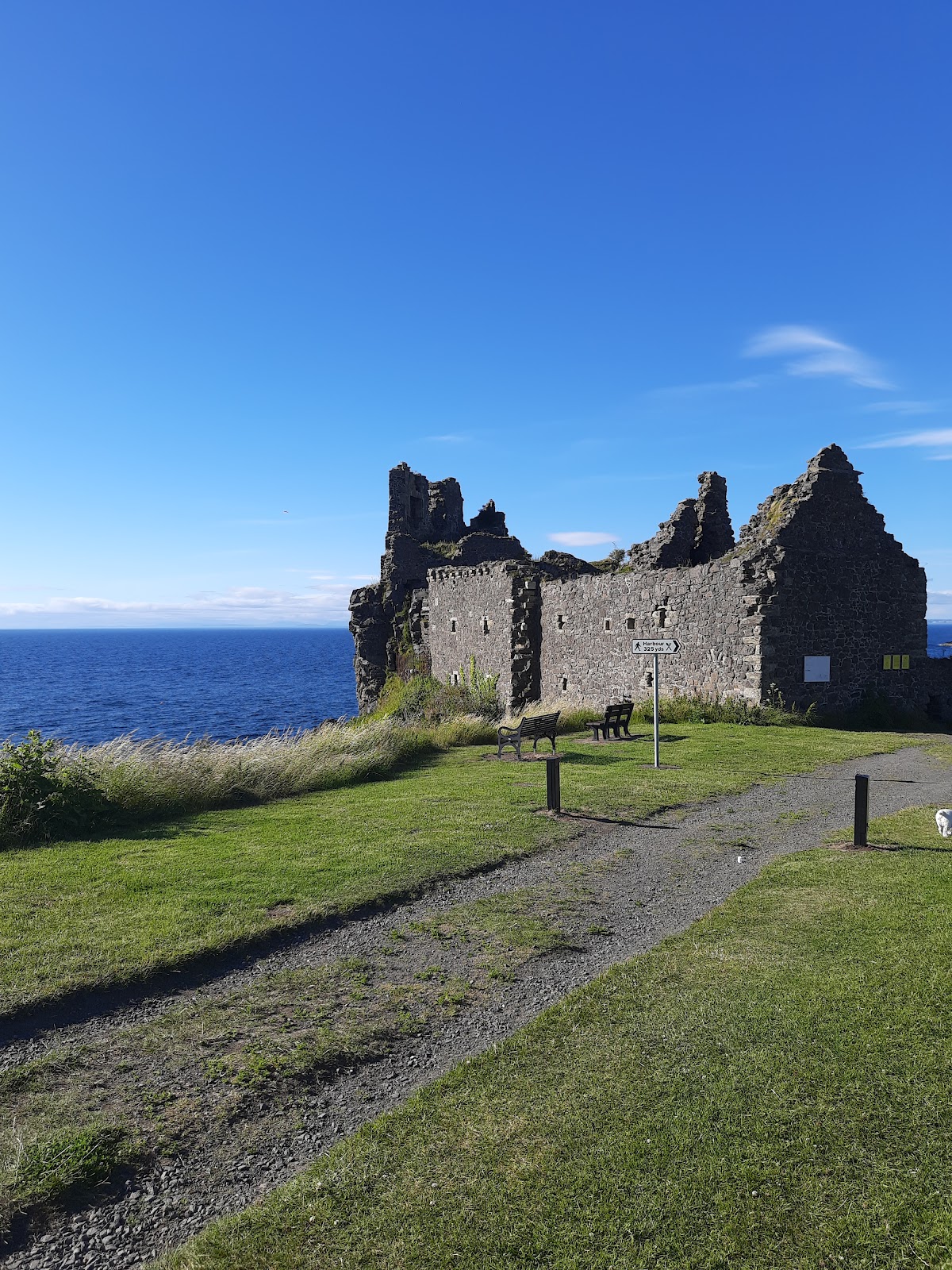
Dunure Castle occupies the top of a precipitous rocky promontory overlooking the Firth of Clyde. Near the village and small harbour, the ruin is arranged around an irregular keep with lower ancillary buildings. The surviving stonework includes the thick walls of the keep, well-preserved basement vaults, lower building ranges, sections of a watercourse, and a separate round dovecot about 50 metres to the northeast.
Keep and defensive works
The keep
The keep represents the original castle, although it was substantially altered over time. Its irregular plan is enclosed by walls approximately five feet thick. The basement vaults remain well preserved, while most of the upper structure has been demolished. The central section may date from the fifteenth century and was arranged to defend access to the keep.
Approach and concealed passage
A detached wall to the northeast may have led toward a gateway. A drawbridge may have stood nearby, and a moat or fosse, meaning a defensive ditch, protected the approach. An additional enclosing wall may also have existed. Browney’s Cave lies beneath the castle and may have served as a sally-port, a concealed passage used for movement out of a fortified site.
The former chapel
The castle formerly had an external chapel with leaded-glass windows. It was associated with the rescue of Allan Stewart in 1570, when Bargany’s men hid there before attacking the castle. The chapel may have been destroyed during a siege in the 1570s, and its remains do not survive.
Lower ranges and water management
Kitchen buildings
The later lower buildings included two ground-floor kitchens. One served the castle household and the other served the retainers. These ranges formed part of the ancillary buildings below the keep and remain among the surviving elements of the consolidated ruin.
Stone-lined watercourse
A stone-lined watercourse entered the entrance of the Area 4 kitchen range at the southern end of an excavation trench. Groundworks farther south exposed another well-preserved section of the same channel. Together, the surviving sections show part of the water arrangement associated with the lower buildings.
Dovecot
The separate dovecot stands approximately 50 metres northeast of the castle. It is a round, beehive-shaped building of uncertain date. A dovecot housed domesticated pigeons or doves, and this one would have contained about 200 nesting boxes. Its birds supplied the castle estate with fresh eggs and meat.
Evidence of dismantling and reuse
Excavation recovered a localised fire and coal deposits in a room where lead from the castle windows appears to have been smelted. The windows had been dismantled and extensively stripped of their lead. This evidence complements the surviving ruin, whose upper keep has largely disappeared while the thick lower walls, basement vaults, building ranges, watercourse sections, and dovecot remain in consolidated form.