Soave Castle: A Medieval Scaliger Fortification in Italy
Site at a Glance
- Rating
- 4.6
- Popularity
- Medium
- Country
- Italy
- Primary era
- Medieval
- External website
- Open
- Eras represented
- Classical, Medieval
- Civilizations
- Roman, Venetian
- Site type
- Military
- Remains
- Castle
On this page15 sections
History
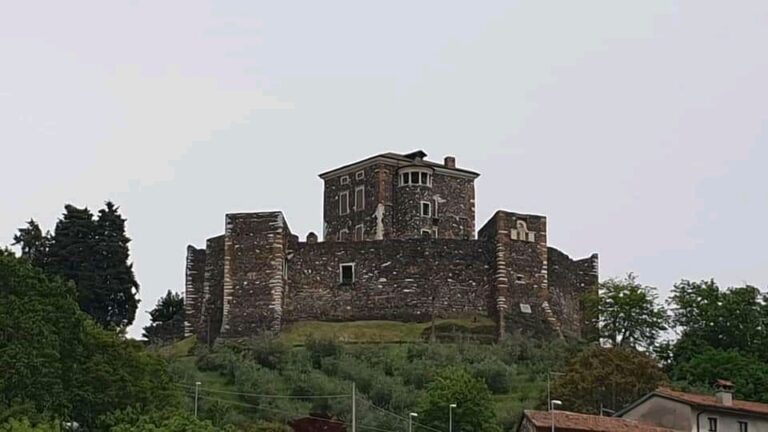
Soave Castle is a medieval fortification in Italy, built and expanded through successive periods of northern Italian rule on Monte Tenda above the town of Soave. Its oldest surviving part, the Mastio, dates from the tenth century, and the castle later became a major Scaliger stronghold and the seat of a captaincy governing 22 subordinate communities.
Early Fortification and Scaliger Rule
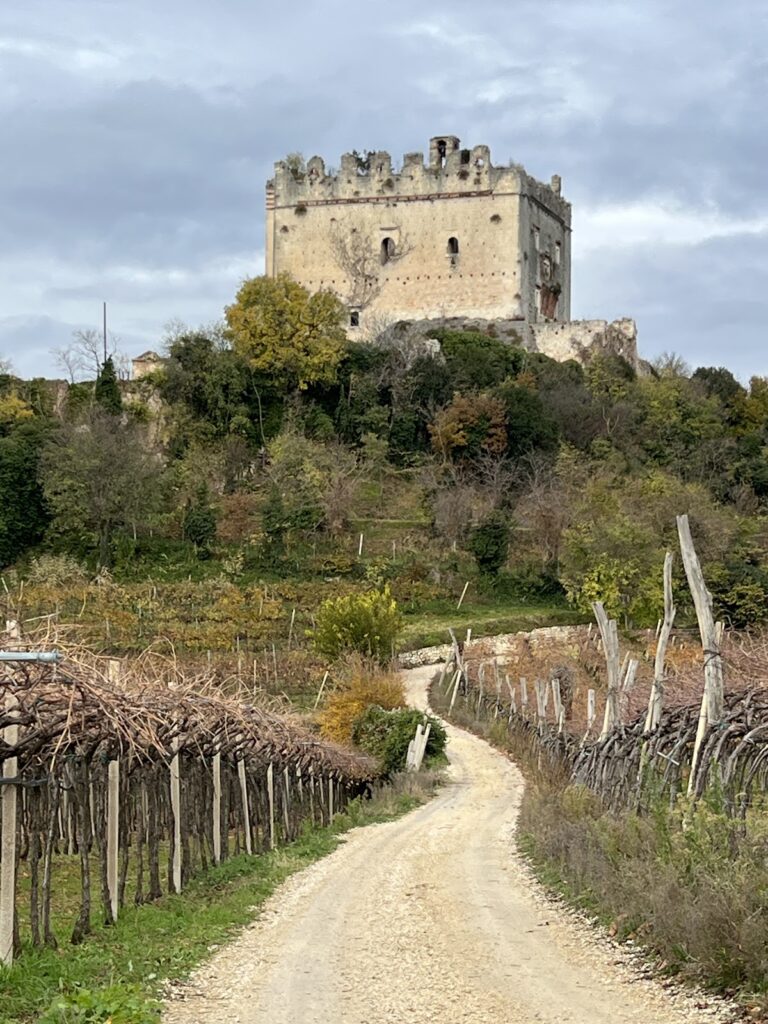
The castle’s earliest recorded ownership was associated with the Sambonifacio counts of Verona, whose possession appears in a diploma issued by Emperor Frederick I Barbarossa. In the tenth century, King Berengar I of Italy granted local lords authority over Soave to help resist Magyar raids into northern Italy. The Mastio, the principal fortified tower and strongest defensive position, belongs to this period and was built over the remains of a Roman lookout tower.
In 1226, as Ezzelino III da Romano expanded his power in Verona, control of the castle was associated with the Greppi family. The family retained it until 1270 or 1271, when the castle passed to the municipality of Verona, which installed its own captain. In 1271, Mastino I della Scala acquired the stronghold as the Della Scala, or Scaliger, family extended its authority over Verona and its surrounding territories.
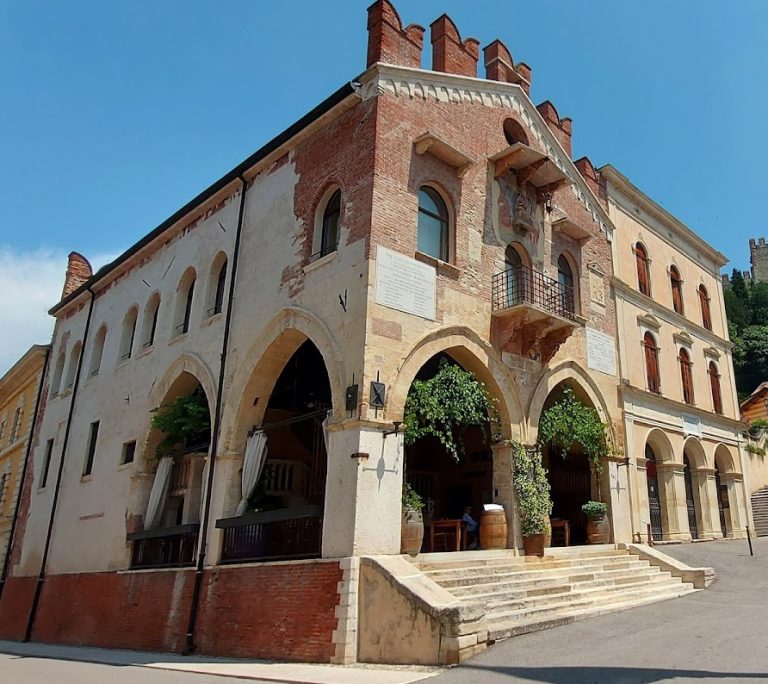
Under Scaliger rule, Soave became the center of a captaincy, a territory administered by a military or governmental captain. The castle was restored and enlarged, particularly during the rule of Cansignorio della Scala. He also surrounded Soave with the town walls that remain visible in the valley and commissioned the Palazzo di Giustizia and the Scaligero palace.
Wars and Changes of Ruler
In 1338, troops led by Rolando de’ Rossi da Parma, supported by Venice, briefly drove the Della Scala from the castle. Scaliger control ended in 1387, after which the stronghold passed first to the Visconti of Milan and then to the Carrara family of Padua.
Venetian forces captured the castle in 1405 with the support of Soave’s inhabitants. Visconti troops under Niccolò Piccinino, a professional military commander known as a condottiero, briefly retook it in 1439. The Venetian army regained the area after Giovanni Pompei’s victory on Mount Bastia.
The War of the League of Cambrai, a sixteenth-century military alliance formed against Venice, brought renewed destruction. The castle and town were burned, and 366 residents of Soave were killed in the fighting. The castle’s liberation in 1511 was associated with Captain Rangone and the inhabitants of Soave, while Antonio Marogna was also remembered locally for his role. Venetian control was restored by 1516.
Private Ownership and Restoration
After the wars, the castle entered a period of peace but lost military effectiveness as firearms developed. Venice, seeking funds for its wars against the Ottoman Empire, first leased the stronghold and later transferred it to the Venetian noble Gritti family in 1696. The family had already held the lease for about a century. Later private subtenants converted the castle into a farm, and a period of abandonment followed.
Giulio Camuzzoni, who owned the castle and served as mayor of Verona and as a senator of the Kingdom of Italy, undertook extensive restoration in the late nineteenth century. The castle remains privately owned and is recognized as Italian national heritage.
Remains
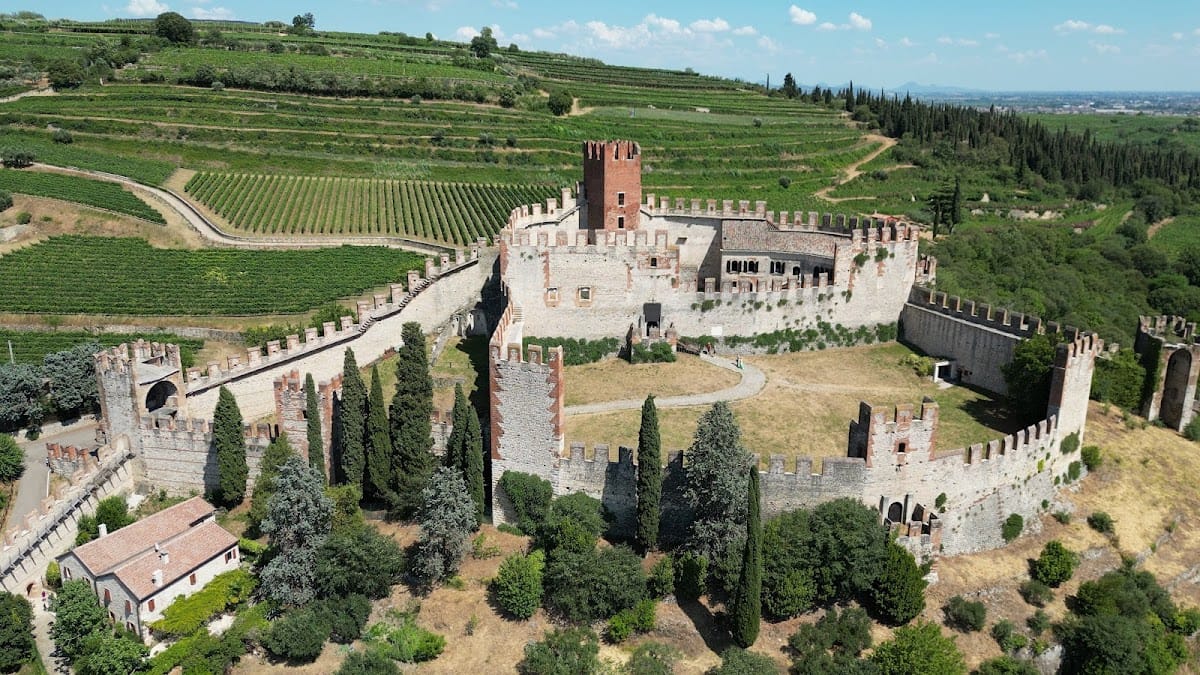
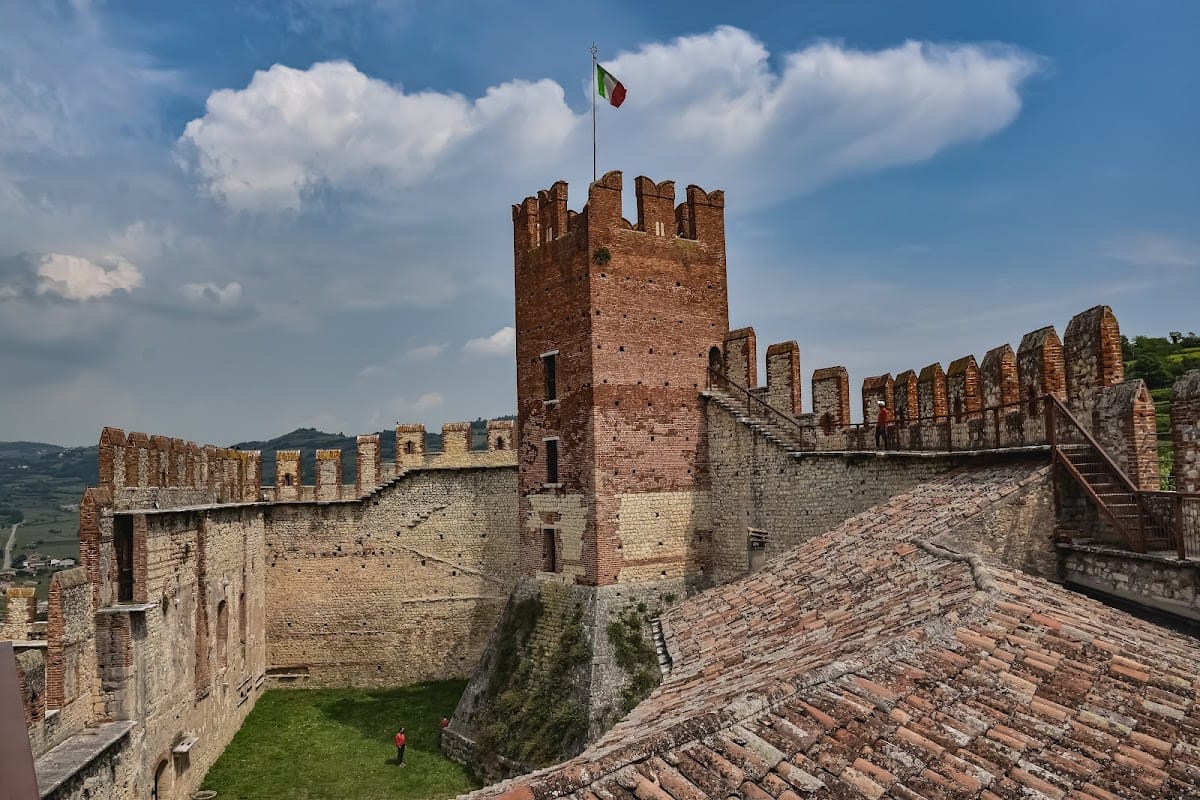
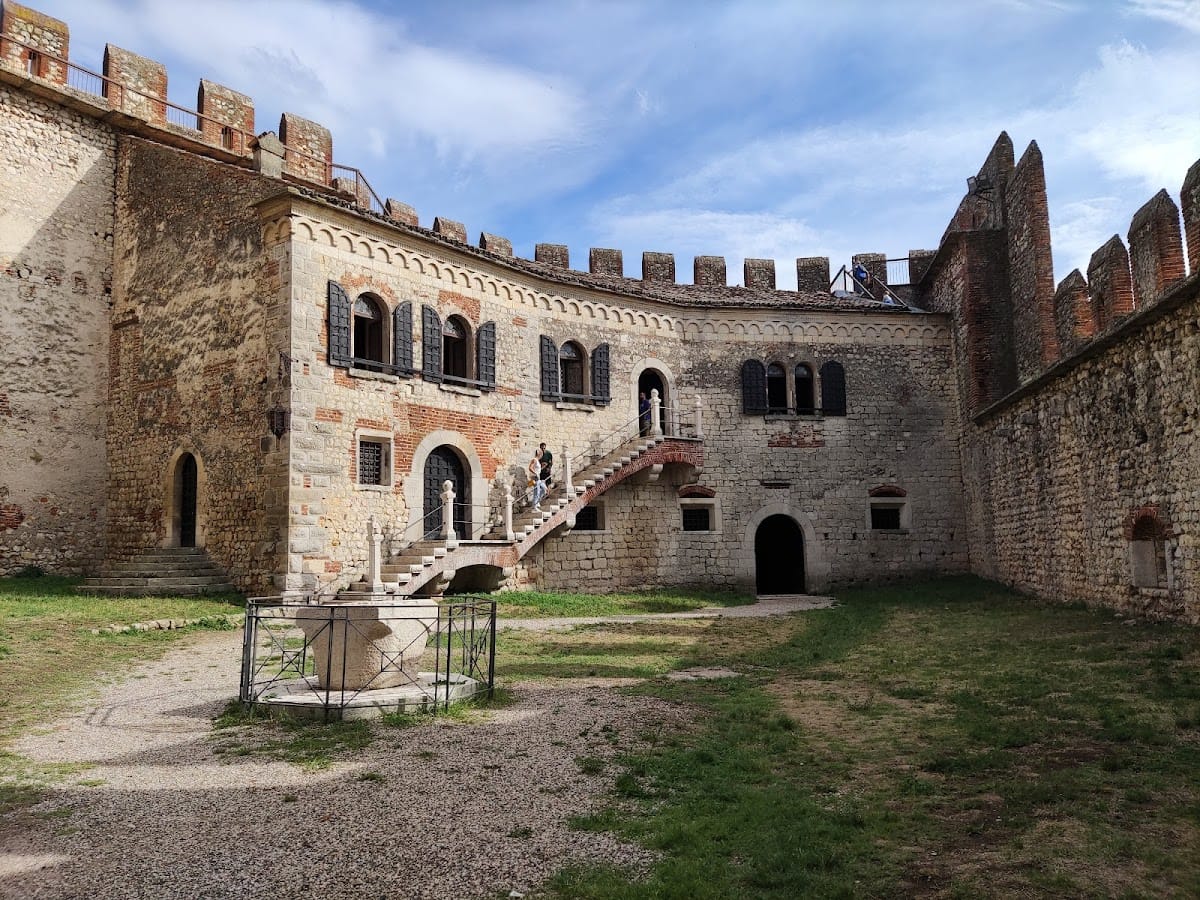
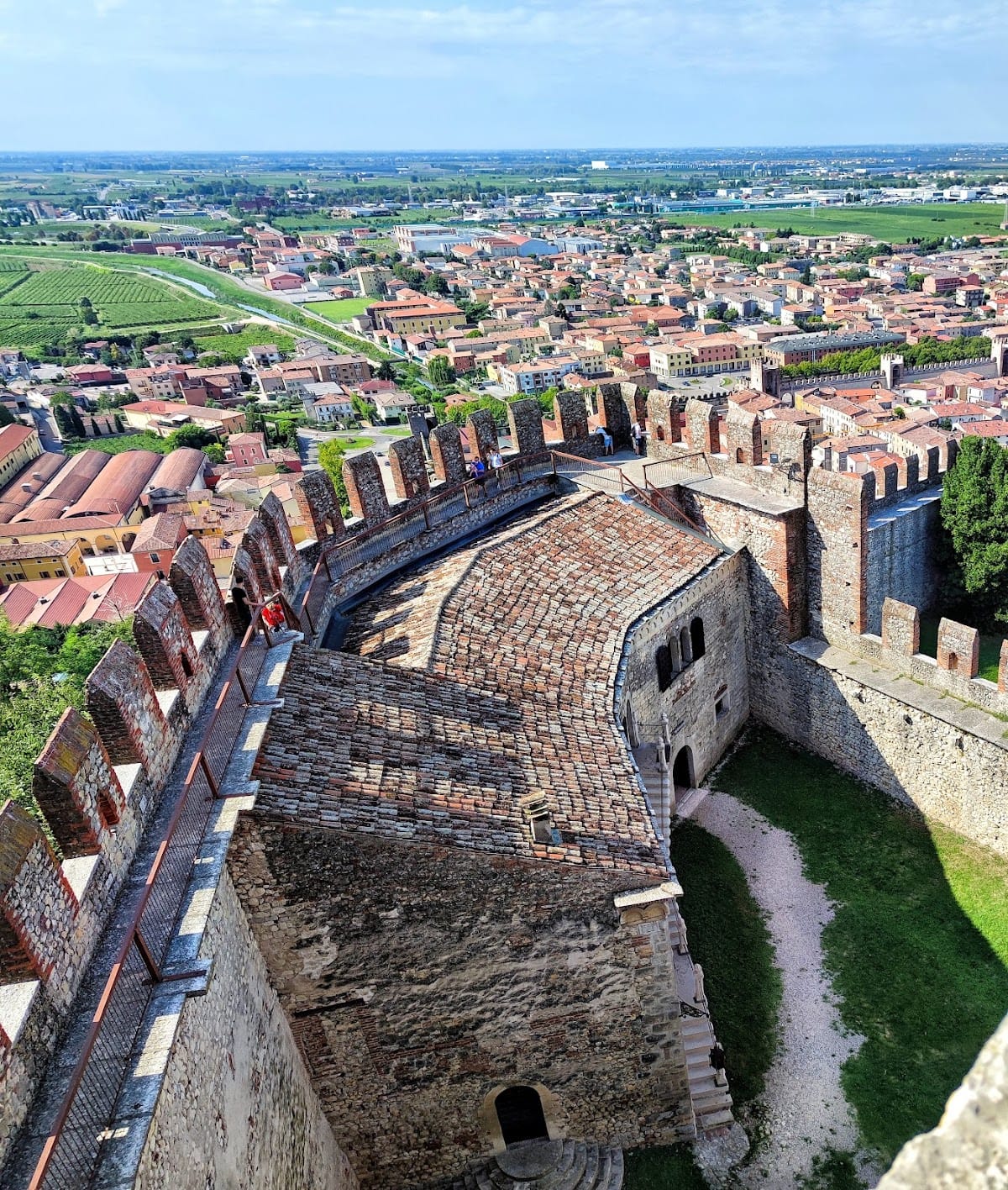
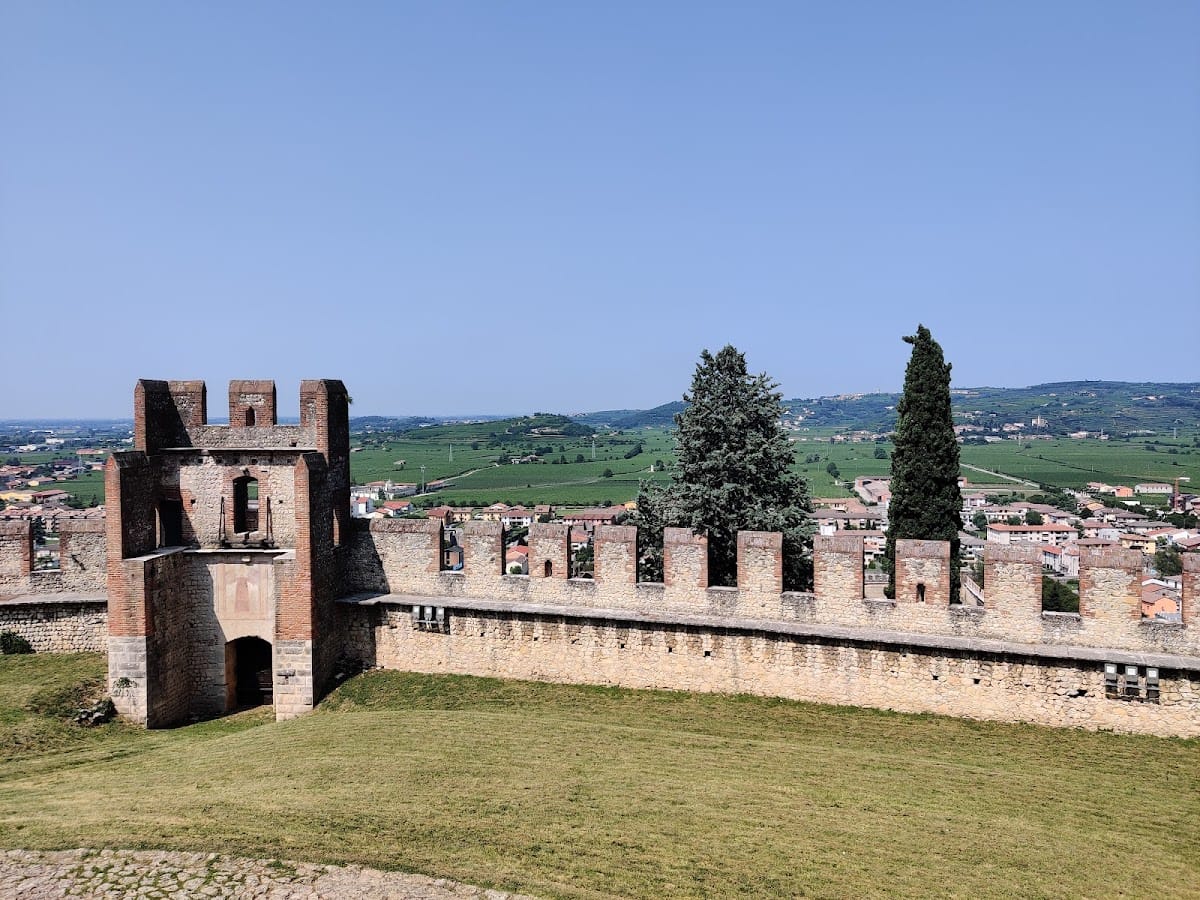
The castle occupies the summit of Monte Tenda, with its walls descending on both sides toward the plain and joining the medieval defenses around Soave. The complex covers about 60 ares, approximately 6,000 square metres, and consists of the Mastio and three courtyards of different sizes. The courtyards rise toward the strongest part of the fortification, while gates, a drawbridge, a portcullis, stairways, and elevated thresholds controlled movement through the complex.
Outer Courtyards
First Courtyard
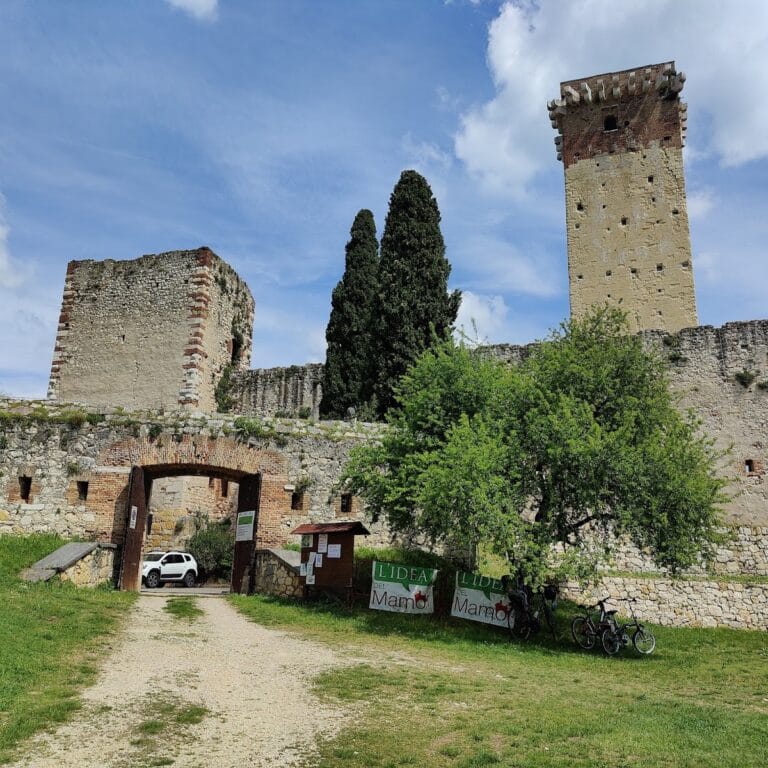
The first courtyard, covering 1,163.90 square metres, was the last to be built. The Republic of Venice added it in the fifteenth century, and a gate with a drawbridge provides its entrance. Within the courtyard are the remains of a small church with three apses, probably dating from the tenth century. It may have offered refuge during Magyar raids and stood outside the walls of the original castle.
Second Courtyard
A portcullis, a vertically sliding fortified gate, leads into the second courtyard. This was the first courtyard of the older castle and is the largest, measuring 2,921.60 square metres. It is known as the Courtyard of the Madonna because a fresco dated 1321 above the western entrance shows the Virgin protecting kneeling worshippers. A supply gate in the courtyard was intended to bring provisions to the occupants during emergencies, while traces of soldiers’ quarters survive along its western and southern sides.
Third Courtyard
The third courtyard is the smallest, with an area of 972.18 square metres, and is also the highest. A small wooden staircase leads to it, and its raised doorway threshold was designed to hinder attackers. Beyond the entrance, a fresco dated 1340 depicts a Scaliger soldier. His equipment and weapons provide evidence of the arms used during the period. An inscription reading “Cicogna” may refer to the painter and has been connected with frescoes at San Pietro in Briano and San Felice di Cazzano di Tramigna.
Mastio and Defensive Areas
Mastio Courtyard
The Mastio is entered through an opening at the base of the tower. It served as the castle’s final defensive refuge. A heap of bones found inside has also led to the suggestion that the tower was used for torture and imprisonment. In the center of its courtyard, an old well curb bears wear caused by ropes. Nearby, the former guardroom displays offensive and defensive weapons used by Scaliger soldiers, and remains of barracks survive in the inner courtyard.
Lord’s Residence and Interior Rooms
Captain’s Residence
An exterior staircase reaches the former residence of the lord or, during the Scaliger period, his representative, the captain. The central room is called the Caminata because of its large fireplace. Boxes on its table contain objects found during or before the restoration, including Roman and Venetian coins, weapon fragments, instruments of war from other castles, and coins and medals associated with Soave.
Residential Rooms
The Caminata opens onto a small courtyard created during the Venetian period. It also connects with a bedroom containing a thirteenth-century fresco of the Crucifixion with the Madonna and Mary Magdalene. A dining room nearby has a set table using tableware that reproduces period forms.
Portrait Room
A small portrait room contains images of Mastino I della Scala, Dante Alighieri, Cangrande della Scala, Cansignorio della Scala, and Taddea da Carrara, the wife of Mastino II. The portrait of Dante reflects the belief that he stayed at the castle.