Castle of Vimianzo: A Medieval Fortress in Galicia


Site at a Glance
- Rating
- 4.4
- Popularity
- Medium
- Country
- Spain
- Primary era
- Medieval
- External website
- Open
- Eras represented
- Medieval
- Civilizations
- Crown of Castile
- Site type
- Military
- Remains
- Castle
On this page9 sections
History
The Castle of Vimianzo is a medieval fortification at the entrance to Vimianzo in Galicia, Spain. Its original construction dates from the late twelfth or early thirteenth century, possibly under the Mariño de Lobeira family. The fortress later became a major stronghold of the Moscoso family and the administrative centre of the seigneurial jurisdiction of Vimianzo.
Early Ownership and Noble Power
In 1348, King Alfonso XI of Castile confiscated the fortress and its domains from Roi Soga Mariño de Lobeira because of debts. He sold them to Juan García de Manrique, Archbishop of Santiago de Compostela. The castle subsequently passed to Fadrique Enríquez, Duke of Arjona.
The fortress probably entered the possessions of the Moscoso family between 1425 and 1429. It was rebuilt during this period and became one of the family’s principal strongholds. The Moscosos of Altamira were related to the Traba family, and Lope Sánchez de Moscoso later established the County of Altamira as its first count.
Captivity and the Irmandiño Revolt
The castle’s role as a centre of noble authority also brought it into the conflicts of fifteenth-century Galicia. Pedro Madruga, the commonly used name of Pedro Álvarez de Soutomaior, held Diego de Muros, Bishop of Tui, captive there. Muros paid a ransom of 700,000 reales.
In 1465, the fortress became the prison of Alonso II de Fonseca, Archbishop of Compostela. Bernal Sánchez de Moscoso ordered his confinement, which lasted two years. A later legend describes the cage used for the archbishop as having been made of gold.
During the Irmandiño Revolt, a major Galician uprising in which rural and urban communities attacked noble fortresses and other expressions of seigneurial power, Vimianzo was besieged and captured by force. The fortress was destroyed in 1467 and later reconstructed on the orders of Alonso II de Fonseca.
Recapture and Later Administration
In 1472, Lope Sánchez de Moscoso, Count of Altamira, recaptured the castle with a large force that included troops from the Mariñas, Andrade, Soutomaior, Ulloa, and Lemos families. Vimianzo then became the centre of a seigneurial jurisdiction extending over Camariñas, Laxe, Zas, and Muxía.
From the sixteenth century, the Altamira family’s move to the royal court changed the way its possessions were managed. Appointed castle governors and local officials administered the fortress and the surrounding jurisdiction. Seigneurial jurisdictions were abolished in 1833, and the Altamira family sold the castle to Ramón Martelo Núñez in 1870.
Modern Ownership and Preservation
The nineteenth-century poet Evaristo Martelo Paumán, Marquis of Almeiras, carried out the last major reform after the castle had fallen into poor condition. He adapted it for habitation. His daughter, Dolores Martelo de la Maza, later transferred the fortress to the Archbishopric of Santiago.
In 1936, shortly before the Spanish Civil War began, an expropriation procedure was initiated. The republican mayor Manuel Alborés and the municipal secretary Andrés García Ferreiro carried out the measure symbolically. The Provincial Deputation of A Coruña acquired the castle in 1973 and adapted it for cultural and social purposes. The fortress was declared a protected Asset of Cultural Interest in Spain on 17 October 1994 and is maintained in very good conservation condition.
Remains
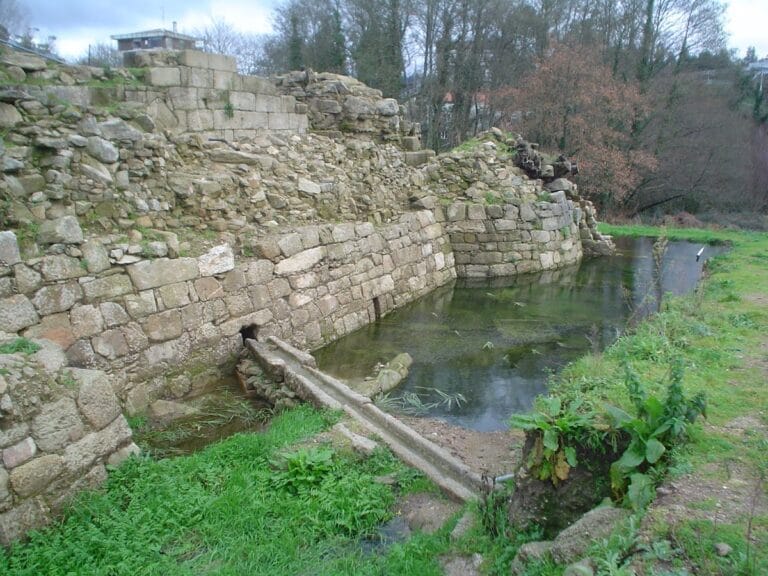
The castle occupies a commanding position at the entrance to Vimianzo. Its irregular polygonal plan follows the terrain, while carefully worked granite masonry laid in regular courses forms much of the visible structure. Elements from the thirteenth century remain within a complex whose principal surviving fabric belongs to the fourteenth and fifteenth centuries.
Fortifications and Courtyard
Three rectangular defensive towers and a keep surround the arms courtyard. The towers have four-sided roofs, while the keep retains projecting battlements and a mullioned window, which is divided by vertical stone supports. A wall-walk, the passage along the top of a defensive wall, links all four towers and encloses the courtyard with them. An entrance gateway leads into this central space.
A deep moat surrounds the entire exterior perimeter. The castle was originally crowned throughout by diamond-point battlements. These remain on the keep and along the wall-walk of one wall, where projecting corbelled elements support them. The complex also preserves pointed arches, arrow slits, paired windows, and interior rooms covered by ribbed barrel vaults, tunnel-shaped ceilings reinforced by projecting ribs.
Gateway and Archaeological Evidence
Two heraldic stones are set at the entrance gateway. One carries the wolf’s head associated with the Moscoso family, while the other displays the six bezants linked with the Castro family. In the present arms courtyard, excavations conducted between 1984 and 1986 exposed the foundations of a large early keep, adding archaeological evidence for the castle’s first phase.
Craft Exhibition
The castle now contains a permanent exhibition of popular crafts. Its displays include pottery, lace, linen work, basketry, stonework, model shipbuilding, and jet ornaments, bringing later cultural use into the historic fortified complex.