Castle of Monopoli: A Spanish Coastal Fortress in Italy


Site at a Glance
- Rating
- 4.4
- Popularity
- Medium
- Country
- Italy
- Primary era
- Early Modern
- External website
- Open
- Eras represented
- Iron Age, Classical, Medieval, Early Modern
- Civilizations
- Byzantine, Kingdom of Naples, Norman, Roman, Spanish
- Site type
- Military
- Remains
- Castle
On this page8 sections
History
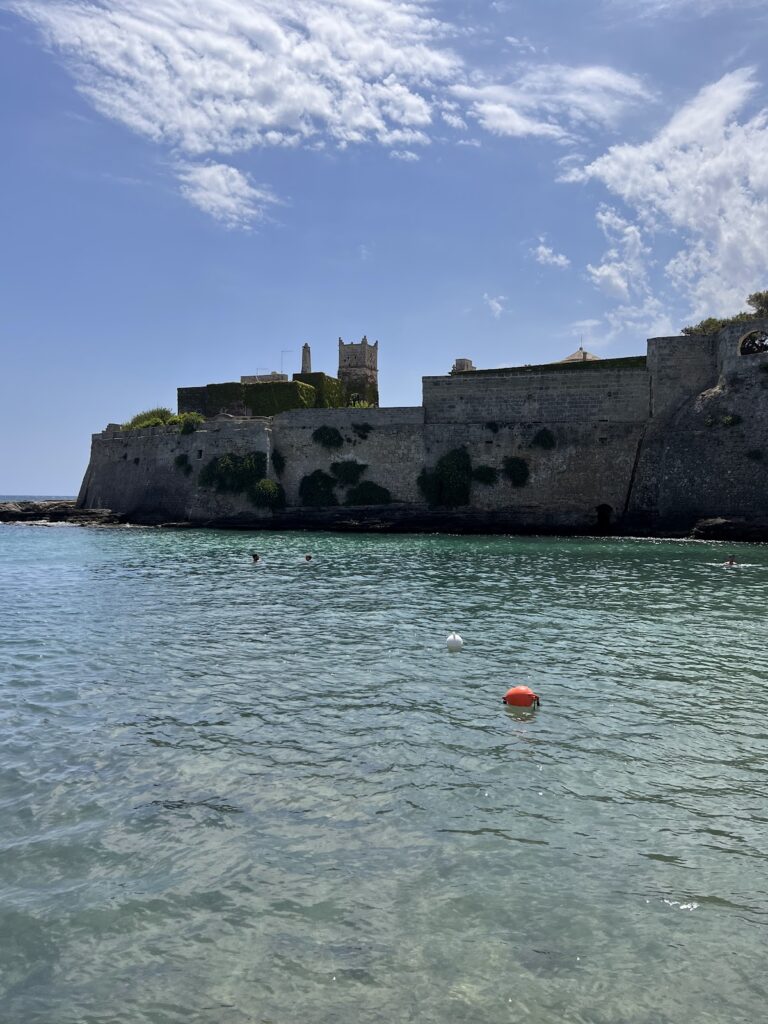
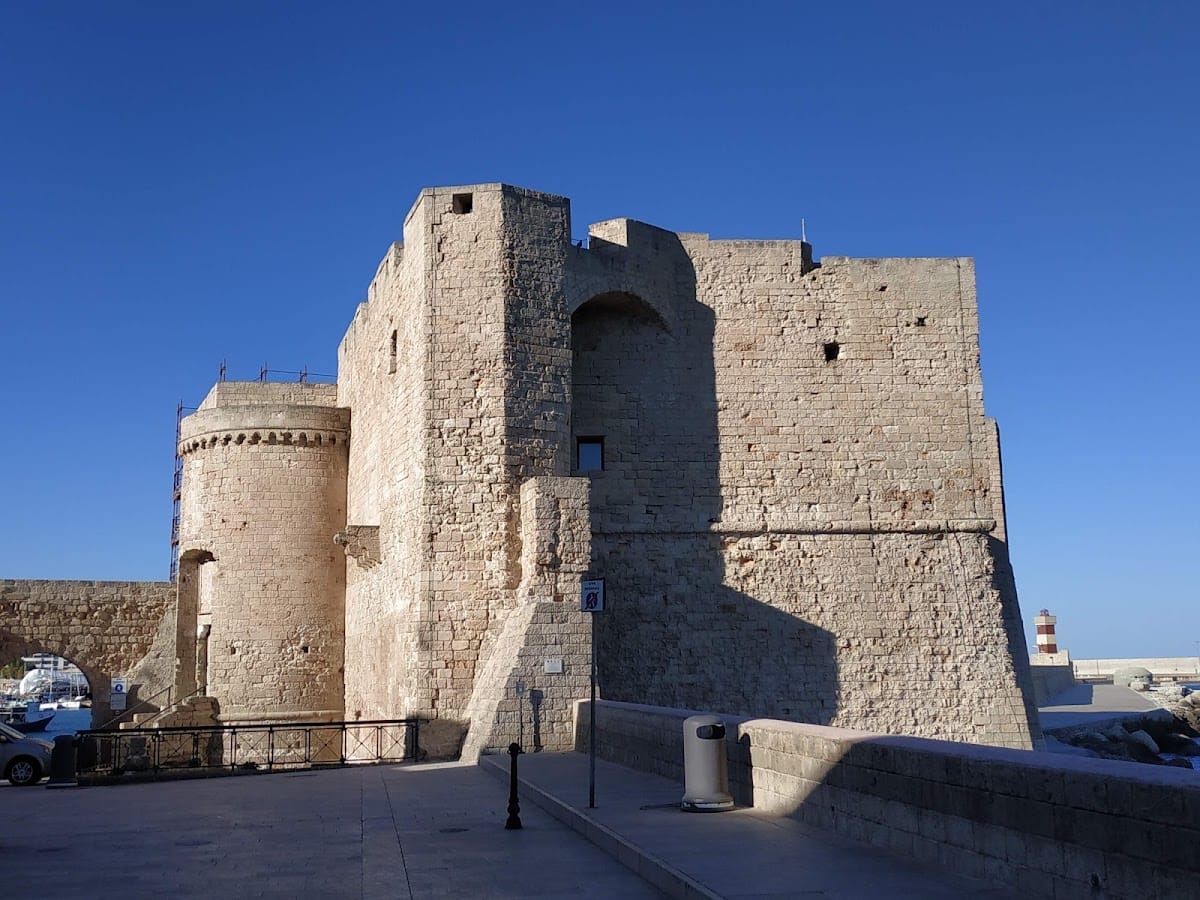
The Castle of Monopoli is a sixteenth-century fortification in Monopoli, Italy, built under Spanish rule as part of Emperor Charles V’s coastal-defence system for Apulia. Completed in 1552, it was intended to control and defend the harbour against military threats in the Mediterranean. Charles V was a Habsburg emperor whose rule included Spain and its Italian territories, while Pedro Alvarez de Toledo, the Spanish viceroy of Naples, supervised the completion of the works. Another attribution identifies Marquis Don Ferrante Loffredo as responsible for finishing the fortress.
Earlier foundations
The fortress was built on the Punta Pinna promontory, where earlier structures had occupied the site. A large Roman gate from the first century BC had been constructed over fifth-century BC Messapian walls. The Messapians were an ancient people of southeastern Italy, particularly associated with Salento and southern Apulia. The tenth-century Church and Monastery of San Nicola in Pinna were later incorporated into the castle.
The church and monastery may have been founded by Sassone, a local resident who became a widow, entered religious life, and established the monastery. In 1054, Argiro, son of Melo of Bari, confirmed its privileges and authorized an extension across the rest of the promontory. Count Goffredo of Conversano transferred lands to the abbot Larentis in 1086 and 1119. A papal bull of 1180 placed the church and monastery under Stefano, Bishop of Monopoli. They were mentioned again in a bull issued by Pope Boniface IX in 1393, after which they disappear from the surviving documentary record.
Fortress, residence, and prison
The castle was enlarged and extensively renovated in 1600. These works substantially changed both its exterior and its internal arrangement, transforming it from a mainly defensive fortress into a residential building. Its strategic importance depended on the defence of Monopoli’s harbour, but that role declined by the beginning of the eighteenth century as the Turkish threat diminished.
The fortress later became a district prison, serving that function from the first half of the nineteenth century until 1969. Its history also includes harsh treatment of prisoners of war, including enslavement, torture, and killings. An eighteenth-century historian reported abundant coral fishing in the waters beneath the castle. Martino Coquemont, a colonel in the army of Ferdinand IV of Naples who lived in the castle around 1750, died in 1773 at the age of 101. Orazio Totaro is identified as the castle’s first owner.
Investigation and restoration
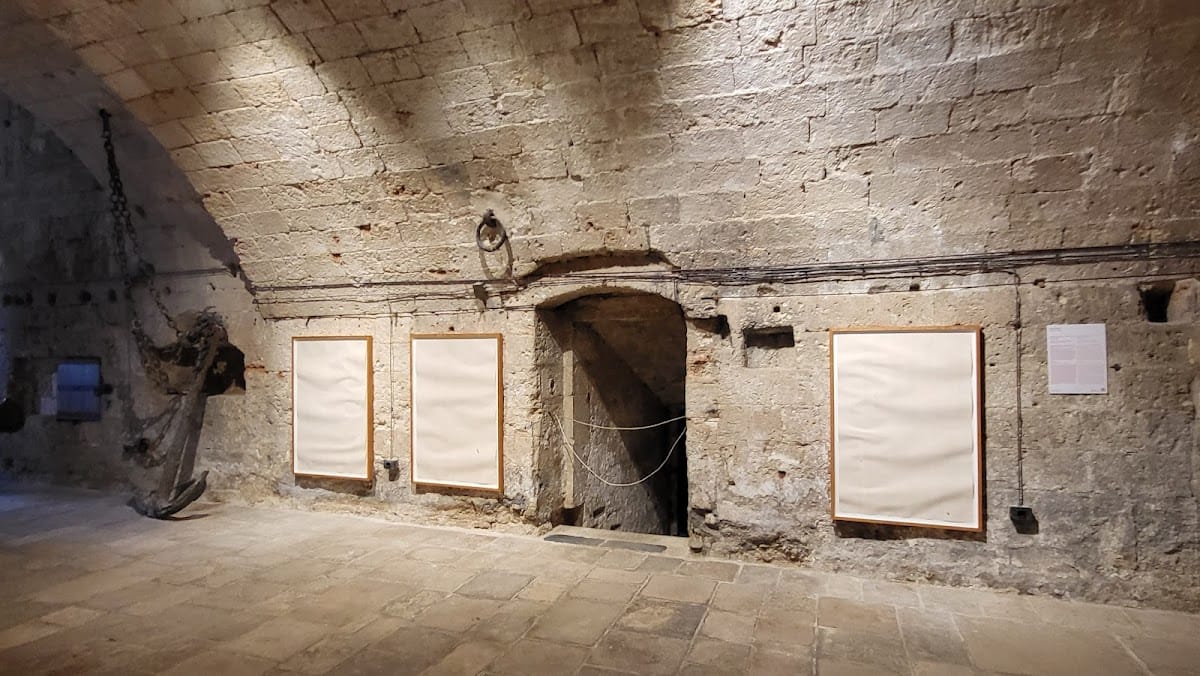
Archaeological investigations by the Archaeological Superintendency of Apulia between the 1990s and 2010 established the sequence of earlier remains incorporated into the fortress. Restoration and consolidation were particularly active during the 1990s, and the work was completed in 2011. The restored castle is owned by the Municipality of Monopoli and is used for cultural events, including painting, photography, and film exhibitions. The Monopoli Sea Museum was founded inside the castle in 2010, presenting the history of Monopoli and its relationship with the sea from the Bronze Age to the beginning of the nineteenth century.
Remains
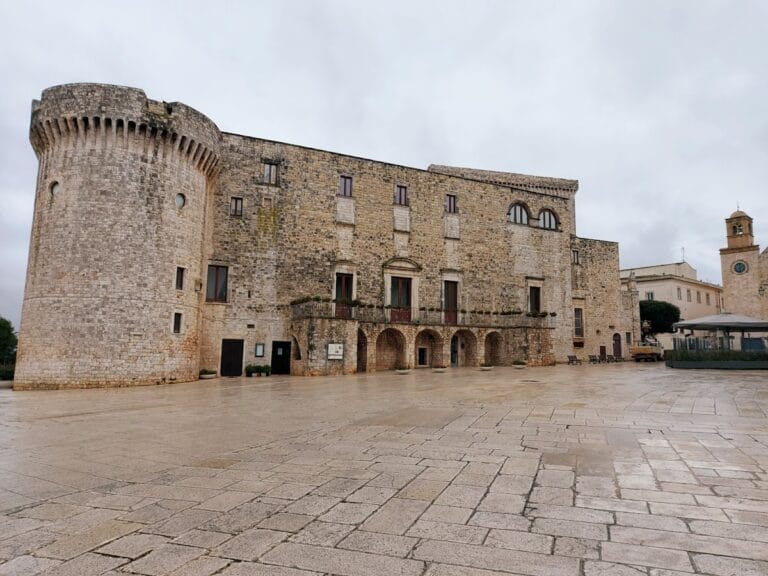
The Castle of Monopoli is a compact urban fortress with a simple plan strengthened by pentagonal bastions, projecting platforms that allowed defenders to cover the walls and approaches with flanking fire. It stands on the Punta Pinna promontory and incorporates defensive, religious, and residential structures from different periods. The masonry uses tuff blocks, with an inner core of tuff fragments and concrete made from lime and pozzolana. It is also described as rubble masonry.
Walls, entrance, and gun positions
The drawbridge and principal entrance were probably on the southwest side, where a cylindrical tower was built later. A small ramp leads to the tower, beside which a well-preserved section of the earlier walls remains visible. Gun positions extend from the roofs down to the waterline, covering areas outside the harbour and within it. La Traditora, a gun position set tangentially along the walls, was designed to fire suddenly against attackers trying to climb them.
A large armoury contains four water-level gun ports. Two face the open sea, while two face into the harbour. Four smoothbore Neapolitan howitzers served these openings. Each gun weighs 1,400 kilograms and dates from the first half of the nineteenth century. Beneath the loggia, a stone coat of arms carries the date 1552 and the name of Viceroy Pedro Alvarez de Toledo.
Roman and Messapian remains
A large Roman gate from the first century BC is visible from the armoury. It had two lateral guardhouses, each two storeys high, surmounted by octagonal towers. These structures are now almost entirely incorporated into the sixteenth-century castle. The Roman fortifications rest on substantial fifth-century BC Messapian walls, which in the area of the church apse rest in turn on a very ancient prehistoric earthwork, or agger, a raised embankment that could form part of an early defensive system.
Church and monastery
The Church of San Nicola in Pinna lies in the castle’s underground levels. It has a single nave, one apse, and a central dome. Part of its left exterior wall is visible from the landing of the central staircase, where traces of original Romanesque corbels survive. The church and monastery were built against the southern guardhouse of the Roman gate, while the guardhouse itself was reused as residential rooms connected with the monastery. The church’s form belongs to the type of rural churches built in the eleventh and twelfth centuries.
Nearby sites