Castello di Montalto Dora: A Medieval Fortress in Italy


Site at a Glance
- Rating
- 4.2
- Popularity
- Low
- Country
- Italy
- Primary era
- Medieval
- External website
- Open
- Eras represented
- Medieval
- Civilizations
- Duchy of Savoy, Holy Roman Empire
- Site type
- Military
- Remains
- Castle
On this page9 sections
History
Castello di Montalto Dora is a medieval fortress in Italy, built during the first half of the twelfth century under the jurisdiction of the Bishopric of Ivrea. A document from around 1140–1141 refers to it as castrum montsalti. Its position controlled the route into the Aosta Valley and the nearby Via Francigena, a major medieval pilgrimage road linking western Europe with Rome.
Foundation and medieval expansion
The first fortress consisted of a tower joined to a defensive wall. In the twelfth century, the Bishopric of Ivrea granted the entire Montalto valley as a fief to the lords of Settimo Vittone. In medieval feudal practice, this transferred administration and associated rights to a vassal while ultimate authority remained with the overlord.
During the fourteenth and fifteenth centuries, the castle was enlarged and altered to improve its defensive strength. In the fourteenth century it became part of the possessions of the House of Savoy. In 1403, the Savoyard authorities enfeoffed it to the de Jordano family of Bard, with Count Enrico as co-lord. The family continued the building works, creating the substantial fortress form that was later retained.
Attacks, ownership, and restoration
The castle experienced repeated attacks, destruction, reconstruction, and alteration. During the 1641 siege of Ivrea, French troops commanded by the Marquis d’Harcourt attacked it during the conflict with the Duchy of Savoy. The interior was dismantled, while most of the external structures remained intact.
At the beginning of the eighteenth century, ownership passed to the Vallesa family, which retained the castle until the early nineteenth century, when the family became extinct. It then became the property of Count Severino of the Casana barons, who began its restoration and enhancement.
Restoration and recovery works directed around 1890 by the architects Carlo Nigra and Alfredo d’Andrade gave the castle its present appearance. Both architects were also associated with the design of Turin’s medieval borough. The Ramezzana family has owned the property since 1956. The privately owned castle forms part of the Roman-era settlement on which it stands and lies within the Ivrea Lakes Site of Community Importance, a protected area established under the European Habitats Directive and additionally designated as a Special Area of Conservation.
Remains
Fortifications and keep
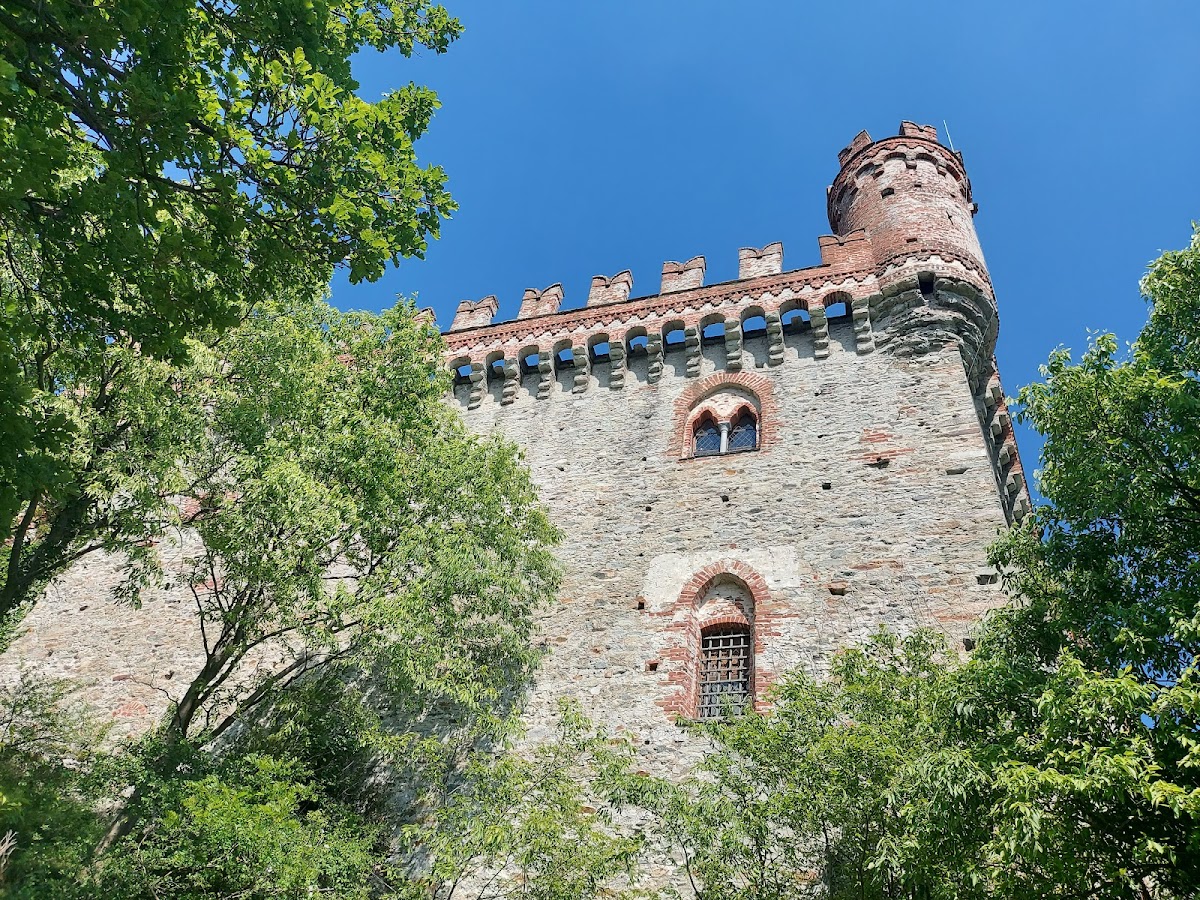
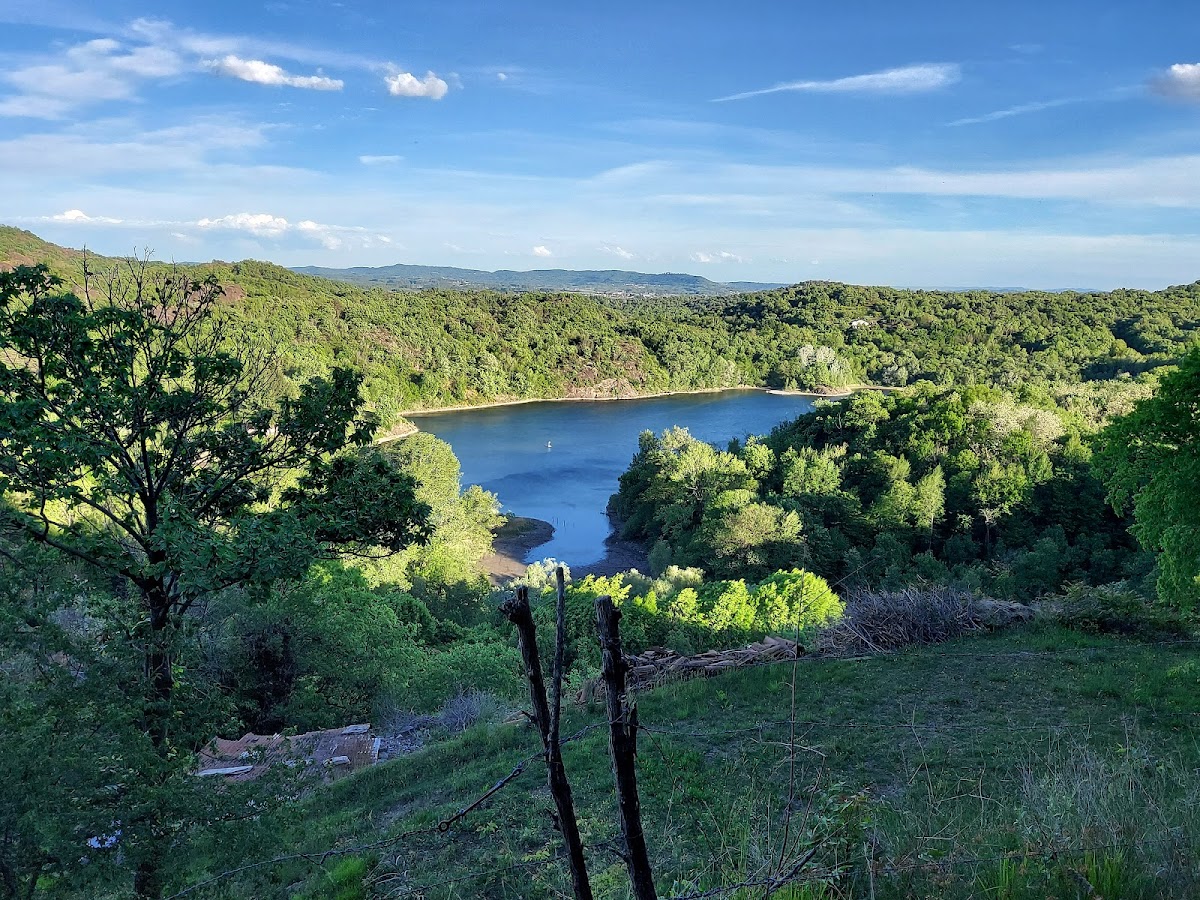
The castle stands at about 405 metres above sea level on Mount Crovero, overlooking Lake Pistono within the Ivrea moraine amphitheatre, a broad curved landform made from glacial debris. Its irregular quadrangular enclosure is formed by two defensive walls. The outer wall survives in only a few traces, while the inner wall rises approximately 14 metres and extends for more than 150 metres. The overall perimeter measures about 175 metres.
The crenellated inner wall has 142 merlons, the raised sections of a defensive parapet, and carries a patrol walkway about 160 metres long. Four round turrets reinforce the corners. A massive square keep, the castle’s principal fortified tower and strongest defensive and residential element, is integrated into the northern side. From this position it controlled the Ivrea lake plain and the road toward the Aosta Valley.
Courtyard buildings and chapel
Guard post and well
A relatively low building in the courtyard is thought to have served as a guard post. It stands apart from the small castle chapel, with a well between the two buildings. The well formerly supplied water to the castle’s inhabitants.
Chapel of Our Lady of Grace
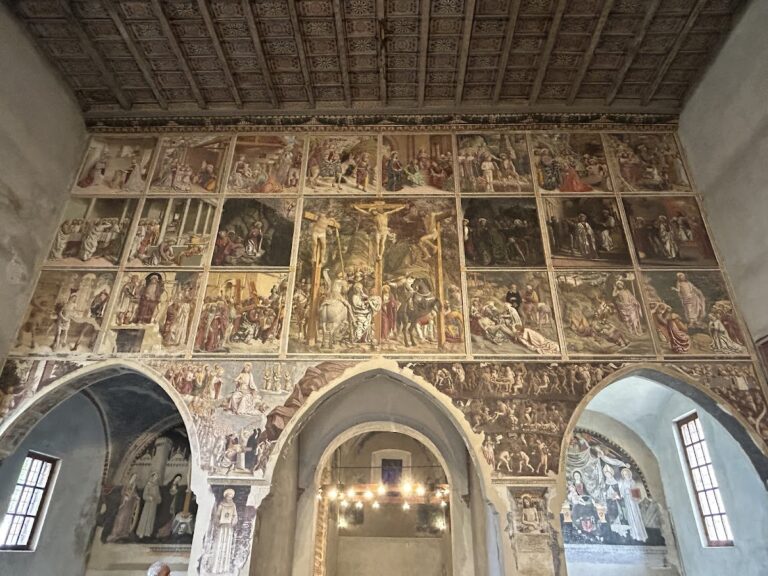
The chapel dedicated to Our Lady of Grace has a single-room interior with a presbytery. Fifteenth-century fresco remnants survive on its southern façade, including an image of Saint Christopher attributed to Giacomino da Ivrea, a fifteenth-century painter associated with the Ivrea area, and a depiction of the Madonna nursing the Child.
Numerous painted fragments remain inside the chapel. A fresco on the southern wall depicts female saints, including Saint Margaret, Saint Liberata with the infant saints Gervasius and Protasius, and Saint Lucy. Saint Liberata also appears among the chapel’s other frescoes.
Noble residential rooms
The noble residential rooms have been rearranged and furnished in period style. They include a large baronial hall where the lord received distinguished guests. Some interiors and part of the guard walkway are accessible within the privately owned castle.