Burg Friesenberg: A Medieval Hilltop Castle Ruin in Switzerland



Site at a Glance
- Rating
- 4.3
- Popularity
- Very Low
- Country
- Switzerland
- Primary era
- Medieval
- Eras represented
- Medieval
- Civilizations
- Habsburg, Holy Roman Empire
- Site type
- Military
- Remains
- Castle
On this page10 sections
History
Burg Friesenberg is a medieval hilltop castle ruin in Switzerland, near Zurich, probably built around 1200. First recorded in 1218 as a landmark in a property register belonging to St. Peter’s Church, it stood more than three kilometres from medieval Zurich and occupied a strategic position on the eastern slope of the Uetliberg.
Foundation and strategic role
During the final phase of settlement in the area, Burg Friesenberg probably served as an outpost of the Regensberg castle of Uetliburg. It formed the geographical endpoint of the Letzi, a forward line of fortifications, although the castle itself was not structurally incorporated into Zurich’s defenses. Its position on a projecting spur gave it a role in controlling the surrounding approach to the city and nearby estates.
A document from 1257 associates the castle with Jakob Mülner, the administrator of the Wiedikon estate and imperial bailiff of Zurich. An imperial bailiff was an official responsible for administering imperial rights and property in a defined area. Burg Friesenberg may therefore have been managed as an outpost of the imperial bailiwick of Zurich by the Zurich knightly Mülner family, which also held the castle and estate of Wiedikon around the middle of the thirteenth century.
Regensberg and Habsburg lordship
An inventory from 1321 describes Friesenberg as a fief of the barons of Regensberg and the counts of Habsburg. The two dynasties are named jointly as its owners in that year, while documents from 1344 identify the Habsburgs alone. The House of Habsburg was a major European ruling dynasty whose territorial power expanded substantially during the later Middle Ages. The Regensbergs were a prominent baronial family in the Zurich region.
Burg Friesenberg was probably abandoned or destroyed around 1300. By 1317 it was described as a Burgstall, a term for the site or ruins of a former castle, often indicating that the castle no longer functioned. The cause remains uncertain. Its destruction or abandonment may have been connected with conflicts between the Habsburgs and the Regensbergs, including the Regensberg feud of 1267 to 1268 or the blood feud that followed the murder of King Albrecht I on 1 May 1308. Another tradition places the destruction in the summer of 1383.
Later ownership and archaeological work
In 1344, the castle site and its associated properties passed to the knightly family of Schultheiss Johannes Mülner for services rendered. The last descendant of this family died at the Battle of Sempach in 1386. Johann Aeppli, who later became a Zurich guild master, purchased the estate and related properties in 1387. A guild master was the leading official of a medieval or early-modern urban craft or merchant guild.
The Oetenbach monastery acquired the property in 1436. After further changes of ownership, it passed to the City of Zurich in 1902. The ruins and the outer wall of the main castle, together with the clearly separated well, were uncovered between 1925 and 1930. The excavation and conservation methods used at that time did not meet modern archaeological standards, and many distinct archaeological layers were destroyed. As a result, the original arrangement of parts of the castle remains partly conjectural.
Minor repairs in the 1980s and 1990s included filling damaged wall sections with concrete. Later neglect caused extensive damage to the masonry. The ruin was closed to the public in 2019 and underwent extensive renovation in 2021 and 2022 with the involvement of Zurich’s city archaeology service. Burg Friesenberg is classified as a Swiss cultural property of regional significance, class B.
Remains
Burg Friesenberg occupies a terraced spur known as Goldbrunnenegg on the steep eastern slope of the Uetliberg, at 658 metres above sea level. The wooded site lies near Uetliberg Cemetery in Zurich’s Wiedikon district. A neck ditch cut across the landward side of the spur, strengthening the natural defensive position. The castle was built as a spur castle, a fortification placed on a projecting ridge or elevated spur, using ashlar masonry made from sandstone of the Upper Freshwater Molasse.
Castle enclosure and keep
Defensive wall
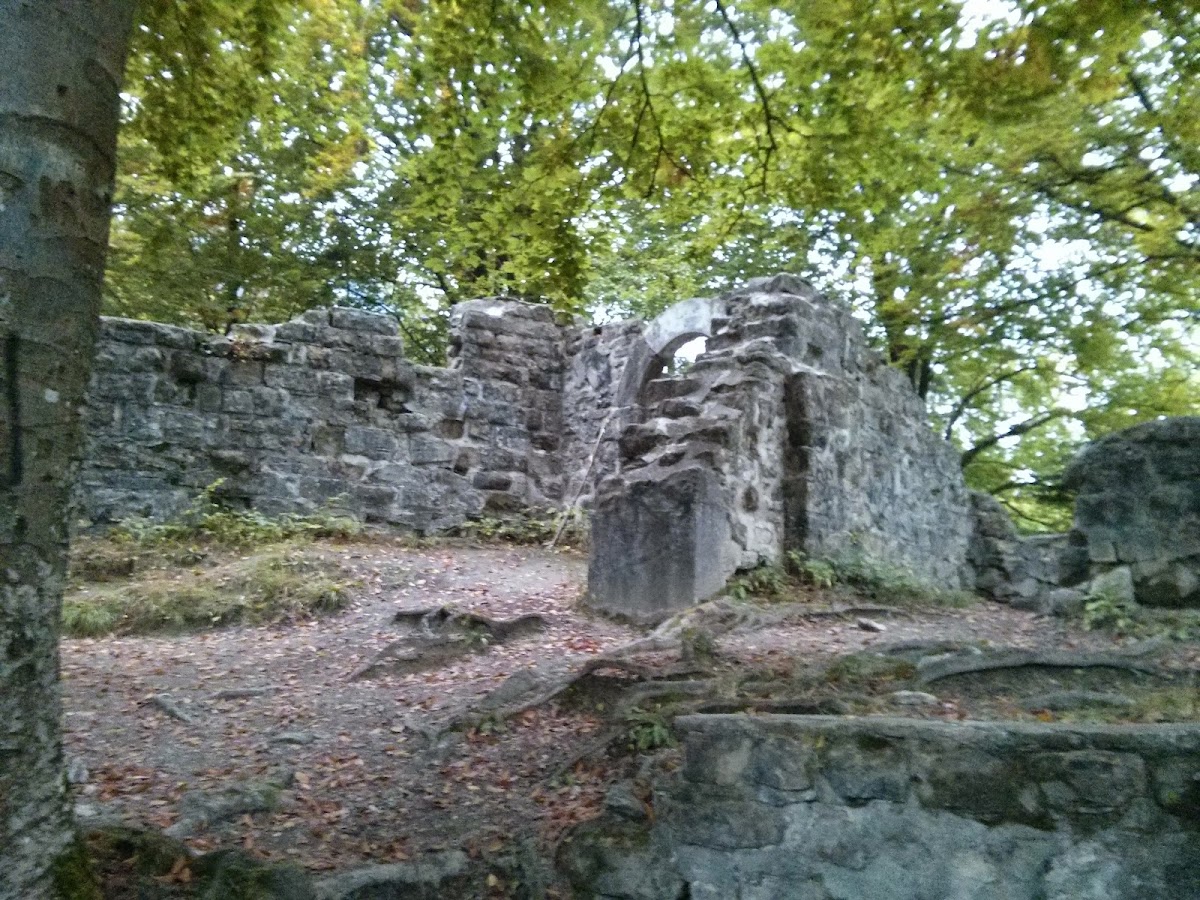
The defensive wall may have enclosed an area measuring up to approximately 30 by 18 metres, including the well. The surviving outer wall forms part of the visible remains of the main castle. Its masonry has been affected by excavation, reconstruction, concrete repairs, and later deterioration, so the original relationship between parts of the enclosure is not fully certain.
Square keep
The keep had a nearly square ground plan, with sides measuring about six metres. During partial rebuilding, it was reinterpreted as trapezoidal, and a window together with a gate arch or portico was inserted incorrectly. These interventions, along with later concrete infill in damaged masonry, have obscured the distinction between original medieval fabric and reconstructed sections. The visible ruin therefore combines surviving castle masonry with later work that shaped its present appearance.
Separated well
Shaft well
A shaft well stood clearly apart from the main castle. It was uncovered during the excavation work carried out between 1925 and 1930 and remains an identifiable element of the castle’s physical organization. Its separated position is included in the surviving layout, alongside the enclosure and keep, although the earlier archaeological work left the original arrangement partly conjectural.