Château de Fayrac: A Medieval and Renaissance Château in France


Site at a Glance
- Rating
- 4.2
- Popularity
- Very Low
- Country
- France
- Primary era
- Medieval
- Eras represented
- Medieval, Early Modern, Modern
- Civilizations
- French
- Site type
- Domestic
- Remains
- Castle
On this page9 sections
History
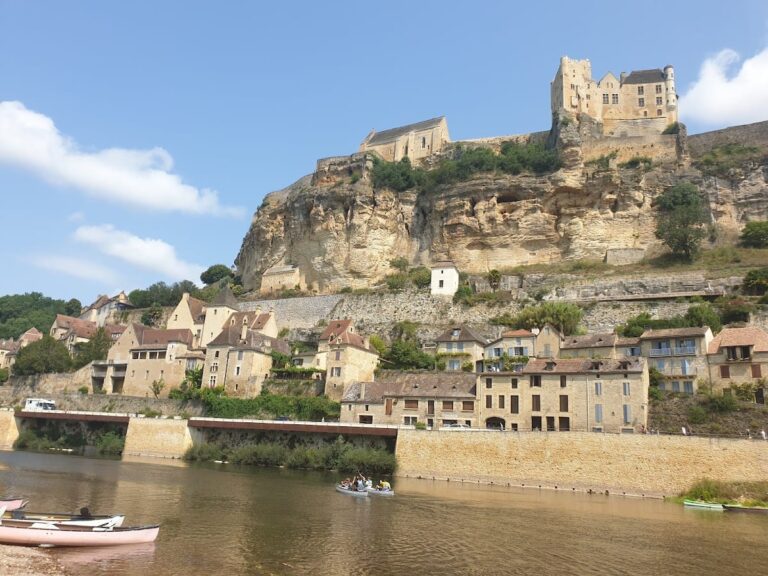
Château de Fayrac is a historic château in France, beside the Dordogne at Castelnaud-la-Chapelle. Its development began with a modest fortified house known in the thirteenth century as Afayrac or Affeyrac and continued through medieval, Renaissance, and nineteenth-century phases. The site later became an observation post during the Hundred Years’ War, the prolonged conflict between the English and French crowns fought mainly in France from the fourteenth to the fifteenth century.
Medieval origins and the Hundred Years’ War
The name Fayrac appears in thirteenth-century church inventories. The early fortified house is represented in the present château by its vaulted cellars and a round tower. By the fourteenth century, the Caumont family, lords of Castelnaud, held the property, which was then known as the “towers of Fayrac.” In 1342, Raoul de Caumont gave Fayrac to his daughter as a dowry.
During the Hundred Years’ War, Fayrac served as an observation post for Castelnaud, a castle aligned with the English crown. It faced Beynac, whose lordship supported the French king, placing the château within the contested military landscape of the Dordogne.
The Prouhet and Blancher families
After the war, Fayrac passed in 1459 to Léonard de Prouhet. The count of Périgord rewarded him for his valor, and he married the château’s heiress. During this period, a fifteenth-century entrance gatehouse with a drawbridge was added. Raymond de Prouhet was recorded in 1529 as lord of Fayrac and lieutenant-general of the Sarlat seneschalship, a regional administrative and judicial district under the French monarchy.
Around the same period, the gatehouse and château were embellished, and a Renaissance residence was added, possibly under the influence of Nicolas Gaddi, then bishop of Sarlat. The Renaissance was a cultural and artistic movement that began in Italy and spread across Europe, emphasizing classical forms and learning.
The château later passed by marriage to the Blancher family. During the French Wars of Religion, sixteenth-century conflicts between Catholics and Protestants in France, Fayrac was held by Protestants alongside Castelnaud and other regional strongholds. Jean de Blancher fought for the Protestant side, while Pierre de Blancher, who remained Catholic, was killed by Protestants on the night of 16 September 1580.
After the fortified town of Domme was captured, command of the town was entrusted to Jean de Blancher. A Pierre de Blancher later held that command around 1591. A member of the same family was still recorded as lord of Fayrac in the early eighteenth century.
Revolutionary confiscation and later restoration
In 1789, Fayrac belonged to a collateral branch of the family, some of whose members had emigrated. The château was confiscated as a national asset and sold to Gayraud, a lawyer from Sarlat who had acquired wealth through speculation in assignats, paper currency issued during the French Revolution that underwent substantial depreciation. He restored the property.
During the nineteenth and early twentieth centuries, the composer Fernand de La Tombelle owned Fayrac and undertook extensive restoration. He had inherited the château, where his mother, Louise Gueyraud, had been born. La Tombelle was one of the founders of the Schola Cantorum, a French institution devoted to teaching and performing sacred and classical music.
After March 1944, André Malraux stayed at Fayrac for several weeks after joining the French Resistance following the arrest of his brothers. Malraux was a French writer, intellectual, and later statesman. Georges Good also spent his childhood at the château while it belonged to his uncle R. Werner. Fayrac has been protected as a historic monument since 31 March 1928.
Remains
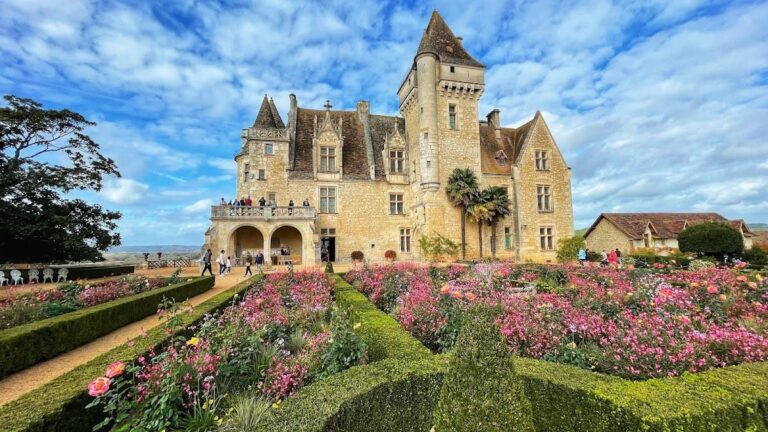
Château de Fayrac stands on a small hill beside the Dordogne at Castelnaud-la-Chapelle. Three wings enclose an elevated inner courtyard, while a wall protects the open side. The complex brings together medieval defensive elements, fifteenth- and sixteenth-century Renaissance features, and nineteenth-century additions.
Medieval and Renaissance fabric
Gatehouse and drawbridge
Access to the inner courtyard is provided by a fifteenth-century entrance gatehouse equipped with a drawbridge. The gatehouse was later embellished during the sixteenth-century transformation of the château. Its fortified form retains the role of controlling entry to the enclosed court.
Towers and residential wings
On the river side, two massive towers give the château a strongly defensive appearance. The earlier fortified house survives in the form of vaulted cellars and a round tower. The other two wings have large windows and crenellated turret features associated with Renaissance architecture. A residential wing recalling the Italian Renaissance was added during the sixteenth-century embellishment.
Nineteenth-century additions and interiors
The nineteenth-century restoration included the construction of a replica medieval donjon, a principal fortified tower used as a stronghold or residence. One tower room contains Fernand de La Tombelle’s large music library and his Érard grand piano, preserving a material connection with the composer’s ownership and restoration of the château.