Dunyvaig Castle: A MacDonald Stronghold and Naval Base on Islay


Site at a Glance
- Rating
- 4.5
- Popularity
- Very Low
- Country
- United Kingdom
- Primary era
- Early Modern
- External website
- Open
- Eras represented
- Medieval, Early Modern
- Civilizations
- Kingdom of Scotland
- Site type
- Military
- Remains
- Castle
On this page8 sections
History
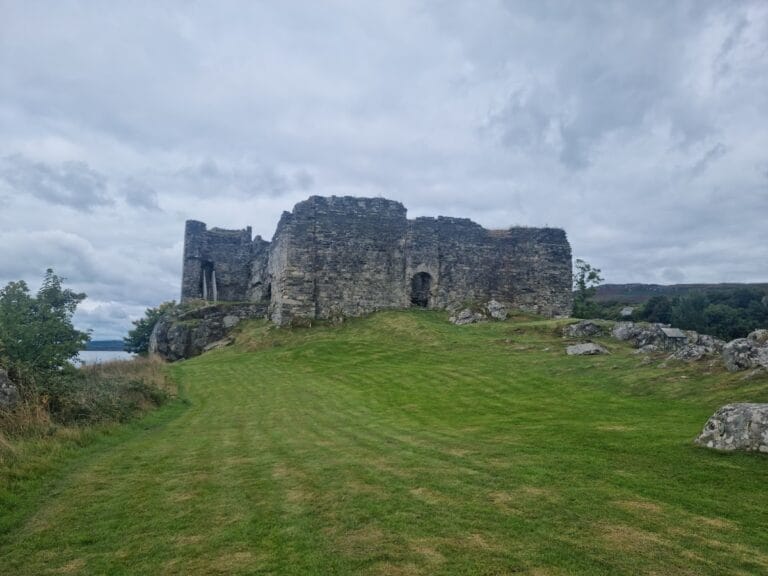
Dunyvaig Castle is a ruined medieval fortress on Islay, Scotland, United Kingdom, built by the Gaelic ruler Somerled probably in the twelfth century. Standing on the shore at the entrance to Lagavulin Bay, it served as a naval base and anchorage for the galley fleet of the Lords of the Isles, and later became the principal seat and seaport of the MacDonalds of Dunnyveg.
Somerled and the Lords of the Isles
Somerled established a powerful lordship across the Isles and parts of the western Scottish mainland during the twelfth century. His descendants included the Macdonald Lords of the Isles, a medieval Gaelic ruling dynasty whose authority across much of the Hebrides relied heavily on seaborne galley fleets. An earlier fortification may have preceded Somerled’s castle, and the promontory may also have held a defense during the Viking period.
During the thirteenth and fourteenth centuries, Dunyvaig was held by Somerled’s descendants, including Angus Mor Macdonald and his sons Alexander Og and Angus Og. The sheltered waters of Lagavulin Bay provided an anchorage for their galleys and supported the castle’s role within the lordship’s maritime network.
Changes in ownership after 1493
After the forfeiture of the Lords of the Isles in 1493, Dunyvaig and its associated holdings passed to the MacIans of Ardnamurchan. The MacIans descended from John Macdonald, the younger brother of Angus Og Macdonald and an ally of Robert the Bruce. The Crown’s punishment of the MacDonald rebellion of 1501–1506 subsequently affected the MacIans.
The MacDonalds leased the castle again in 1519. It passed to the Campbells in 1543, before the MacDonald holdings on Islay and Jura were restored in 1545. In 1598, John Stewart of Arskok held Dunyvaig and received an annual payment of 3,000 Scots pounds toward its expenses. During the same period, the MacDonald of Dunyvaig defeated the MacLeans of Duart at the Battle of Gruinart but was ordered to surrender the castle.
The struggles of 1608–1615
In 1608, Angus MacDonald, eighth of Dunnyveg, surrendered Dunyvaig by negotiation to the king’s lieutenant, the 3rd Lord Ochiltree, and Andrew Knox, Bishop of the Isles. Knox arrived on 2 August with a royal naval force and 1,000 men. A Crown garrison was installed, and the MacDonald estates were forfeited.
Ranald Og Macdonald captured the castle in 1614, but Angus Og MacDonald retook it and tried to negotiate its surrender. In September, Bishop Knox attempted to recover Dunyvaig, but the operation failed and he was forced to retreat. Knox left his son Thomas and his nephew, John Knox of Ranfurly, as hostages, whose release George Graham later negotiated.
On 6 January 1615, Sir John Campbell of Calder, assisted by Sir Oliver Lambart, retook Dunyvaig with artillery and troops brought in the Phoenix. Lambart captured 22 men, while 22 others, including Coll Ciotach, escaped through a postern, a small secondary gate used for discreet access or escape, and reached a longboat.
Sir James MacDonald and Coll Ciotach captured the castle again in June 1615, killing its captain and some of the garrison. Sir James fled, while Coll Ciotach surrendered to Argyll on 13 October. This occurred before artillery from the ships Charles and a barque could be landed against the castle.
Siege, demolition, and protection
In 1647, Dunyvaig became involved in the conflict between the MacDonalds, the Campbells, and the Covenanters, Scottish Presbyterians who opposed royal attempts to impose episcopal church government. A siege led by David Leslie, a military commander serving with Covenanter forces, eventually forced the castle to surrender because of a shortage of water. Coll Ciotach, a prominent MacDonald warrior and leader, was hanged at the castle wall, and Dunyvaig then passed to the Campbells of Cawdor.
The Campbells of Cawdor held the castle until 1677, when Sir Hugh Campbell demolished it and moved to Islay House. The surviving fabric is consequently predominantly ruinous. Dunyvaig was designated a scheduled monument in 1989, a legal status protecting archaeological and historic sites considered nationally important.
Remains
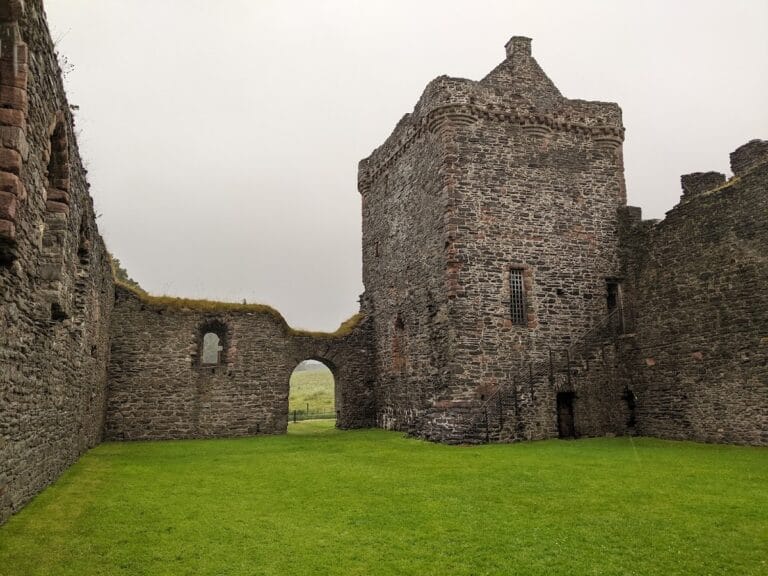
Dunyvaig occupies a raised rocky promontory on the eastern side of Lagavulin Bay, close to the bay’s entrance and directly beside the sea. Its position provided views across the sea passage between the Kintyre peninsula and County Antrim in Northern Ireland. The surviving complex is formed mainly by the ruins of a sixteenth-century castle, together with an outer court, a smaller inner courtyard, a thirteenth-century courtyard or enclosure, and a keep assigned variously to the fifteenth or sixteenth century.
Outer court and sea entrances
The enclosing walls have been dated either to the late fourteenth century or, less certainly, to the thirteenth century. The outer-court walls were approximately 2–3 metres thick and now rise only a little above the surrounding ground. Its landward entrance stood in the northern wall. Traces of four small buildings survive within the court, probably representing kitchens and storage rooms. A blocked gateway in the western wall led down toward the lower shore, while a larger sea gate occupied the southwest wall.
Inner courtyard and keep
Near the centre of the southern wall, a vaulted opening led into a small triangular courtyard. A drawbridge once crossed a ravine at its southern corner, and surviving stairs on the opposite side led toward the keep. Built on irregular rock, the keep required particularly heavy masonry support at its southeast corner. Its southeast, southwest, and northeast sides remain standing to two storeys. The small inner courtyard retains an arched entrance and part of a rib vault, a vaulted ceiling supported by intersecting masonry ribs.