Castell de Santa Pau: A Gothic Feudal Castle in Spain
Site at a Glance
- Rating
- 4.3
- Popularity
- Very Low
- Country
- Spain
- Primary era
- Medieval
- Eras represented
- Medieval, Early Modern
- Civilizations
- Crown of Aragon, Spanish
- Site type
- Military
- Remains
- Castle
On this page9 sections
History
Castell de Santa Pau is a Gothic feudal castle in Spain, at the center of Santa Pau in the Garrotxa region. Its construction and development span the twelfth to seventeenth centuries, and its history is closely connected with the neighboring castle of Finestres and the lineage that became the barons of Santa Pau.
Origins and the Santa Pau lineage
The place-name Sancta Pace appears in 878 and again in 979, in the will of Bishop Miró. The lords of Finestres, formerly associated with the Porqueres family, are traditionally thought to have adopted Santa Pau as their place-derived surname after building the castle. Members of the Santa Pau family first served as castellans, officials responsible for administering and defending a castle for its lord. Ponç I held that position in 1147, followed by Arnau in 1192, Pere in 1196, and Ponç II in 1218. With Ponç II, the line of castellans of Finestres ended, and the Santa Pau family became the lords of the castle before later attaining the title of barons of Santa Pau.
Around 1221, Agnès held the lordships of Porqueres and Santa Pau. In 1251, her son Ramon Ademar sold Porqueres Castle to the abbot of Banyoles because of needs connected with the castles of Finestres and Santa Pau. About two decades later, the Santa Pau and Foixà families were joined through the marriage of Gueraula, Ramon Ademar’s widow, who had been left without an heir.
Royal connections and the medieval barony
King Peter III of Aragon stayed at Castell de Santa Pau in 1285 after a major battle against the French. He returned to the fighting from Santa Pau by way of Besalú and achieved a final victory at the Col de Panissars. On 28 February 1297, Ponç III of Santa Pau accompanied the king during the Sicilian campaign and received the privilege of holding a weekly market for the barony of Santa Pau, a territorial lordship governed by a baron. A settlement charter, which formally established the community and its legal privileges, followed in 1300.
In 1312, Huguet II of Santa Pau paid homage to King James II for the castles of Finestres, Santa Pau, and Sant Aniol. By 1433, Hug Ademar of Santa Pau held the lordships of Santa Pau, Finestres, and Castellfollit. After a dispute with Francesc Gelabert de Centelles, he acquired Mosset, Peracolls, and Torre Bastarda in 1437.
The Oms family and the remença revolt
The Oms family acquired the barony of Santa Pau and Finestres through a sale ordered by the Royal Court of Besalú in 1456. Six years later, during the remença revolt, Catalan peasants rose against oppressive feudal dues and obligations. At Santa Pau, rebels opposed the procurator after he imprisoned the remença syndic while enforcing pensions and other payments. Francesc de Verntallat, one of the revolt’s leaders, was also at Santa Pau. After the war, Verntallat, the remença peasants, and Guillem d’Oms, lord of Santa Pau and Finestres, supported King John II.
In 1473, John II ordered the royal bailiff to place Guillem d’Oms in possession of Finestres Castle. Remença forces had conquered it in the king’s name, while Verntallat and Pere Joan Sala exercised authority there. In 1486, forces led by Narcís Goixat seized Castell de Santa Pau and captured Mossèn Oms in an attempt to compel the surrender of Finestres. Ferdinand II of Aragon condemned the seizure from Alcalá de Henares, and the castles soon returned to the Oms lineage.
War, rebuilding, and later ownership
French troops occupied the castle in 1694. Spanish troops captured it several months later and blew up part of the building. Antoni IV d’Oms then had the castle rebuilt, at a cost of 2,000 pounds. During the second half of the eighteenth century, the marquises of Moià de la Torre became lords of Santa Pau and Finestres because of credit-related debts. The barony of Santa Pau thereafter remained attached to the marquises of Castelldosrius. In 1969, Fèlix II de Sentmenat i de Güell, the tenth Marquis of Castelldosrius, was recorded as Baron of Santa Pau.
The castle’s name gave rise to the legend of the nun Santa Pau. It is protected as a Cultural Asset of National Interest and as a historic monument, with heritage records dated 1949 and 8 November 1988. It is registered under reference RI-51-0006107 and Catalan architectural-heritage inventory number 2069. In August 2023, Santa Pau Town Council publicly announced its purchase of the castle from its owners. The building had been unused for more than fifty years, since the community of nuns left the village school, and it has significant structural defects.
Remains
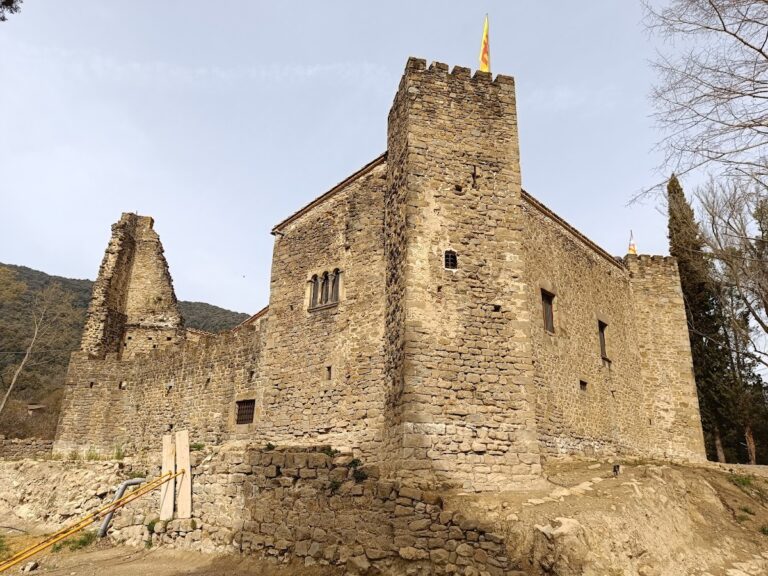
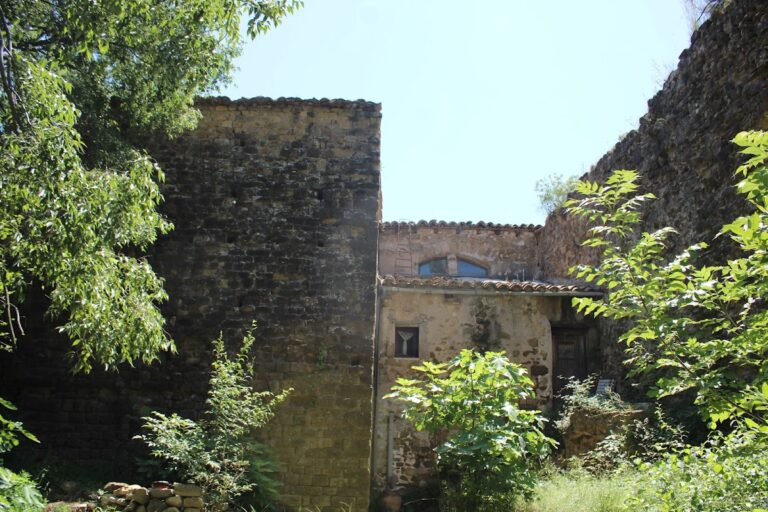
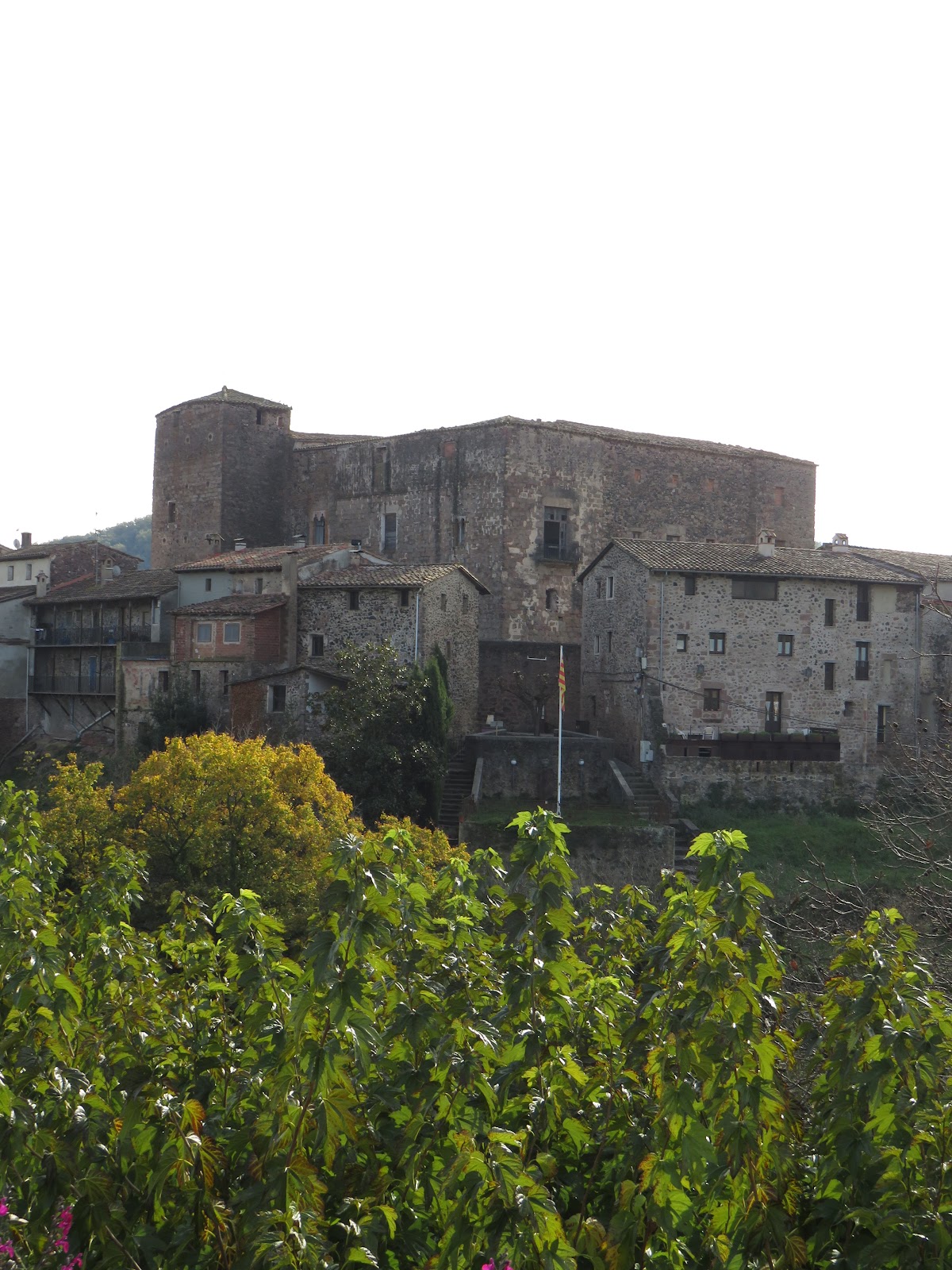
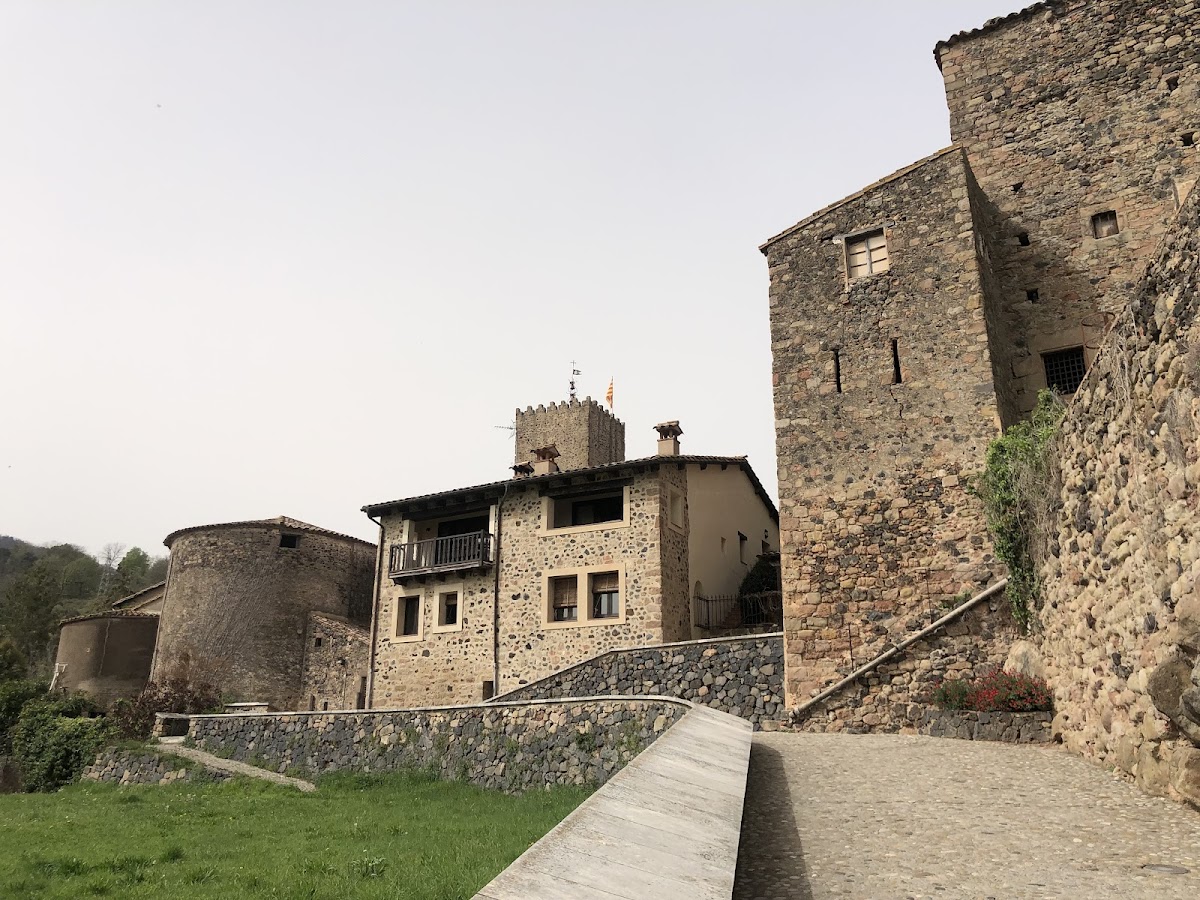
Castell de Santa Pau is a large rectangular manor complex arranged around an interior courtyard. The town is almost attached to its walls, integrating the castle into Santa Pau’s urban center. The roughly square complex has the character of a fortified aristocratic manor house. Its lower level, extending to the first floor, is built from dressed stone blocks, while the upper part uses mortar. Most of the walls and moats have nearly disappeared, but Gothic windows and later openings survive.
Keep and courtyard
A tall, slender keep with a square plan stands on the northeastern side of the complex. It projects only slightly from the main building but dominates the entrance. The ground floor of the keep contains the small baronial chapel and is regarded as the oldest part of the castle. Within the complex, the arms courtyard survives with its large staircase, providing the principal internal open space described in the building.
Baronial chapel
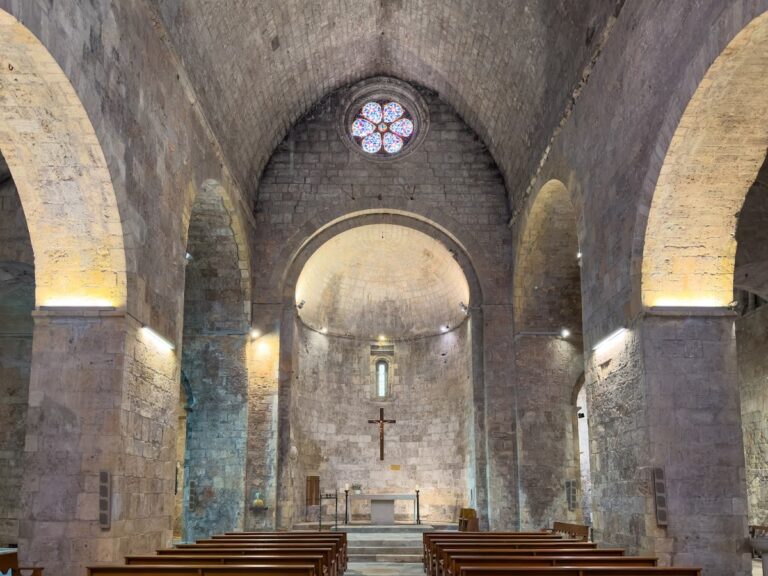
The very small baronial chapel is attached to the castle. Its entrance has a rounded arch made from fairly regular stone blocks and is reached by two steps. A small loophole-like opening is set above the doorway. Hug Ademar donated a True Cross relic to the chapel, a Christian relic traditionally identified with the cross on which Jesus was crucified, and an altarpiece dating from 1340 stood in the choir.
During the French occupation, the chapel’s silver was pawned. The building was restored in 1766 and was later used by the nuns for a time as a charcoal store and pantry.
Coat of arms
Above the entrance lintel, a coat of arms is carved on a single block of stone. It shows three turbans representing three captive kings, together with a bear carrying a flag and twelve palm branches. The imagery represents the victories attributed to Arnau against the Arabs.