Hörtenberg Castle Ruins: A Medieval County Seat in Austria


Site at a Glance
- Rating
- 4.2
- Popularity
- Very Low
- Country
- Austria
- Primary era
- Medieval
- Eras represented
- Medieval, Early Modern, Modern
- Civilizations
- Habsburg, Holy Roman Empire
- Site type
- Military
- Remains
- Castle
On this page12 sections
History
Hörtenberg Castle Ruins, also known as Pfaffenhofener Schlössl, are a medieval hilltop castle ruin in Pfaffenhofen, Austria. Built by the Counts of Eschenlohe, the castle stood at about 797 metres above sea level beside a regionally important medieval road junction. In 1239, Heinrich of Eschenlohe styled himself comes von Hertenberch, or Count of Hörtenberg, and the castle served as the center of the County of Hörtenberg.
County seat and judicial centre
Meinhard II of Tyrol acquired the castle in 1281. Five years later he purchased the County of Hörtenberg and its associated rights and possessions. In 1291, Duke Otto of Bavaria, who had previously held superior feudal authority, transferred full ownership to Meinhard. The castle chapel was dedicated to Saint Dionysius, regarded as the patron saint of the Carolingian dynasty, which ruled much of western and central Europe between the eighth and tenth centuries.
Hörtenberg became the seat of the county court. A judge and court are first recorded there in 1288, and by about 1300 the county court was housed at the castle. During Meinhard II’s rule, other judicial districts, including the district of Fragenstein Castle near Zirl, were incorporated into the Court of Hörtenberg. The court exercised both low jurisdiction over lesser civil and criminal matters and high jurisdiction over major criminal cases, including capital punishment. Its authority also extended to the Schlossberg court. Executions took place near Mount Hörtenberg and later at Lengeberg near Oberhofen.
Custodians, pledgeholders, and rebuilding
The castle was administered by appointed custodians and was repeatedly given to pledgeholders as security for financial obligations. The Lords of Matsch held it from 1363 to 1405. Under Ulrich of Windeck, extensive new construction took place between 1413 and 1436.
In 1448, Sigmund the Wealthy granted Hörtenberg to his first wife, Eleanor of Scotland, as part of her morning-gift endowment. Their only son, Wolfgang, and Eleanor both died in 1480, after which appointed custodians generally administered the lordship. Emperor Maximilian I, who succeeded Archduke Sigmund, occasionally used Hörtenberg as a base for chamois and deer hunting.
Archduke Ferdinand II redeemed the pledge in 1577, making the lordship the freehold property of his morganatic wife, Philippine Welser. In a morganatic marriage, the spouse and children of the lower-ranking partner did not receive the higher-ranking partner’s full dynastic rights. After Philippine’s death, Hörtenberg passed in 1580 to the Margraves of Burgau, specifically to their son, Margrave Karl of Burgau. Following Karl’s death in 1613, it passed to Archduke Maximilian III, the German Master of the Teutonic Order.
The castle was pledged to the Wolkenstein family in 1619 and was held by the Counts Fieger of Hirschberg from 1633 to 1805. The Counts Spaur and later the Barons of Goldegg then held it as pledgeholders. The Knights of Goldegg returned the court in 1824. The court itself had moved to the Pflegehaus in Telfs during the seventeenth century. In 1787, the Schlossberg court, whose jurisdiction covered almost the entire municipality of Scharnitz, was dissolved and incorporated into the Court of Hörtenberg.
Destruction and modern preservation
At the beginning of the eighteenth century, Hörtenberg was used to store military supplies. On 5 August 1706, lightning ignited about 1,500 hundredweights of gunpowder kept at the castle. The explosion largely destroyed the complex.
The state took over Hörtenberg in 1824 but soon transferred it to the Lener family of Pfaffenhofen. Father Alexander Lener restored the keep in 1873 and made it accessible again. The Order of the Poor School Sisters later acquired the tower and a house that had developed from the former outer bailey. Eugen Matt owned the castle property from 1973, and the municipality subsequently acquired the former castle and cleared its heavily overgrown grounds in 2007. Hörtenberg is listed as protected cultural property in Austria. The battlements depicted in Pfaffenhofen’s arms represent Hörtenberg Castle, while the arms themselves derive from the Lords of Eben.
Remains
Castle layout and defensive works
The surviving complex consists of a core castle and a lower outer bailey built during the thirteenth and fourteenth centuries. The outer bailey is partly inhabited, while the wider site survives as a partially renovated ruin. Remains of a ring wall and extensive outer defensive works dating from around 1500 mark the castle’s fortified perimeter. A well shaft also survives within the complex.
Keep
Stone tower
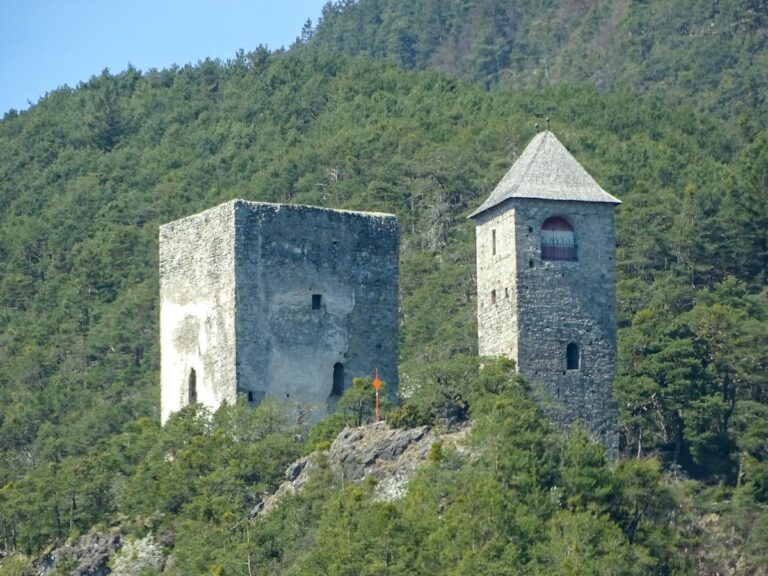
The five-storey keep is square, measuring about 9 by 9 metres. Its walls are approximately 2.5 metres thick at ground level and become thinner on the upper levels. The tower is built mainly from slate rubble masonry arranged in irregular courses. Bossed ashlar blocks, whose outer faces project from the wall, and traces of painted corner stones remain visible.
Entrances and lighting
The keep was entered through an elevated doorway measuring about 1.5 metres wide and 2.2 metres high. The four upper storeys received light through a small number of narrow slits. The tower now has renewed entrances and battlements, as well as a pyramid roof added in 1873 to secure the structure.
Chapel and archaeological evidence
Castle chapel
A small chapel built in 1866 may occupy the site of the earlier castle chapel dedicated to Saint Dionysius. The identification of the later building with the medieval chapel remains uncertain.
Excavated finds
Excavations in autumn 2004 recovered material from the Bronze and Iron Ages, dating from the second and first millennia BC. Finds from the thirteenth through sixteenth centuries also connect the archaeological record with the period of the castle’s medieval and early modern use.