Château de Gevrey-Chambertin: Medieval Fortified Castle and Wine Estate


Site at a Glance
- Rating
- 4.3
- Popularity
- Very Low
- Country
- France
- Primary era
- Medieval
- Eras represented
- Medieval
- Civilizations
- Duchy of Burgundy
- Site type
- Military
- Remains
- Castle
On this page10 sections
History
Château de Gevrey-Chambertin is a medieval fortified castle in France, begun in the eleventh century and probably extensively altered during the second half of the thirteenth century. Before and during the time of Saint Bernard, the site served as a priory of the Abbey of Cluny, a major Benedictine monastery whose dependent religious houses extended across western Europe.
Cluniac origins
In 1015 and 1019, Hugues, bishop of Auxerre, and his sister Maheldis de Semur donated the Curtis called Gevrey to the Cluniac monastery. They were heirs of Count Lambert de Chalon, and the monastery was then led by Abbot Saint Odilon. A priory was a religious establishment governed by a prior and subject to a larger monastic institution, placing Gevrey within Cluny’s wider religious network.
The site had become a fortified castle by the eleventh century. Between 1257 and 1275, the Cluniac abbots Yves de Poisey and his nephew Yves de Chazan gave it the principal form of its medieval fortress.
Damage, ownership, and later use
Wars, pillage, fires, and the passage of time altered the castle and destroyed parts of the original complex. After it was sold as a national estate in 1791, later works changed the middle floor of the large square tower. This conversion probably destroyed a notable glazed-tile floor dating from the time of Saint Bernard or possibly from the period of Yves de Poisey.
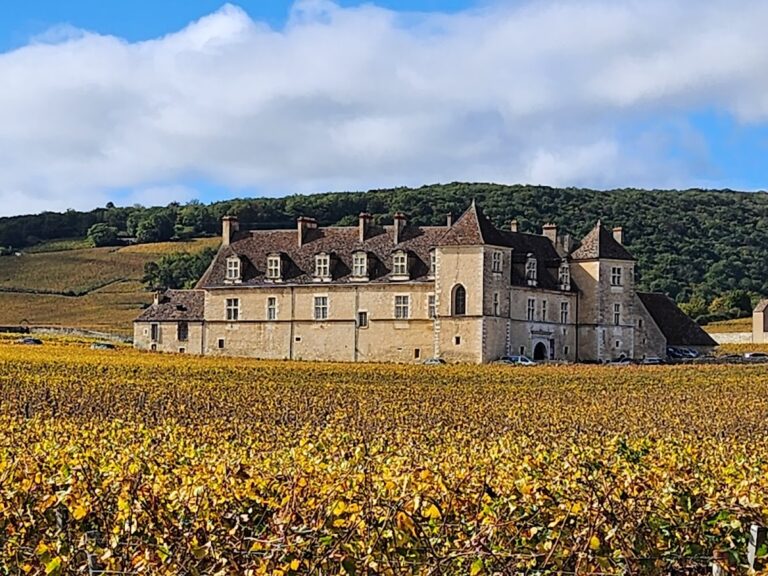
Jacques Masson acquired the castle in 1858, and it remained with his descendants until 2012. That year, the castle and its vineyard were acquired by Louis Ng Chi Sing, a businessman and investor from Macao. The property is now used as a wine estate, with vineyard management entrusted to Domaine Armand Rousseau and an intention declared to restore the castle.
The castle, its fixed bridge, and its keep were listed in the French Monuments historiques inventory on 24 September 1993. This is France’s heritage-protection designation for historically or architecturally important sites and structures.
Remains
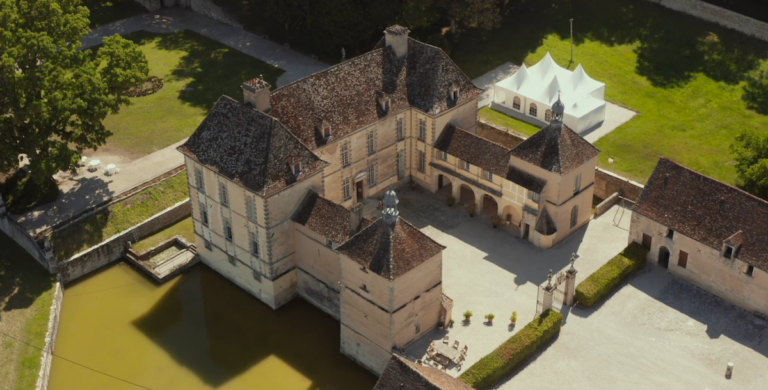
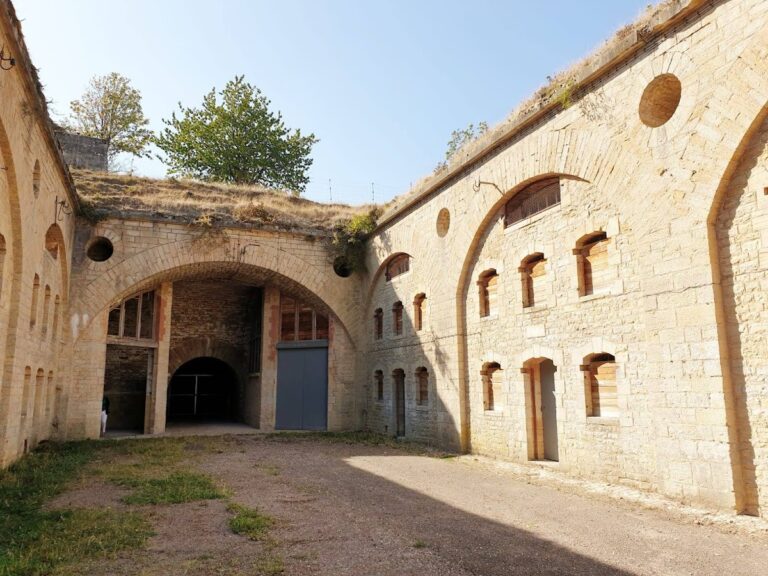
The castle occupies a large rectangular enclosure surrounded by moats. Its defenses were organized around corner towers and a connecting wall with a covered way, a protected passage along or behind a fortification wall. The surviving medieval fabric includes the gatehouse, the large square tower, the residential building beside the gatehouse, and sections of the surrounding wall.
Entrance and fortified enclosure
Gatehouse and bridge
The southwest entrance was formed by a gatehouse approached across a fixed stone bridge and a drawbridge. Two square towers originally flanked the entrance. One of these gatehouse towers has been lost, as has the drawbridge mechanism, while the gatehouse and fixed bridge remain part of the surviving complex.
Walls and covered way
A wall linked the towers around the enclosure and incorporated a covered way for protected movement along the fortification. Remnants of this surrounding wall survive together with the residential building adjoining the gatehouse, preserving parts of the castle’s defensive and domestic arrangement.
Corner towers and archaeological traces
Square and round towers
A large square tower occupied the southeast corner of the enclosure. At the northeast corner, a small round tower stood on a projecting corbel-like masonry support called a cul-de-lampe and was topped by a dovecote. The northwest corner tower was topped by a gallery. The square tower also contained the former glazed-tile floor associated with the period of Saint Bernard or possibly Yves de Poisey.
Glazed tiles and vineyard
Fragments from the former floor, some intact and others broken, were found in the lime mortar of nearby walls, in shallow deposits around the building, and in the grass-covered terrace that replaced the area once called the arsenal. The property also includes a 2.3-hectare vineyard producing wine under the Gevrey-Chambertin appellation, the legally defined designation for wines made under regulated conditions in the Gevrey-Chambertin area.