Fort de Beauregard: A Séré de Rivières Fort near Dijon
Site at a Glance
- Popularity
- Low
- Country
- France
- Primary era
- Modern
- Eras represented
- Modern
- Civilizations
- French
- Site type
- Military
- Remains
- Fort
On this page12 sections
History
The Dijon defensive belt
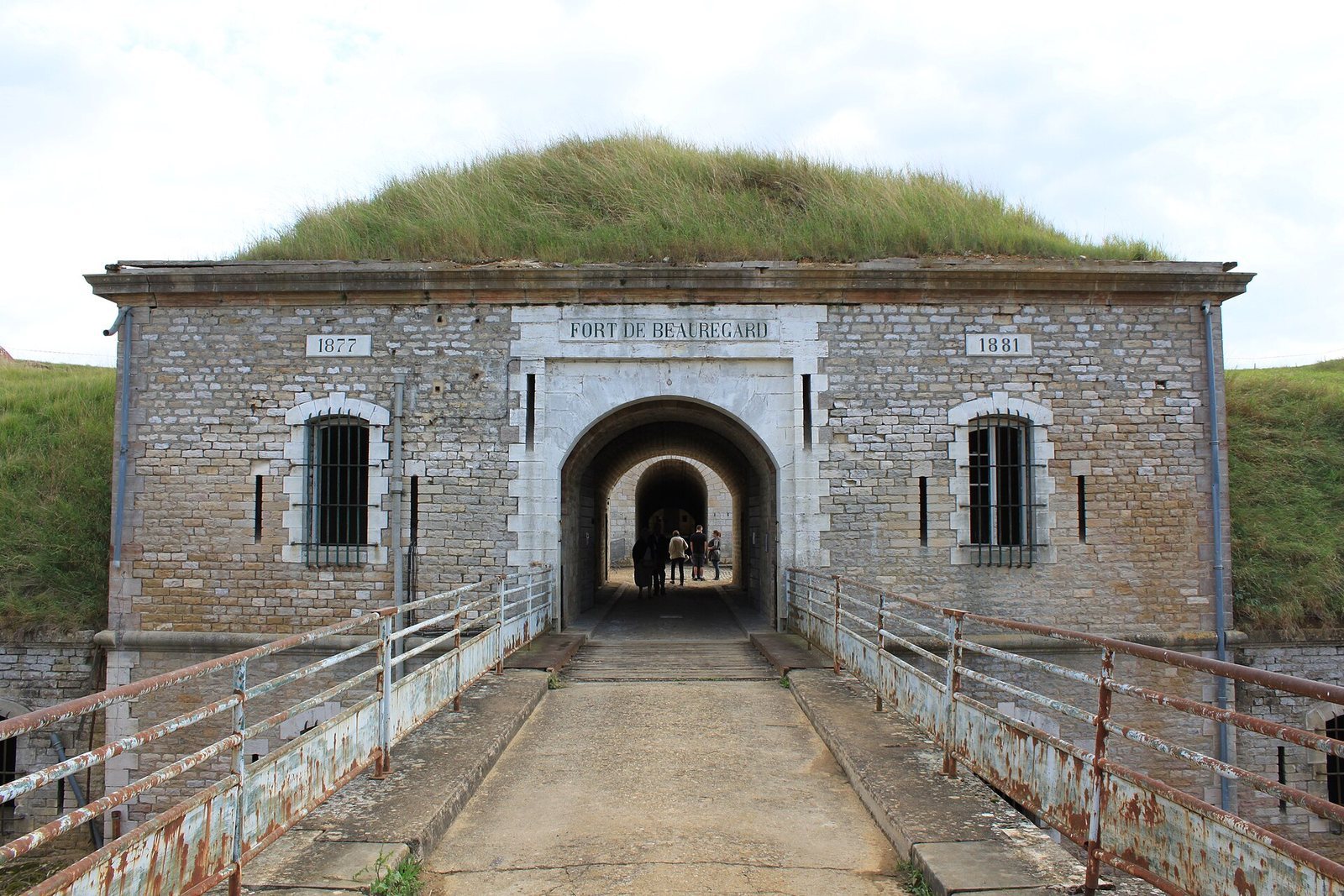
Fort de Beauregard is a French Model 1874 fortification at Fénay, France, built between 1877 and 1881 as part of the defenses of Dijon. It belonged to the Séré de Rivières system, a national network of forts developed after France’s defeat in 1870-71. Dijon was assigned to the system’s second defensive line, behind the first line centered on Verdun, Toul, Épinal, and Belfort. A belt of forts and redoubts around Dijon was constructed between 1875 and 1883.
The fort seems to occupy the site of an earlier fortification shown on maps, including one from 1846. It was also built near Beauregard farm, which is mentioned as early as the seventeenth century.
Military service and planned modernization
In 1887, during Georges Boulanger’s tenure as minister of war, the fort was briefly renamed Fort Fauconnet. The new name honored Adrien Fauconnet, a gendarmerie colonel who led Dijon’s defense against Baden troops commanded by General Gustav von Beyer on 29 October 1870. Mortally wounded, Fauconnet died the following day after learning that a decree of 27 October had appointed him brigadier general in the auxiliary army.
The fort’s garrison comprised 348 men, with 20 rampart guns, five mortars, and six guns assigned to defend its flanks. In 1914, its garrison numbered 101 men. The fort was not used during the First World War. Plans to modernize it with special concrete, including a restructuring program in 1900 and a complementary program in 1908, were not carried out.
Occupation, reuse, and ownership
During the German occupation of 1940-44, Fort de Beauregard formed part of the defenses of the nearby Longvic air base, and anti-aircraft batteries were installed there. It later served as a warehouse for Air Base 102 Dijon-Longvic, until its decommissioning in 1984.
The army put the fort up for sale in 1997. The SIVOM of Saulon-la-Chapelle bought it in 1998, and Fénay became its sole owner in 2003. Clearing, cleaning, and removing debris helped reveal the military site. Fort de Beauregard was listed as a French historic monument in 2006. In December 2024, the municipality sold it to a private buyer.
Remains
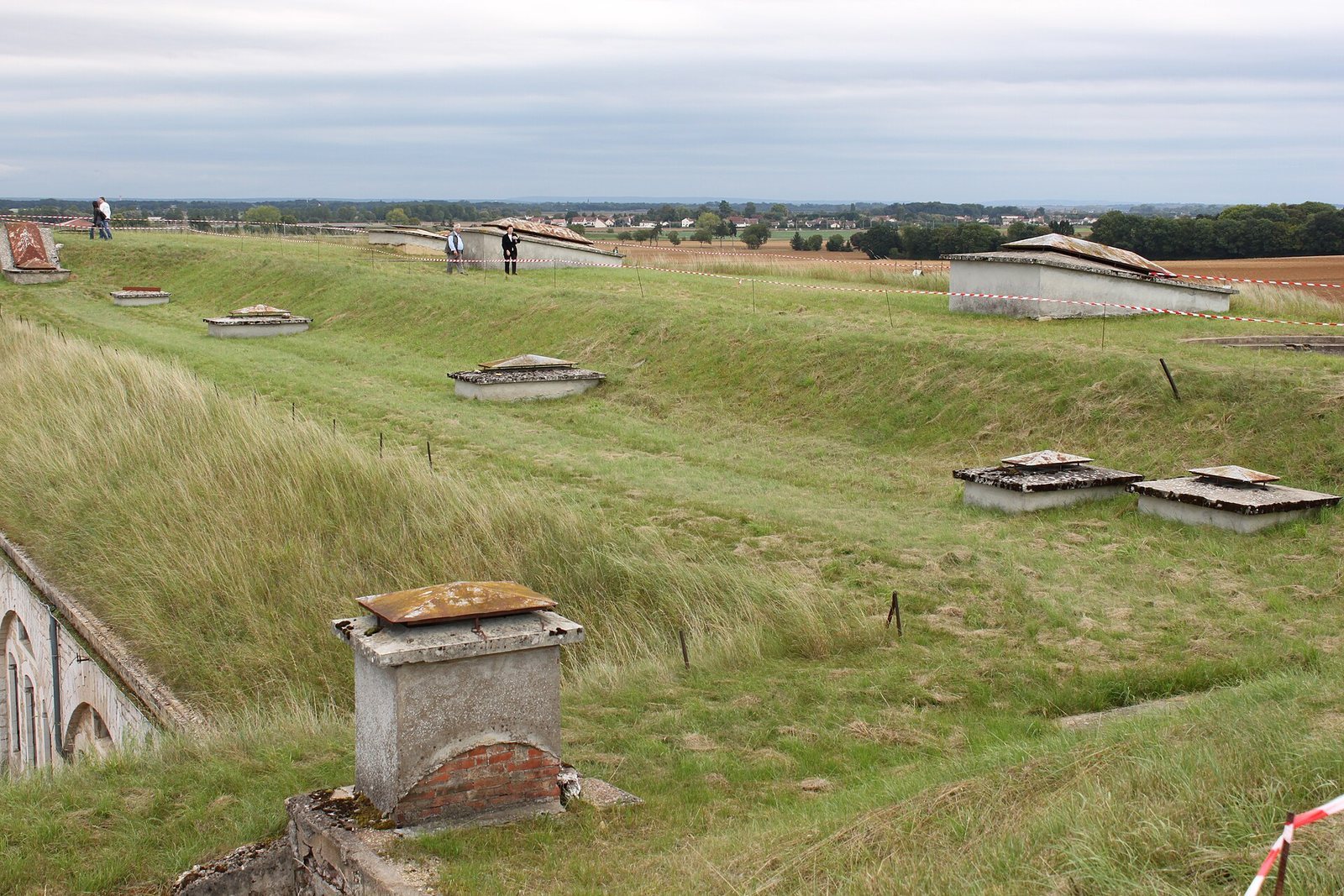
The fort covers 3,913 square metres and has a rectangular plan. It lies south-southeast of the Dijon urban area, at an average elevation of 251 metres, across the boundary between Fénay and Longvic. Three-fifths of its area is in Fénay and two-fifths in Longvic.
Defensive layout and access
Plan and ditch
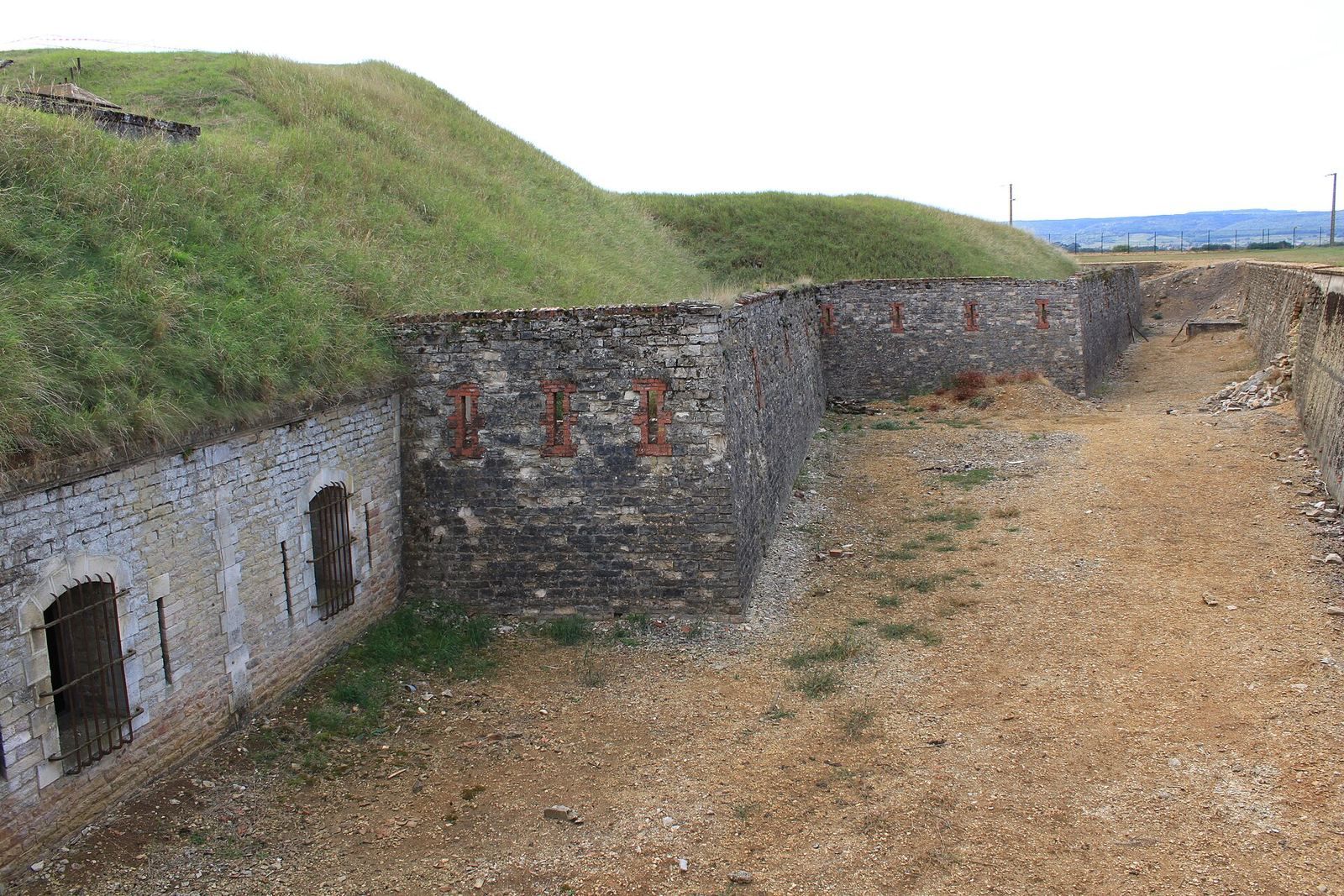
A deep ditch, about six metres deep, surrounds the fort. At the rear, an inward-set angle is protected by a small projecting outwork. Two projecting defensive angles cover a double defensive wall along the inner face of the ditch. This wall is partly detached from the main fort and pierced with infantry loopholes, allowing defenders to fire into the ditch and hinder an enemy crossing.
Caponier defenses and rampart
A caponier, a protected position for firing along a ditch, defends the eastern ditch at the second projecting angle. A larger, double caponier at the third angle covers the southern and western ditches. A roadway along the rampart serves nine shelter traverses, which are covered protective barriers, and two corridors leading to the caponiers.
Poncelet drawbridge
The ditch is crossed by a Poncelet-type drawbridge, whose chains remain in place. Devised by French general and mathematician Jean-Victor Poncelet in 1820, the mechanism uses counterweights linked in an articulated chain. Their balancing effect changes as the bridge deck moves. One end of the weights is fixed to the wall, while the other connects to the chain attached to the deck. This arrangement replaced older lifting-arm bridges, whose exposed mechanisms could be targeted by enemy fire. The Beauregard bridge is the only Poncelet-type example in the Dijon region. In France, seven other bridges of this type are believed to retain their mechanisms, from roughly 90 originally installed.
Magazines and later installations
Powder magazines and gun positions
The fort has two powder magazines with a combined black-powder storage capacity of 30 to 40 tonnes. Four positions for 75 mm anti-aircraft guns were added in the 1930s and equipped with the guns on Model 1915 anti-aircraft mounts.
Observation tower
A metal Model 1947 observation tower was installed at the fort’s summit in the 1950s. From the tower, the fort and surrounding countryside can be seen.