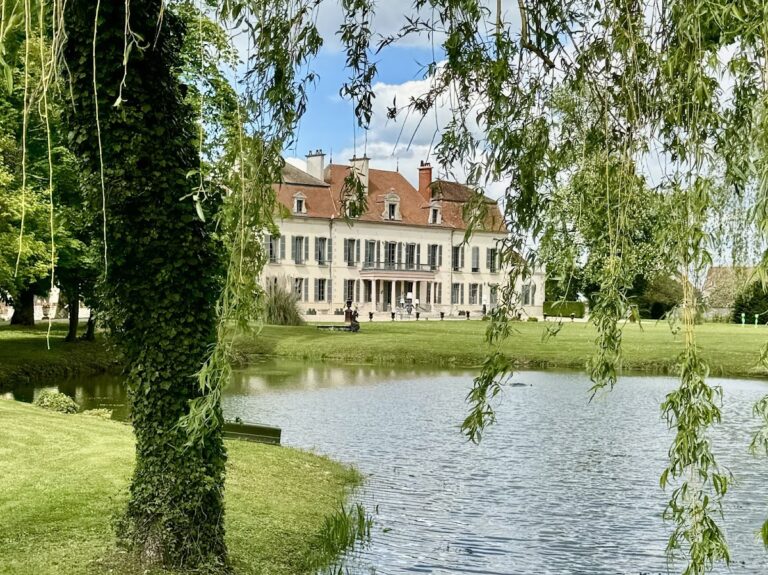
Clos de Vougeot: A Cistercian Wine Estate and Château in France


Site at a Glance
- Rating
- 4.5
- Popularity
- Medium
- Country
- France
- Primary era
- Medieval
- External website
- Open
- Eras represented
- Medieval, Early Modern
- Civilizations
- Duchy of Burgundy, French
- Site type
- Economic
- Remains
- Production Complex
On this page13 sections
History
Clos de Vougeot is a historic wine estate in France, founded by Cistercian monks between 1109 and 1115 in what is now Vougeot, Burgundy. Its architecture combines Cistercian and Renaissance elements, while its long development reflects the importance of organized wine production within a monastic estate.
Cistercian foundation and development
The monks of Cîteaux Abbey, about 12 kilometers southeast of Vougeot, formed the vineyard through aristocratic donations and purchases. They planted and expanded the estate for nearly seven centuries, gradually surrounding it with enclosing walls. The cultivation of the vineyard led to the construction of buildings for processing and storing wine, creating a substantial monastic complex.
Monastic wine production and Renaissance residence
During the fifteenth century, the monks built the wine-making building and later added a large cellar and an upper dormitory. The dormitory housed lay brothers from Cîteaux Abbey who worked in the vineyards. In 1551, Dom Jean XI Loisier, the forty-eighth abbot of Cîteaux, added a Renaissance manor as a residence. This addition established the château in essentially its present form.
Revolutionary confiscation and private ownership
On 13 February 1790, during the French Revolution, Cîteaux Abbey and its associated properties, including Clos de Vougeot, were confiscated and declared national property. The confiscated holdings amounted to about 13,000 hectares.
The Ouvrard family acquired the château and estate in 1818. Gabriel-Julien Ouvrard, a prominent banker under Napoleon, initially managed the property, followed by his son Jules Ouvrard, a politician, until Jules died in 1861. The estate was then neglected and abandoned while a lasting owner capable of maintaining it could not be found.
Restoration and twentieth-century stewardship
In 1889, the Burgundian owner and wine merchant Léonce Bocquet bought the château and its adjoining 15 hectares of vines. He prevented the building’s destruction, carried out extensive restoration, and rehabilitated the first-floor rooms while preserving their Renaissance character. After his death in 1913, he was buried within the château grounds.
Étienne Camuzet, a winegrower from Vosne-Romanée and deputy for Côte-d’Or, acquired the château in 1920. The 15 hectares of vines were sold to 15 regional winegrowers, including Camuzet. Unable to maintain the building, he sold it on 29 November 1944 to the civil society Les Amis du Château du Clos de Vougeot.
Les Amis du Château du Clos de Vougeot granted the leadership of the Confrérie des Chevaliers du Tastevin, a Burgundian wine confraternity founded in 1934, a 99-year lease. After the château again fell into serious disrepair, the confrérie restored it during the second half of the twentieth century. The building has been protected as a historic monument since 1948, under an order confirmed in 1949.
Since the Climats of Burgundy were inscribed on the UNESCO World Heritage List in 2015, Clos de Vougeot has served as their headquarters. Les Amis du Château du Clos de Vougeot owns the château, while the Confrérie des Chevaliers du Tastevin holds the long-term lease and manages it. The estate functions as a museum and as an event and communications venue. The surrounding vineyards cover about 50 hectares and are divided among more than 80 owners.
Remains
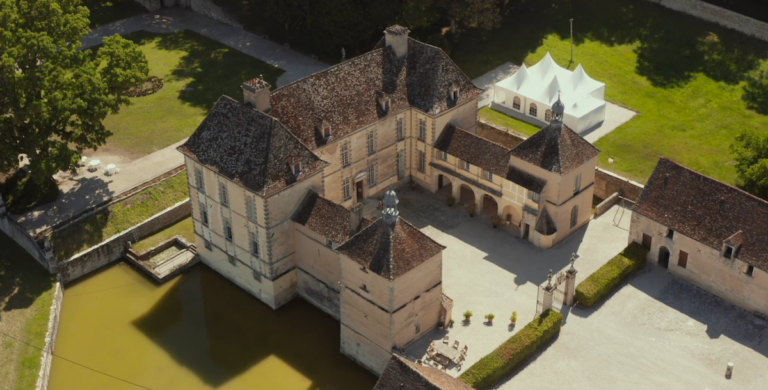
Clos de Vougeot stands at the heart of its walled vineyard in Vougeot, on Burgundy’s Route des Grands Crus between Dijon and Beaune. The complex brings together a fifteenth-century monastic wine-production group and a Renaissance residential wing. An alley and a low wall enclose the vineyard, while the surviving buildings retain the relationship between agricultural work, wine storage, and residence.
Monastic wine-production buildings
Fifteenth-century cuverie
The fifteenth-century cuverie, a building for wine production and the handling of grape must, is arranged in the form of a cloister. It contains four monumental oak presses operated by capstans, each capable of pressing four tonnes of grapes, together with numerous wine vats. The building remains part of the complex’s preserved wine-making group.
Large cellar
A large cellar adjoins the cuverie and is partly underground. Eight stone pillars support its wooden roof structure, while lancet windows regulate the light and temperature. The cellar could hold 2,000 pièces, traditional Burgundian barrels containing about 228 liters each. It is also used as a banquet space.
Former lay-brothers’ dormitory
The large former dormitory rises above the cellar. Its original monumental timber roof structure was accompanied by a roof made from Burgundy stone slabs. The space housed lay brothers from Cîteaux Abbey who worked in the vineyards. It now serves as the museum and projection area.
Renaissance residential wing
Manor and first-floor rooms
The residential wing added in 1551 is identified by its mullioned windows and was inspired by the royal Louvre palace of King Henry II. Its first-floor rooms contain notable fireplaces restored by Léonce Bocquet, while retaining the wing’s Renaissance character.
Kitchen and later uses
The Renaissance wing includes its former kitchen, alongside spaces now used as a banquet hall, museum, and projection room. A plaque at the château entrance and the confrérie’s coat of arms at the entrance to the large cellar are associated with the building. A memorial stele commemorates Léonce Bocquet, who was buried within the grounds.
Nearby sites