Ardstinchar Castle: A Late-Medieval Kennedy Stronghold in Scotland

Site at a Glance
- Rating
- 3.8
- Popularity
- Very Low
- Country
- United Kingdom
- Primary era
- Medieval
- External website
- Open
- Eras represented
- Medieval
- Civilizations
- Kingdom of Scotland
- Site type
- Military
- Remains
- Castle
On this page7 sections
History
Ardstinchar Castle is a late-medieval castle in the United Kingdom, standing at Ballantrae on the west coast of Ayrshire near the mouth of the River Stinchar. Hugh Kennedy of Ardstinchar built it in the mid-fifteenth century, creating a fortified residence that became the seat of his family for more than a century.
Hugh Kennedy and the Barony
Hugh Kennedy was a Scottish landholder and soldier who had first entered religious life as a Dominican friar. He later left his monastery, travelled to France, and served as a mercenary in the Hundred Years’ War, the prolonged series of conflicts between England and France fought chiefly from 1337 to 1453. During the Siege of Orléans in 1428–1429, he led troops for Joan of Arc, the French military and religious figure who commanded French forces during the later stages of the war.
Hugh probably inherited the estate from his brother Alexander Kennedy, who held the land by 1429 and died without issue. Hugh and another brother, Thomas Kennedy, combined their estates to create the Barony of Ardstinchar. Hugh retained a liferent, the legal right to use property or receive its income during his lifetime, in his own land until his death in 1454.
Royal Visits and Kennedy Conflict
Ardstinchar remained in the hands of Hugh Kennedy’s descendants for more than a hundred years. James V, king of Scotland from 1513 to 1542, visited the castle on 25 November 1529. Mary, Queen of Scots, who ruled from 1542 to 1567, stayed there on 8 August 1563.
The castle also stood within a long-running feud between the Cassillis family and Clan Kennedy, a conflict that had begun during Hugh Kennedy’s era. In 1601, the feud ended with the murder of the last Baron of Bargany and Ardstinchar. His widow, Jean Stewart, had formerly been a lady-in-waiting to Anne of Denmark. She remained at Ardstinchar and resisted an attempt to remove her in 1603, but died in 1605.
Decline and Later Protection
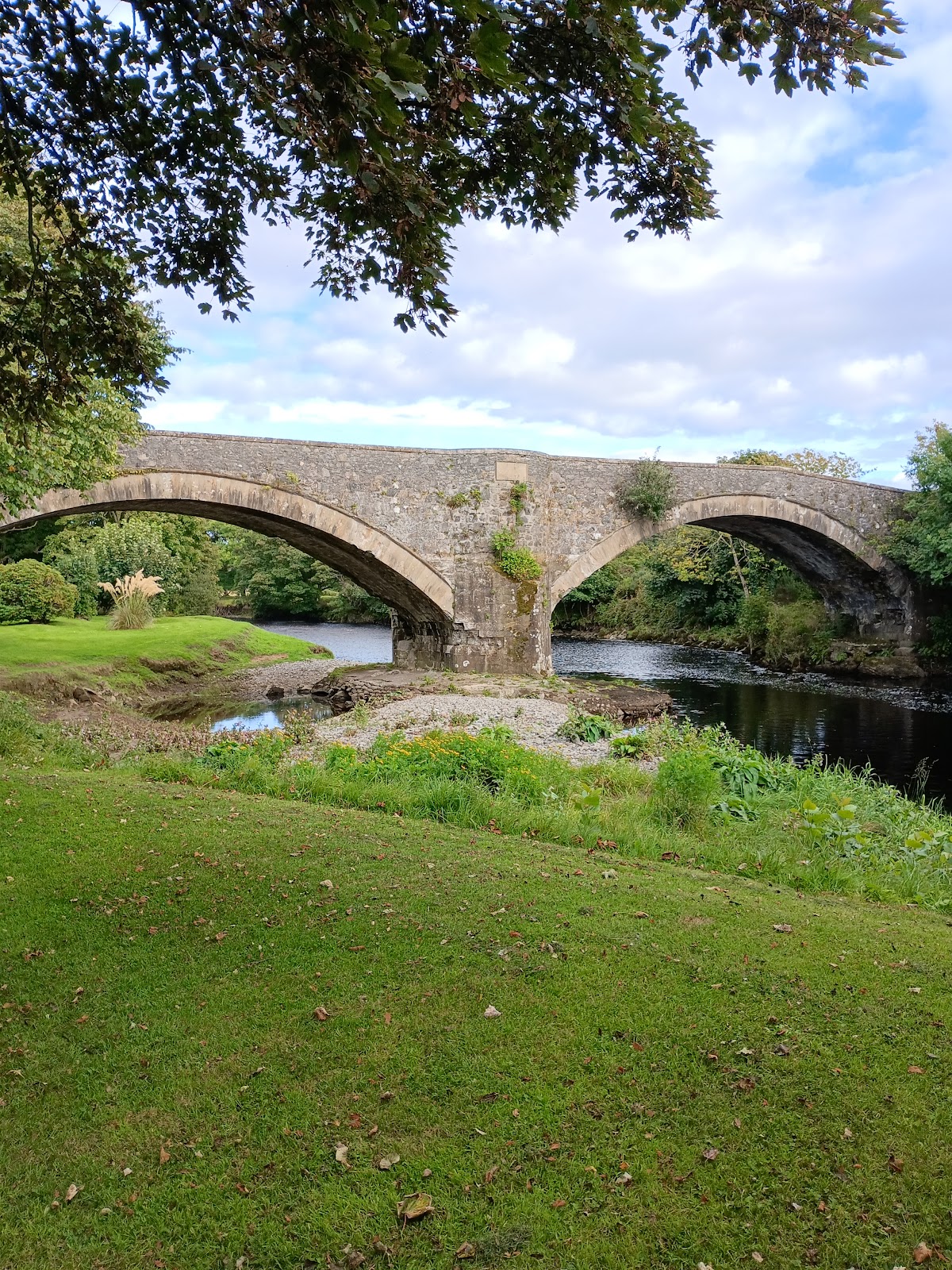
After the family lost its fortunes, Sir John Hamilton of Letterick, the son of the 1st Marquis of Hamilton, purchased the estate. By 1770, the castle had fallen into disrepair. Its stone was then quarried for a three-arch bridge over the River Stinchar and for several buildings in Ballantrae, including an inn that is now the King’s Arms Hotel.
Ardstinchar Castle has been a scheduled monument, a legally protected archaeological or historic site, under record SM311 since 1954.
Remains
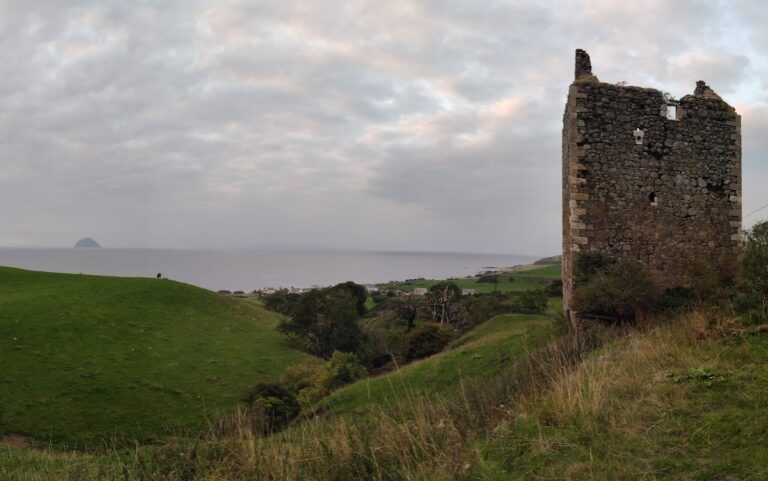
The castle originally occupied a wedge-shaped enclosure on a rocky hill or outcrop near the River Stinchar. Three square towers were connected by battlemented walls. A gatehouse stood on the north side, while the keep formed the southeastern part of the courtyard and was joined to a long hall house.
The Keep
The keep is the principal surviving structure. This fortified tower measures approximately 8.7 by 6 metres, with walls about 1.1 metres thick, and rises 15 metres above the surrounding ground. Its position on the summit of the rocky outcrop made it the dominant surviving element of the castle. A walkway on a half-turret also remains. The walkway is associated with Mary, Queen of Scots’ stay and with the likelihood that she used it to admire the view.
Courtyard Defenses
The courtyard wall survives in sections and varies from 1 to 1.6 metres in thickness. The remains of the other towers are too small for their dimensions to be measured. Outside the northeastern courtyard wall, a trench cut into the rock measures about 8 metres across and 1.5 metres deep. A second, shallower trench lies on the western side, adding to the surviving evidence of the castle’s defensive arrangement.
Nearby sites